
 AU
AU
 UK
UK
 CA
CA
 NZ
NZ
 IND
IND

 US
US

 Share
Share
 X (Formerly Twitter)
 Whatsapp
 Facebook
 LinkedIn
 Telegram
 Email This Article
 Copy Link
 Summarize with AI
 Chat GPT
 Perplexity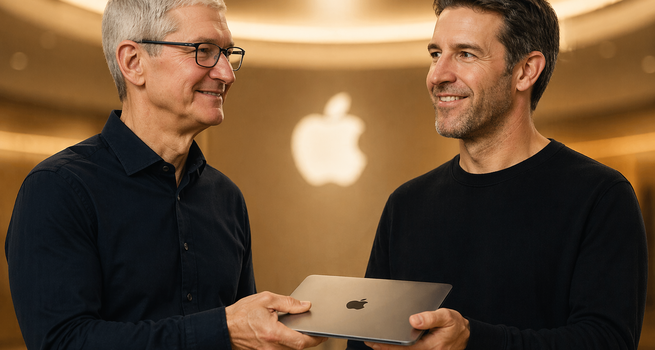
John Ternus, architect of the M-chip revolution, will become chief executive on September 1 as Cook ascends to executive chair — marking the most consequential leadership transition at the world's most valuable company since Steve Jobs departed in 2011
Tim Cook once said that Apple was not the company he joined — it was better. On Monday, filing a brief eight-paragraph disclosure with the Securities and Exchange Commission, the 65-year-old confirmed what Silicon Valley had long speculated: he is ready to let someone else prove the same.
Apple's board on April 17 appointed John Ternus, 50, the company's head of hardware engineering, as its next chief executive officer, effective September 1. Mr Cook, who has run Apple since Steve Jobs fell gravely ill in August 2011, will become executive chair. Art Levinson, who has served as chair, moves to lead independent director.
The succession is orderly, deliberate and very Apple — announced not with fanfare but with a two-page regulatory filing, signed by general counsel Jennifer Newstead, on a Sunday evening. It is the culmination of a transition that insiders say the board has planned for several years.
AT A GLANCE · THE SUCCESSION
Outgoing CEO: Tim Cook — Executive Chair from September 1
Incoming CEO: John Ternus, 50 — effective September 1, 2026
Board change: Art Levinson becomes Lead Independent Director
Apple market cap at announcement: ~$3.2 trillion
Cook's tenure as CEO: ~15 years
Ternus at Apple since: 2001
What Tim Cook built
When Cook took the helm, Apple's annual revenues were $108bn. Today they exceed $400bn. The company's market capitalisation has grown from roughly $350bn to become, for extended periods, the first to cross $3 trillion — a figure larger than the GDP of France.
That ascent was built not merely on the iPhone, which Jobs had launched in 2007, but on a set of strategic choices that were entirely Cook's own. He forged an unrivalled global supply chain, concentrated manufacturing relationships in ways that gave Apple pricing discipline no rival could match, and transformed services — the App Store, Apple Music, iCloud, Apple TV+ — into a business generating more than $100bn in annual revenue.
“He took a company built around one man's vision and turned it into an institution. That is arguably harder.”
— Senior Silicon Valley investor, speaking on condition of anonymity
Cook also presided over Apple's most consequential hardware reinvention since the iPhone itself: the transition from Intel processors to Apple Silicon. That project — shepherded to fruition by John Ternus — gave the Mac a performance and efficiency lead it had not enjoyed in decades and laid the architectural groundwork for Apple's ambitions in artificial intelligence and spatial computing.
The Apple Watch, AirPods and the Vision Pro headset all arrived on Cook's watch, expanding the company beyond the smartphone into what analysts call a 'wearables and peripherals' category that alone would rank among the Fortune 100. Cook also navigated bruising regulatory scrutiny across the US, EU and China, a confrontation with the FBI over device encryption that defined the privacy debate of its era, and the supply-chain convulsions of the Covid-19 pandemic — emerging, each time, with Apple's margins largely intact.
TIM COOK ERA: KEY MILESTONES
2011 Cook becomes CEO as Steve Jobs resigns due to illness; Apple's market cap stands at ~$350bn
2014 Apple Pay launches; Cook publicly comes out as gay in a landmark Bloomberg Businessweek essay
2015 Apple Watch ships; Apple Music debuts, marking the pivot to recurring subscription revenues
2018 Apple becomes the first US company to reach a $1 trillion market capitalisation
2020 Apple announces transition to Apple Silicon — M1 ships; pandemic-era demand surge lifts revenues
2023 Vision Pro unveiled; Apple becomes the first company to sustain a $3 trillion valuation
2026 Cook announces transition to executive chair; John Ternus named CEO-designate
The man who will inherit the machine
Ternus is, in many respects, the anti-Jobs and the anti-Cook simultaneously. He is not the charismatic showman who conjures desire from thin air, nor the operations maestro who can recite container-ship schedules from memory. He is, above all, an engineer's engineer — the man Apple's hardware teams credit with forging the culture that produced the M-series chips, the titanium-framed iPhone Pro line and the intricate industrial design of the Vision Pro.
He joined Apple in 2001, the year the iPod launched, and spent two decades rising through hardware engineering before Cook elevated him to senior vice-president in 2021. Those who have worked alongside him describe a leader who combines deep technical literacy with a talent for cross-functional consensus — qualities that, in Apple's matrix organisation, matter enormously.
'John understands what makes Apple products feel inevitable,' said one longtime Apple engineer who has worked directly with him. 'He doesn't just know how they're built. He knows why they have to be built that way.'
What the market expects — and fears
Apple shares dipped fractionally in after-hours trading on the announcement before recovering, a muted reaction that analysts read as a sign the market had been quietly anticipating the move. The greater anxiety, several investors said, is not the identity of the new chief executive but the strategic questions that await him.
Artificial intelligence represents perhaps the most consequential test. Apple has been cautious — some critics say too cautious — in its public AI posture, integrating large language models into Siri and on-device features with emphasis on privacy rather than raw capability. Whether Ternus will press the accelerator on AI investment, strike partnerships with frontier model providers, or double down on Apple's in-house approach will be among his earliest and most scrutinised decisions.
Equally pressing is China. Apple still derives roughly a fifth of its revenues from the mainland, and the company's dependence on Foxconn and other Chinese manufacturers remains a geopolitical vulnerability that no supply-chain diversification programme has yet fully resolved. Cook managed that relationship with unparalleled diplomatic dexterity; Ternus will be expected to continue the delicate navigation.
Then there is services. The EU's Digital Markets Act has already forced Apple to allow third-party app marketplaces on its European devices, eroding the exclusivity — and the economics — of the App Store. Further regulatory pressure in the US and UK looms. Managing the transition from a hardware company to a hardware-and-services hybrid, without cannibalising the premium brand that underpins both, will define the early years of the Ternus era.
“The question is not whether Apple can survive the transition. It is whether Ternus can grow beyond the hardware genius he is already known to be.”
— Technology analyst, Bernstein Research
The shadow and the gift of the chair
Cook's decision to remain as executive chair introduces a dynamic that Apple will need to manage carefully. Jobs's return as an advisor after his first departure in 1985 became the stuff of corporate legend — and trauma. Cook's continued presence at the board table, with his relationships with Beijing, the Cupertino leadership team and the world's largest institutional shareholders, is an asset Ternus would be foolish to ignore.
But it is also a constraint. New chief executives need room to make their own mistakes, pursue their own instincts and, eventually, put their own fingerprints on a company's strategy. Whether Cook can resist the gravitational pull of an organisation he has led for 15 years — and whether Ternus can assert himself against a figure of such stature — will be the quiet drama of Apple's next chapter.
For now, the baton passes in the most ordered fashion Apple's board could contrive. September 1 is five months away. There is time, the company seems to be saying, to do this properly. That, too, is very Tim Cook.


 Jun 03, 2026


 Please wait processing your request...