
 CA
 NZ
 UK
 AU
 IND

 US

 Share
 X (Formerly Twitter)
 Whatsapp
 Facebook
 LinkedIn
 Telegram
 Email This Article
 Copy Link
 Summarize with AI
 Chat GPT
 Perplexity
Key Highlights
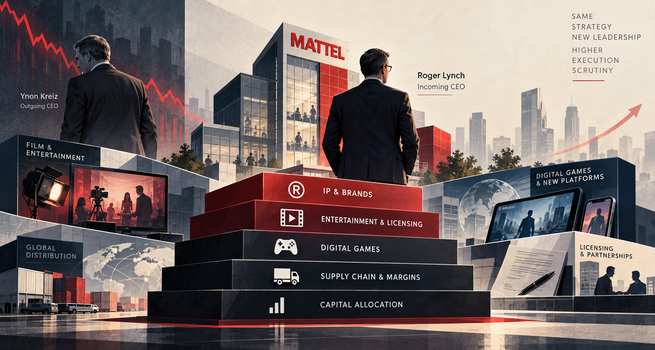
- Mattel named board member Roger Lynch as Chairman and CEO, succeeding Ynon Kreiz.
- The stock market response was negative, with shares touching a 52-week low of $12.44 during the session.
- Shares were at $12.59, down 4.80 percent from the previous close of $13.22.
- The Leadership change arrives as investors weigh Earnings quality, valuation and the push into digital games and entertainment.
- Institutional investors will likely focus on Capital allocation, free Cash Flow and execution risk under new leadership.
Mattel (NASDAQ: MAT) announced on Wednesday that its board has appointed Roger Lynch as Chairman, effective October 2, and as Chief Executive Officer, effective on or before November 2. Lynch has served on the board since 2018 and has been its Independent Lead Director. He succeeds Ynon Kreiz, who leaves both roles on October 2 after more than eight years to take a senior leadership position at another public company. Diana Ferguson, a director since 2020 and chair of the Audit Committee, becomes the new Independent Lead Director.
The board said the appointment followed a comprehensive succession planning process led by director Judy Olian. Even so, the announcement came with a short lead time, and the company Kreiz is joining was not named. For institutional investors, a leadership change of this kind raises a familiar question: does continuity of strategy outweigh the uncertainty that any change at the top introduces?
Stock Market Reaction
Investors answered quickly. Mattel shares trading at $12.59, down $0.64, or 4.80 percent, on Volume of about 4.65 million shares. Earlier in the morning the decline was deeper, with shares touching $12.44, a fresh 52-week low, before recovering part of the loss.
The 52-week range of $12.44 to $22.48 shows how far sentiment has moved over the past year. Market Capitalisation was about $3.67 billion. On the data available, the stock traded at roughly 9.3 times both trailing and forward earnings, with trailing Earnings Per Share of $1.09. That is a modest earnings multiple for a company with a global Brand portfolio, and it suggests investors are already discounting a degree of operational and Demand risk.
The reaction reflects the timing as much as the news. Market commentary noted that the announcement followed a mixed second-quarter report, in which Revenue exceeded expectations but earnings per share fell short, and that a recent analyst downgrade had already sharpened investor scrutiny. Broader pressure on consumer discretionary stocks, linked to higher bond yields and cautious household spending, added to the pressure on the shares.
The Profile of the Incoming Chief Executive
Lynch has run Condé Nast as Chief Executive Officer since 2019. According to the release, he unified global operations there and broadened the monetisation of its intellectual property, delivering consistent profit growth since 2020. His earlier roles include chief executive of Pandora, founding chief executive of Sling TV, and leadership positions at Video Networks International and Chello Broadband. He holds an MBA from the Tuck School of Business at Dartmouth College and a physics degree from the University of Southern California.
The board's choice signals where it sees the company's value. Lynch's record sits at the intersection of media, technology and consumer businesses, which aligns with Mattel's stated shift from toy Manufacturing toward an IP-driven play and family entertainment company. His years on the board also mean he has been involved in the strategy he will now execute, which lowers the risk of an abrupt change of direction.
At Condé Nast, Mike Perlis will serve as interim chief executive while its board searches for a successor, according to a letter from Lynch. That is a matter for another company, but it confirms that the transition at Mattel is part of a wider set of leadership changes.
What Kreiz Leaves Behind
The outgoing chief executive leaves a company that is materially different from the one he took over in 2018. Mattel reports that it ranks first globally in dolls, vehicles, and infant, toddler and preschool categories. Hot Wheels is on track for a ninth consecutive year of growth, and the company has built momentum in action figures and launched Mattel Brick Shop.
The licensing portfolio has widened to include Disney Princess and Frozen, Teenage Mutant Ninja Turtles, Toy Story, KPop Demon Hunters and DC. Mattel Studios' first theatrical release, Barbie, was the top global box office film of 2023 and the highest-grossing film in the history of Warner Bros. Pictures. The company has also moved into film, television, consumer products, digital games, live events and publishing.
On the balance sheet, Mattel says it has significantly increased free cash flow, returned to an investment-grade Credit rating and resumed share repurchases. It has also restructured and diversified its Supply chain. These are the metrics that institutional investors typically use to judge capital allocation, and they form the baseline against which the new chief executive will be measured.
Digital Games and the Competitive Landscape
One of the more consequential strategic threads is digital gaming. Mattel took full ownership of Mattel163, its mobile games studio, earlier this year, which the company says advances game development, publishing and digital customer acquisition. The move is widely seen as an effort to keep pace with rival Hasbro, as toy industry pressures build.
Digital games offer the prospect of higher-margin, Recurring Revenue that is less tied to seasonal retail cycles. They also bring new risks, including development costs, hit-driven outcomes and the need for different organisational skills. A chief executive with experience scaling consumer technology businesses may be well placed to manage that transition, though the outcome will depend on execution and is far from certain.
Risks That Remain in Focus
Several factors will shape how the market judges the change in leadership.
- Execution risk during transition. Kreiz departs on October 2, while Lynch's CEO appointment takes effect on or before November 2. Investors will watch how the handover is managed and how quickly strategic priorities are clarified.
- Earnings quality. A quarter in which revenue beat expectations but earnings did not raises questions about margins, costs and the effect of pricing actions.
- Tariffs and supply chain. Mattel's own disclosures point to Tariff developments, trade restrictions and cost Inflation as factors that could raise product costs and reduce earnings and liquidity.
- Consumer demand. Higher costs for fuel and food, high consumer Debt and weaker consumer spending can reduce demand for discretionary products such as toys.
- Internal controls. The company has referred to additional controls implemented to remediate a prior material weakness in internal control over financial reporting, which remains a governance point for investors to monitor.
- Licence dependence. The ability to secure, maintain and renew popular entertainment licences is central to the strategy, and any loss or weakening of key partnerships would affect the growth outlook.
Valuation in Context
A price-to-earnings multiple near nine suggests the market is not paying a premium for Mattel's growth prospects. Whether that reflects an undervalued Franchise portfolio or a fair discount for cyclical and execution risk is a question the data alone cannot settle. Lower multiples can persist when earnings are seen as volatile, and they can narrow if profit delivery proves more consistent. Both outcomes are plausible.
The new chief executive's first communications to investors will therefore matter. Clarity on capital allocation priorities, including the balance between share repurchases, Investment in entertainment and digital assets, and Balance Sheet strength, will help institutional investors calibrate their assessment. Guidance on the pace of Margin recovery and the contribution of digital games would also inform how the market values the company over the next several quarters.
Outlook
The appointment of an insider with media and technology credentials suggests continuity of the IP-led strategy rather than a reset. The board's public statements describe Mattel as well positioned for its next phase of profitable growth. The share price reaction shows that investors are not yet fully convinced, and that near-term sentiment is being shaped by a mixed earnings report, cautious consumer conditions and the timing of the announcement.
Over the medium term, the stock market's verdict is likely to depend on measurable outcomes: free cash flow, margin trends, the performance of Hot Wheels and other core franchises, and progress in digital games and studio output. Leadership changes can be a source of renewed focus or of disruption, and the evidence will emerge only through reported results.

 Oct 20, 2026





 Please wait processing your request...