
 CA
 NZ
 UK
 AU
 IND

 US

 Share
 X (Formerly Twitter)
 Whatsapp
 Facebook
 LinkedIn
 Telegram
 Email This Article
 Copy Link
 Summarize with AI
 Chat GPT
 Perplexity
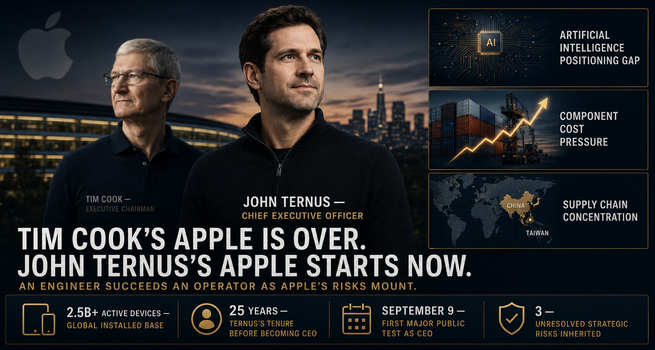
Key Highlights
- John Ternus became Apple's chief executive officer on September 1, succeeding Tim Cook, who moves into the role of executive chairman, with Johny Srouji stepping in as hardware engineering chief.
- The transition arrives with Apple at a financial high point, which raises the bar for continuity rather than easing the pressure on its new leadership.
- Ternus represents a genuine change in operating philosophy, an engineer succeeding an operator, after 25 years spent building the products rather than the systems around them.
- Cook remains active as executive chairman with a focus on government and policy relationships, creating a dual Leadership structure rather than a clean exit.
- Ternus inherits three unresolved strategic questions at once: an artificial intelligence positioning gap, a global component cost crisis, and continued Supply chain concentration in China.
Apple (NASDAQ:AAPL) has changed chief executives only twice in its modern history, and both times the country's most valuable company treated the moment as a succession rather than a rupture. This is the third. On September 1, John Ternus, formerly Apple's senior vice president of Hardware Engineering, became chief executive officer, succeeding Tim Cook after fifteen years at the helm. Cook has not left the company. He becomes executive chairman, and Johny Srouji now leads hardware engineering in Ternus's place. Apple is also arriving at this moment from a position of financial strength rather than weakness, which changes the nature of the pressure on Ternus considerably. A leader inheriting a struggling company is expected to fix things. A leader inheriting a company at its peak is expected simply not to be the reason it stops being at its peak, which is, in its own way, the harder assignment.
A Story That Starts With a Screw
Twenty-five years ago, in his first year at Apple, Ternus was inspecting screws destined for the Apple Cinema HD Display at a supplier Facility late at night. Apple's specification called for 25 grooves cut into the screw heads. The supplier had delivered 35. Ternus argued the point and won, and the supplier corrected the design. It is a small story, almost trivial on its face, but it captures something that has defined his career since: an insistence that the parts nobody sees are exactly the parts worth getting right.
That instinct carried him from Apple's product design team in 2001 through two decades of hardware leadership, culminating in his appointment as senior vice president of Hardware Engineering in 2021, succeeding Dan Riccio. Along the way, Ternus took on responsibility for AirPods, iPad, Mac, iPhone hardware and eventually Apple Watch, becoming the executive whose fingerprints sit on nearly every physical product Apple has shipped in the past decade. His most consequential achievement is widely regarded as leading the multi-year transition of the Mac lineup from Intel processors to Apple's own silicon chips, a platform shift completed ahead of schedule that reset performance and battery-life expectations across the entire personal computing industry. It is the clearest evidence available that Ternus can turn ambitious engineering bets into products that actually ship, on time and at scale.
An Operator Hands Off to an Engineer
Cook's tenure was built on a different foundation entirely. He rose to Apple's top Job by mastering supply chain logistics and operational discipline, turning Apple's already dominant hardware Franchise into a Recurring Revenue machine anchored by services. Where Steve Jobs was the product visionary and Cook the operational architect, Ternus now represents a third archetype: the engineer who spent his career inside the hardware itself, rather than around the systems that manufacture and monetise it.
This is not a cosmetic distinction. It signals something about how Apple's board expects the company to compete over the next decade. An operator's instinct is to defend margin, refine existing systems and extract more value from an installed base that already exceeds 2.5 billion active devices. An engineer's instinct is to fund new categories and tolerate short-term inefficiency in pursuit of genuine product differentiation. Which instinct comes to define Apple under Ternus is not yet settled, and it is the single most important open question for anyone trying to understand where the company goes from here.
Cook, for his part, has publicly framed the choice as intentional rather than reluctant, describing Ternus as having the mind of an engineer and the judgment to lead Apple into its next chapter. The board's approval of the transition in April, following a multi-year succession process, suggests this was not a decision made under pressure but one shaped deliberately, with Ternus reportedly shadowing Cook through key operational moments in the months since, including sessions around this year's developer conference.
Cook Has Not Actually Left
What makes this transition unusual is that it is not a clean handover. Cook becomes executive chairman, and in that role he is expected to continue engaging directly with policymakers and governments, particularly on matters involving China, where a significant share of Apple's Manufacturing base remains concentrated. This preserves, at least for now, the diplomatic relationships Cook spent fifteen years building, while formally shifting day-to-day operational and product authority to Ternus.
The result is a dual leadership structure during the transition period, and it raises a fair question for anyone watching from the outside: how much does Apple's strategic direction actually change while its previous chief executive remains active in the boardroom, in Washington and in Beijing. Arthur Levinson's move from non-executive chairman to lead independent director, effective the same day, suggests Apple's board is treating governance continuity as seriously as executive continuity, reinforcing the sense that this transition was designed to minimise disruption rather than signal a break from the past.
The In-Tray Ternus Inherits
None of the problems facing Apple were created by this leadership change, but all of them are now Ternus's to solve. Artificial intelligence sits at the top of the list. Apple has faced sustained criticism for lagging competitors on generative AI, including a prolonged effort to rebuild Siri, and Ternus has previously described Apple's approach to the category as a longer race rather than a sprint, a framing that asks patience of a market that has not always been patient with Apple's rivals either.
A global shortage of memory and other components, driven by surging Demand for artificial intelligence infrastructure elsewhere in the technology industry, has already forced Apple to raise prices on some of its hardware, with further pricing action considered plausible if the shortage persists. And Apple's manufacturing base remains heavily concentrated in China and Taiwan, a dependency that turned into a visible Liability during the Tariff escalation of 2025 and has pushed Apple to accelerate Diversification into India and Vietnam.
Apple's Vision Pro headset, a product Ternus himself helped develop, stands as a reminder that engineering ambition does not automatically translate into commercial success, and it is a data point worth remembering as Apple considers its next wave of new product categories under his leadership.
September 9: The First Stage Appearance
Ternus's first major public moment as chief executive arrives quickly, at Apple's annual hardware event on September 9, in what happens to be the company's fiftieth year. New iPhone and Apple Watch models are expected, alongside what several reports describe as Apple's first foldable iPhone. Until now, Ternus has largely spoken about Apple's direction in Cook's shadow, at one point during an Earnings Call deferring to what Cook had already said rather than answering in his own words. September 9 is the first occasion on which he takes that stage as the person actually responsible for the answer, not the executive summarising it.
An Engineer's Apple, Starting Now
Apple's leadership transition is a genuine pivot in philosophy rather than a ceremonial handover. It replaces an operator who built scale and financial discipline with an engineer who built products, arriving at a moment when Apple's unresolved problems, from artificial intelligence to supply chain concentration, sit closer to the engineering side of the Business than the operational side. Cook's continued presence as executive chairman ensures the transition will be gradual rather than immediate, which buys Ternus time but also raises the stakes on how convincingly he uses it. The clearest early test of whether that time is being used well is not a Quarterly Report but a stage appearance, and it arrives in just over a week.


 Oct 20, 2026





 Please wait processing your request...