
 CA
 NZ
 UK
 AU
 IND

 US

 Share
 X (Formerly Twitter)
 Whatsapp
 Facebook
 LinkedIn
 Telegram
 Email This Article
 Copy Link
 Summarize with AI
 Chat GPT
 Perplexity
Key highlights
- Top savings yields above 4% still barely beat inflation; most consumer borrowing costs considerably more.
- A hold does not cut card rates; September's hike is still feeding through to cardholders.
- Mortgage rates follow Treasury yields, so waiting for Fed relief may mean waiting much longer.
- Fixed-rate car and student loans shield existing borrowers; new borrowers still face today's higher rates.
The Fed has paused, but a December rise is a live possibility. How should households think about debt, savings and big purchases?
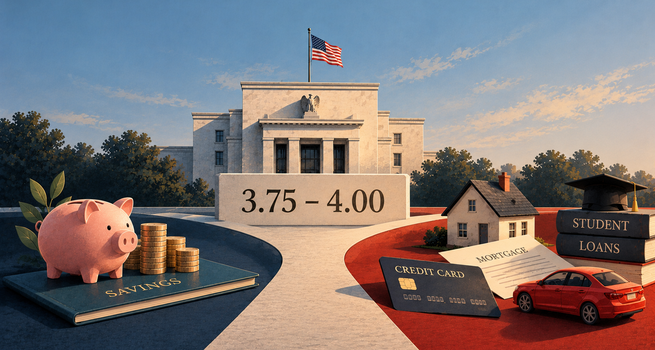
Personal finance has a habit of being treated as a collection of tips. It is better thought of as a ledger with two columns: what your money earns and what your debts cost. A central-bank decision matters to a household only insofar as it shifts one column relative to the other. On Wednesday the Federal Reserve left the benchmark rate at 3.75-4%, two of its voters wanted to raise it, and futures markets put the chance of a rise in December at about 85%. The arithmetic of the household ledger has not improved. It may be about to deteriorate.
The comparison that matters most
Start with the largest line in the ledger. Inflation, by the Fed's preferred measure and excluding food and energy, is expected to have topped 3% in September. The best online savings accounts now pay more than 4%. That leaves savers with a small real return, perhaps a point, before tax. The average megabank Savings Account pays far less, which means a saver who stays put is, in all likelihood, losing ground to prices.
Set that beside the cost of borrowing. Credit cards, the most common form of consumer debt, charge rates many times what even the best savings account pays. This asymmetry is the oldest rule in household finance, and it is sharper than usual now. Money used to clear an expensive balance earns a guaranteed return equal to the interest avoided; money parked in savings earns a few points at best. For a household with both, the order of operations is rarely in doubt.
Cards: the fast lane
Cards are the clearest case of the Fed's influence. Most carry variable rates tied to the prime rate, which usually sits about three percentage points above the Fed's benchmark, and changes tend to reach statements within one or two billing cycles. That is why a pause at the Fed has not translated into cheaper cards. Average card rates have climbed for three straight months and are at their highest since December 2025, in part because lenders worry about delinquencies, and the September increase has not yet fully worked its way through. If the committee raises rates again in December, that will lift card costs once more.
For anyone carrying a balance, the practical question is not whether rates will fall, but how much of the balance can be retired before they rise. Lenders will sometimes negotiate on terms for borrowers who ask, and a better credit record, which comes from paying Debt down and paying on time, tends to unlock better offers when conditions ease.
Mortgages: not the Fed's to give
Home loans confuse many people because they assume the Fed controls them. It does not. Fixed-rate mortgages are priced off long-term Treasury yields, which reflect investors' expectations for Inflation and growth over years rather than one decision. The ten-year Yield stood at around 5.03% after the announcement, and, by one widely followed measure, thirty-year mortgages have been above 7% for more than a month.
The implication for a would-be buyer is that waiting for a Fed cut is not a strategy. Mortgage rates are likelier to ease when oil prices cool, consumer spending softens and a run of inflation reports shows progress towards 2%. None of these is in the Fed's gift. Policy moves in Washington may help at the margin, and the president has signed an order meant to lower some mortgage costs, but the underlying driver is the bond market.
Cars: a seasonal discount, with conditions
Car loans are fixed for their life, and market rates reflect the Fed's benchmark among other things. The headline rate on a new-car Loan has hovered around 7% all year. As the year ends, manufacturers' finance arms traditionally cut their rates to clear stock, which can make loans look cheaper for a spell, an effect that owes more to the calendar than to any easing of credit.
There is a catch. The cheapest offers usually go to buyers with the strongest credit. Anyone with a weaker record, and especially buyers in the used-car market, where loan rates still exceed 10%, will see little of the seasonal relief. Comparing offers from several lenders, rather than accepting the dealer's, matters more than the timing.
Student loans: fixed, but for whom?
Federal student loans, too, are fixed for the life of the loan, so existing borrowers are insulated from the Fed's choices. New borrowers pay rates set by last May's ten-year Treasury auction: between 6.52% and 9.07%, depending on the type of loan. A bipartisan bill to cap these rates is in committee, and the president has said he "might" back it. For now it is a prospect, not a plan, and borrowers cannot count on it.
What to do with uncertainty
The common thread is uncertainty about direction. If the Fed raises rates in December, variable costs will rise and the argument for retiring expensive debt will strengthen. If it holds, little changes. The same pattern in both cases suggests a short list of sensible habits, each cheap to follow: reduce high-interest balances first; shop for the best available savings rate instead of settling for a large bank's default; ask lenders to improve terms; and keep an eye on credit health, which determines how much of any future easing a borrower will actually get.
None of this is dramatic, and none of it depends on forecasting the Fed. That is the point. The central bank's decision on Wednesday was a pause, but for a household, the ledger carries on. What matters is which column is larger.


 Oct 16, 2026





 Please wait processing your request...