
 CA
 NZ
 UK
 AU
 IND

 US

 Share
 X (Formerly Twitter)
 Whatsapp
 Facebook
 LinkedIn
 Telegram
 Email This Article
 Copy Link
 Summarize with AI
 Chat GPT
 Perplexity
Key Highlights
- Moonshot AI closed a $3.5 billion funding round at a $35 billion valuation, well above its original $1 billion to $2 billion target
- The Kimi K3 model's open-weight release has drawn White House allegations of restricted Nvidia chip use and AI distillation
- Annual recurring revenue reached $300 million in June, up from $200 million in April, with daily sales rising sharply after launch
- The valuation surge revives DeepSeek-era questions about whether US export curbs are containing Chinese AI development
- A follow-on round at a $50 billion pre-money valuation is reportedly being discussed ahead of a possible Hong Kong listing
The Round That Outran Its Own Target
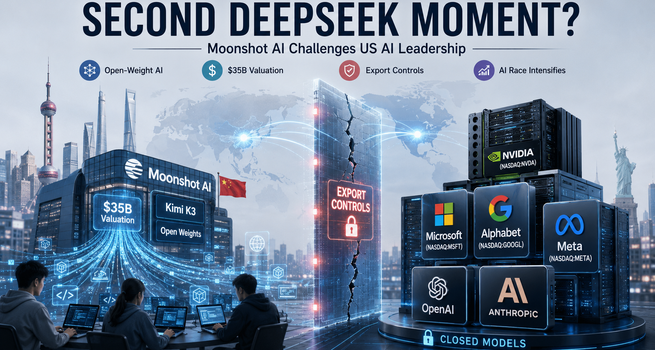
Moonshot AI, the Beijing-based developer behind the Kimi assistant, has closed a financing round valuing the company at $35 billion on proceeds of $3.5 billion, well past its initial target of $1 billion to $2 billion. Talks are already underway for a further round at a $50 billion pre-money valuation, positioned as a final private financing step ahead of a potential Hong Kong initial public offering later this year.
The catalyst was Kimi K3, a 2.8 trillion parameter model that Moonshot released with open weights, the numeric values a model learns during training. That decision let developers download, modify and host the technology without licensing fees, a structural contrast with the proprietary approach favored by leading US labs. The model also carries a 1 million token context window, allowing it to process very large documents or codebases within a single prompt.
K3's release triggered a selloff in technology stocks and was widely described as another "DeepSeek moment," recalling the earlier episode in which a separate Chinese lab matched frontier performance despite constrained hardware access. Moonshot has positioned K3 as approaching the level of OpenAI and Anthropic, both of which, along with Microsoft (NASDAQ:MSFT), Alphabet and Meta Platforms (NASDAQ:META), have built commercial AI strategies around proprietary, closed-weight models. Giving the model away outright is itself a strategic wager: open distribution builds developer adoption faster than any licensing deal could, the dynamic that turned early open-source infrastructure into durable platforms. For investors in US AI and semiconductor names, this cuts both ways, testing whether proprietary data remains a durable moat or open-weight reach becomes the more valuable asset.
Washington's Response Shifts the Stakes
Moonshot's commercial momentum has collided directly with Washington's export control regime. A White House official alleged the company trained K3 using restricted Nvidia chips, drawing the chipmaker into a dispute not of its own making, and renewed earlier distillation claims, in which one model trains on a competitor's outputs, this time implicating Anthropic. Moonshot has not issued a public response.
The two claims carry different weight. Distillation is hard to substantiate and remains contested on technical grounds. Export control violations are governed by defined US Export Administration Regulations, and a confirmed breach carries a more direct legal pathway, including possible Entity List designation, the mechanism historically used against Huawei. For investors, this is the more consequential thread, testing whether existing chip restrictions can be enforced against determined circumvention.
Revenue Growth Behind the Valuation
Moonshot's annual recurring revenue reached 300 million dollars in June, up from 200 million dollars in April, and daily sales rose by at least six times following K3's launch. That is a genuine demand signal, reinforced by Moonshot pricing K3's API access at a premium to domestic Chinese rivals rather than competing purely on cost. Unlike earlier stages of the generative AI funding cycle, when valuations leaned on anticipated future capability, this round is underpinned by realized commercial traction, even if that traction remains recent and unproven over a full cycle.
The open question for allocators is durability. A model released for free generates adoption quickly, and if Moonshot converts that reach into recurring paid usage at premium pricing, the current growth rate looks less like a spike and more like the early stage of a defensible business. Whether it can, particularly if regulatory restrictions limit its access to advanced computing infrastructure, will determine whether the valuation proves structurally sound or reflects a narrow window of investor enthusiasm.
What This Means for US Markets
Three constituencies have a stake in how this resolves. Nvidia faces reputational and regulatory exposure from the export control allegation, despite being accused of no wrongdoing, since any resulting enforcement tightens across its China-facing business. OpenAI, Anthropic, Microsoft, Alphabet and Meta Platforms face a more direct challenge, as K3 tests whether proprietary, closed-weight models still justify a durable pricing advantage. And allocators across AI infrastructure, semiconductors and software should note that private markets are pricing a Chinese frontier lab as a credible competitor, well ahead of where public equity research assumed this gap would close.
None of this resolves in either direction yet. If Moonshot keeps converting open-weight reach into premium-priced recurring revenue and the export control allegations do not escalate into enforcement, the valuation looks less like momentum pricing and more like an early bet on a genuine third global AI power. If regulatory action restricts its hardware access, or growth cools once the K3 novelty fades, it will look built on six weeks of exceptional numbers. Either way, export controls have not stopped a well-capitalized Chinese lab from reaching near-frontier performance, and the AI competitive landscape now needs to be modeled as global and open-weight aware, not as a closed contest among a handful of American companies.


 Nov 10, 2026





 Please wait processing your request...