
 CA
 NZ
 UK
 AU
 IND

 US

 Share
 X (Formerly Twitter)
 Whatsapp
 Facebook
 LinkedIn
 Telegram
 Email This Article
 Copy Link
 Summarize with AI
 Chat GPT
 Perplexity
Key Highlights
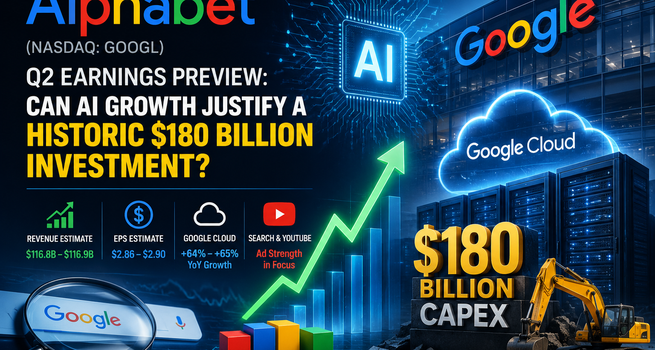
- Wall Street expects second-quarter revenue of approximately $116.8 billion to $116.9 billion.
- Consensus EPS estimates range between $2.86 and $2.90.
- Google Cloud is expected to remain the fastest-growing business, with revenue projected to increase around 64% to 65% year over year.
- Investors will closely monitor Search advertising, YouTube performance, AI monetization, and updated capital expenditure guidance.
- The biggest debate has shifted from earnings growth to whether Alphabet's unprecedented AI investment can generate attractive long-term returns.
Alphabet (NASDAQ: GOOGL) enters its second-quarter earnings announcement facing one of the highest expectations among the Magnificent Seven. While quarterly revenue and earnings estimates suggest another period of healthy expansion, investors are increasingly focused on a much larger question: whether the company's aggressive artificial intelligence investment strategy can generate sufficient returns to justify one of the largest capital spending programs in corporate history.
Consensus estimates call for revenue between $116.8 billion and $116.93 billion, with earnings per share expected to land between $2.86 and $2.90. Those figures imply another quarter of double-digit growth, reflecting continued strength across Google's advertising ecosystem and rapid expansion of its cloud computing business.
However, headline earnings are unlikely to determine the market's reaction. Instead, investors are expected to scrutinize management's commentary on AI infrastructure spending, cloud demand, advertising trends, and the long-term economics of Alphabet's enormous investment cycle.
Google Cloud Remains the Centerpiece of the AI Story
Among Alphabet's businesses, Google Cloud has become the primary growth engine.
Analysts expect Cloud revenue to increase roughly 64% to 65% year over year, making it one of the fastest-growing large-scale cloud platforms globally. The segment has transformed from a persistent loss-maker into a meaningful contributor to operating profits while benefiting from surging enterprise demand for generative AI infrastructure.
Businesses continue migrating workloads to cloud platforms while simultaneously deploying AI models that require significantly greater computing capacity. Google's investments in custom Tensor Processing Units (TPUs), advanced networking, and Gemini AI models position the company to capture a larger share of enterprise AI spending.
For investors, sustained cloud growth would reinforce the argument that Alphabet's heavy infrastructure investments are already translating into commercial demand rather than remaining speculative expenditures.
Search and YouTube Still Drive the Financial Engine
Although AI has dominated investor attention, Google's advertising businesses remain the foundation of Alphabet's financial performance.
Search advertising continues to generate the majority of company revenue, while YouTube has become an increasingly important contributor through advertising, subscriptions, and premium content offerings.
Investors will watch closely for evidence that advertising demand remains resilient despite macroeconomic uncertainty. Stable or improving ad pricing, healthy search volumes, and continued engagement across YouTube would provide reassurance that Alphabet's legacy businesses continue generating substantial cash flows capable of funding its AI expansion.
The emergence of AI-powered search experiences has also introduced new questions regarding monetization. Market participants will seek management's assessment of how AI Overviews and conversational search products are affecting user engagement, advertising placement, and revenue generation.
Capital Spending Has Become the Biggest Debate
Perhaps the most closely watched topic this quarter will be Alphabet's capital expenditure outlook.
Earlier in the year, many Wall Street analysts projected full-year 2026 capital expenditure of roughly $115 billion to $120 billion. Alphabet dramatically altered that narrative by raising its own guidance to approximately $175 billion to $185 billion, representing one of the most aggressive investment plans among global technology companies.
The increase reflects accelerated spending on AI infrastructure, including hyperscale data centers, custom chips, networking equipment, and computing capacity required to support increasingly sophisticated artificial intelligence models.
While such spending demonstrates management's confidence in long-term AI demand, it also raises questions about capital efficiency and future returns on investment.
Why Free Cash Flow Is Under Greater Scrutiny
The revised capital expenditure outlook has significantly changed how investors model Alphabet's free cash flow.
Free cash flow is calculated by subtracting capital expenditures from operating cash flow. As investment rises, free cash flow naturally declines unless operating cash generation grows rapidly enough to offset the additional spending.
Some recent projections suggest Alphabet could generate approximately $235 billion in operating cash flow on revenue approaching $500 billion during 2026. Under that scenario, even capital expenditure near $180 billion would still leave roughly $55 billion in annual free cash flow.
While that would represent lower free cash flow than previously expected, it remains substantial by almost any corporate standard.
Consequently, the debate has shifted away from whether Alphabet can remain free cash flow positive toward whether today's investment ultimately produces significantly higher future earnings.
AI Monetization Is Becoming More Important Than AI Investment
Over the past two years, investors largely rewarded technology companies simply for expanding AI capabilities.
That phase now appears to be evolving.
Markets increasingly expect companies to demonstrate measurable financial returns from those investments rather than simply announcing larger infrastructure budgets.
For Alphabet, that means investors want evidence that AI is driving incremental revenue across multiple businesses.
Cloud computing offers the clearest example, as enterprises purchase AI infrastructure and machine learning services. Search also represents a potential monetization opportunity if AI-enhanced search experiences increase user engagement and advertising effectiveness.
Similarly, YouTube's recommendation algorithms, content creation tools, and advertising optimization continue benefiting from advances in artificial intelligence.
Management commentary regarding customer adoption, pricing power, enterprise demand, and monetization trends may therefore carry greater weight than the reported quarterly numbers themselves.
Wall Street Has Set a High Bar
Alphabet's valuation already reflects considerable optimism surrounding AI.
Investors broadly expect another quarter of double-digit revenue growth, continued cloud acceleration, resilient advertising performance, and sustained confidence in the company's AI strategy.
Any indication that cloud growth is slowing, enterprise AI demand is weakening, or advertising conditions are deteriorating could trigger investor concerns about whether current spending levels remain justified.
Conversely, another quarter of strong execution could strengthen confidence that Alphabet's infrastructure investments are creating a durable competitive advantage in artificial intelligence.
Given the scale of planned capital expenditure, even small adjustments to management's long-term outlook could materially influence investor sentiment.
Balanced Outlook
Alphabet's second-quarter earnings arrive at a pivotal moment for both the company and the broader AI investment cycle. Revenue growth, cloud expansion, and resilient advertising remain essential, but the central question has become whether unprecedented AI infrastructure spending can generate equally unprecedented long-term returns.
While higher capital expenditure is likely to pressure free cash flow over the next several quarters, Alphabet still possesses one of the strongest cash-generating businesses in the technology sector. Investors appear increasingly willing to tolerate near-term margin pressure if management can demonstrate that today's investment lays the foundation for sustained cloud growth, AI monetization, and durable earnings expansion.
Ultimately, the market's reaction is likely to depend less on whether Alphabet beats quarterly estimates and more on whether management strengthens confidence that its multi-billion-dollar AI investment strategy will translate into lasting shareholder value.
Q. When is Alphabet (NASDAQ: GOOGL) reporting Q2 earnings?
A. Alphabet is expected to report its second-quarter financial results with Wall Street closely watching revenue, EPS, Google Cloud performance, and AI-related commentary.
Q. What revenue is Wall Street expecting from Alphabet?
A. Analysts expect second-quarter revenue of approximately $116.8 billion to $116.93 billion.
Q. Why is Google Cloud important for Alphabet stock?
A. Google Cloud has become Alphabet's fastest-growing business and is viewed as the primary beneficiary of enterprise AI adoption.
Q. Why is Alphabet increasing capital expenditure so aggressively?
A. The company is investing heavily in AI infrastructure, including data centers, custom chips, and computing capacity needed to support growing demand for artificial intelligence services.
Q. Does higher capex mean lower free cash flow?
A. Higher capital expenditure generally reduces free cash flow in the near term, although strong operating cash flow can partially offset the impact.
Q. What will investors watch most after the earnings release?
Q. Beyond revenue and EPS, investors will focus on Google Cloud growth, advertising demand, AI monetization, free cash flow trends, and any updates to Alphabet's capital expenditure outlook.


 Nov 13, 2026





 Please wait processing your request...