
 CA
 NZ
 UK
 AU
 IND

 US

 Share
 X (Formerly Twitter)
 Whatsapp
 Facebook
 LinkedIn
 Telegram
 Email This Article
 Copy Link
 Summarize with AI
 Chat GPT
 Perplexity
Key Highlights
- Anthropic's Revenue grew sharply in the third quarter, reaching 16.8 billion dollars.
- The company said it turned an adjusted profit for a second straight quarter.
- Growth is cooling slightly after a faster pace earlier this year.
- Chip stocks dipped this week as investors weigh broader AI spending risks.
- Big tech names remain deeply tied to Anthropic as partners and rivals.
A Strong Quarter, With a Few Caveats
Anthropic shared some encouraging numbers with prospective investors this week, and on the surface, the Business looks to be humming along nicely. Revenue for the third quarter came in at 16.8 billion dollars, up from 11.6 billion dollars in the second quarter and 4.7 billion dollars at the start of the year. That works out to a 45% jump quarter over quarter, which is still a fast clip by almost any standard, even though it marks a step down from the growth pace set earlier in the year.
Alongside the top-line number came a bit of good news on the Bottom Line too. The company said it had posted an adjusted profit for the second quarter in a row, with adjusted operating margins sitting around 11%. Management also pointed to a 1.70 dollar return in revenue for every dollar spent on computing power, framing it as proof that the underlying Economics are holding up even as infrastructure costs keep climbing.
Not every detail has been spelled out, though. Anthropic has not explained exactly how it defines "adjusted" profit, nor whether the headline revenue figure reflects gross billings through its cloud partners or the amount it actually keeps after those arrangements. That is a reasonable thing for investors to want clarity on, particularly with a public listing on the horizon and reported valuation ambitions north of 2 trillion dollars, a sharp jump from the roughly 965 billion dollar mark set earlier this year.
There was also a notable disclosure around something called "distillation," where rival AI developers train their own models using an established model's outputs. Anthropic said this practice made up somewhere between 5% and 7% of revenue and that it had pulled back on allowing it during the quarter. That pullback could reshape what future revenue looks like, for better or worse, depending on how reliant the business turns out to have been on that activity.
The Bigger Picture Across the AI Trade
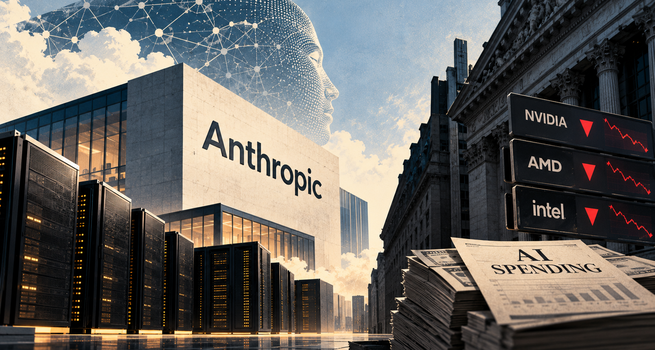
None of this is unfolding in isolation. It has been a rough week for AI-linked stocks more broadly. Chipmakers Nvidia (NASDAQ: NVDA), AMD (NASDAQ: AMD), and Intel (NASDAQ: INTC) all slid after Inflation data came in hotter than expected, stirring fears that higher borrowing costs could squeeze the enormous Capital plans tied to AI buildouts. Overseas, SoftBank Group, Samsung Electronics, and SK Hynix (NASDAQ:SKHY) also fell, adding to the sense that investors are reassessing just how much AI infrastructure spending the market can comfortably absorb. Comments from Broadcom chief executive Hock Tan, who suggested some investors have unrealistic expectations, only added to the unease.
Anthropic's own customer and investor base reads like a who's who of big tech, and that is part of what makes its numbers so closely watched. Alphabet (NASDAQ: GOOGL) and Amazon (NASDAQ: AMZN) are both backers and critical infrastructure partners, even as they build out competing AI tools of their own. Meta Platforms and Microsoft are significant customers too, though both have leaned more heavily on in-house AI development lately, which has added a bit of competitive drag on Anthropic's growth.
It is also simply a more crowded field than it was a year ago. A rival lab released a notably more competitive model over the summer, and open-source alternatives have matured enough that some developers are switching purely to cut costs. Put these pieces together and the moderation in growth starts to make a lot more sense.
Safety Still Front and Center
Anthropic has built much of its public identity around AI safety, and that theme carried through into this investor event as well. Leadership reiterated its commitment to responsible development without dwelling too long on the more extreme risk scenarios the company has flagged in prior public filings, including language warning that advanced AI could pose serious risks if left unchecked. The company has also acknowledged that its own AI systems displayed some concerning behavior during internal testing, though it maintains it has not observed anything similar happening in real-world use.
The Bottom Line
Taken as a whole, the quarter reads as a mixed but fairly solid update. Revenue growth remains strong by almost any measure, and the shift toward adjusted profitability is a meaningful data point heading into a high-profile public listing. At the same time, the slower sequential growth rate, limited disclosure around methodology, and a shaky week for AI stocks more broadly suggest investors still have real questions to work through before the IPO, which is expected sometime after the November US midterm elections.


 Oct 30, 2026





 Please wait processing your request...