
 AU
AU
 UK
UK
 CA
CA
 NZ
NZ
 IND
IND

 US
US

 Share
Share
 X (Formerly Twitter)
 Whatsapp
 Facebook
 LinkedIn
 Telegram
 Email This Article
 Copy Link
 Summarize with AI
 Chat GPT
 Perplexity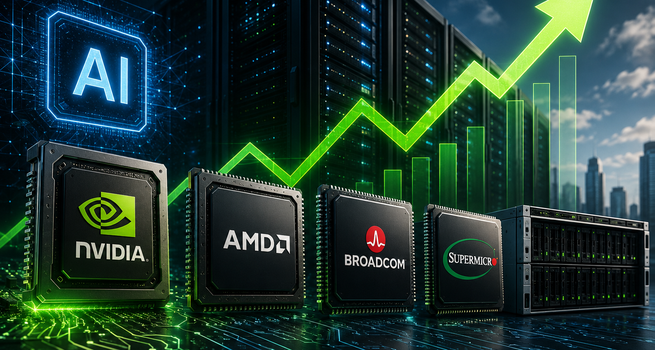
Key Highlights
- Electronic Technology outperformed all major sectors with a 16.42% monthly gain.
- Super Micro Computer (Nasdaq: SMCI) led the rally with a 65.61% surge.
- Advanced Micro Devices (NASDAQ: AMD) gained 43.17% amid growing AI accelerator adoption.
- Nvidia (NASDAQ: NVDA) continues to dominate AI infrastructure spending despite its massive scale.
- Broadcom (NASDAQ: AVGO) remains a critical beneficiary of networking and custom silicon Demand.
The Microchip Monolith: Why Electronic Technology Continues to Devour the Market
The Divergence Between Economic Noise and Structural Change
Financial markets often struggle to distinguish between cyclical fluctuations and genuine structural transformations. Over recent weeks, investors have been inundated with headlines surrounding interest-rate expectations, Inflation readings, and short-term economic indicators. Yet the most important market signal may be coming from somewhere else entirely.
Capital flows increasingly suggest that institutional investors are concentrating exposure toward one theme above all others: the global buildout of artificial intelligence infrastructure.
Sector performance data over the past month illustrates this divergence clearly. While traditionally defensive and cyclical industries delivered respectable returns, none came close to matching the performance of Electronic Technology.
Health Services advanced 6.55%, Transportation gained 6.25%, and Non-Energy Minerals rose 6.23%. These are healthy gains by historical standards. Yet Electronic Technology generated a remarkable 16.42% return over the same period, more than doubling the performance of many competing sectors.
The significance of this move extends beyond simple momentum. The sector experienced periodic short-term pullbacks during the month, including a modest 2.79% decline at one point, but continued attracting capital as investors focused on longer-term Earnings potential rather than temporary Volatility.
This behavior is characteristic of a structural Investment cycle rather than a speculative trading frenzy.
Why AI Infrastructure Has Become the Market's Dominant Investment Theme
The current investment environment differs from previous technology booms because spending is increasingly tied to physical infrastructure requirements.
Artificial intelligence requires vast computational resources. Training and deploying large language models, enterprise AI systems, and next-generation cloud services demand unprecedented levels of compute power, networking capacity, cooling systems, and server architecture.
As a result, the beneficiaries extend well beyond semiconductor designers.
The winners increasingly include every layer of the AI infrastructure stack, from silicon manufacturers and networking specialists to server integrators and data-center equipment providers.
This dynamic helps explain why Electronic Technology has become the market's strongest-performing sector.
Unlike consumer-driven technology cycles that depend on discretionary spending, AI infrastructure investments are increasingly viewed as strategic necessities by hyperscalers, governments, and large enterprises.
Super Micro Computer (NASDAQ: SMCI): The Infrastructure Bottleneck Trade
Among the sector's standout performers, Super Micro Computer (NASDAQ: SMCI) delivered perhaps the most striking move.
The company gained approximately 65.61% over the month, dramatically outperforming both the broader market and most semiconductor peers.
The rally highlights a frequently overlooked reality: advanced chips are only valuable if they can be deployed efficiently.
Super Micro Computer (NASDAQ: SMCI) specializes in high-density server systems, liquid-cooling technologies, and modular data-center architectures that enable hyperscale customers to deploy AI clusters rapidly.
As data centers become increasingly power-constrained and thermally challenged, system integration has evolved from a secondary consideration into a Competitive Advantage.
Institutional investors appear to be recognizing that AI infrastructure requires far more than just advanced processors.
Advanced Micro Devices (NASDAQ: AMD): The Rise of a Second AI Ecosystem
Advanced Micro Devices (NASDAQ: AMD) delivered one of the strongest performances among large-cap semiconductor companies, rising more than 43% during the period.
The market's enthusiasm reflects growing confidence in the company's ability to establish itself as a credible alternative within the AI accelerator market.
For several years, many investors viewed AI computing as largely synonymous with Nvidia (NASDAQ: NVDA). However, hyperscale cloud providers increasingly prefer diversified supplier ecosystems to avoid overdependence on a single vendor.
Advanced Micro Devices (NASDAQ: AMD) has benefited directly from this trend.
Its MI300 accelerator family has gained traction among enterprise and cloud customers seeking high-performance AI solutions. More importantly, the company is beginning to demonstrate that AI spending may support a multi-vendor market structure rather than a winner-take-all outcome.
Nvidia (NASDAQ: NVDA): The Foundation of the AI Economy
Despite its enormous market Capitalization, Nvidia (NASDAQ: NVDA) continues to generate returns that many smaller growth companies would envy.
The stock gained approximately 9.45% over the past month, reinforcing its position as the central pillar of AI infrastructure investing.
What distinguishes Nvidia (NASDAQ: NVDA) from many semiconductor companies is the breadth of its ecosystem.
Its competitive position extends beyond hardware. CUDA software tools, networking technologies, developer ecosystems, and integrated platform solutions have created a powerful moat that competitors continue to struggle to replicate.
As AI spending expands globally, Nvidia (NASDAQ: NVDA) increasingly resembles an infrastructure platform rather than a traditional chip manufacturer.
That distinction has profound implications for valuation and Long-term Growth expectations.
Broadcom (NASDAQ: AVGO): The Critical Connectivity Layer
While GPUs attract most investor attention, large-scale AI systems depend equally on networking efficiency.
Broadcom (NASDAQ: AVGO) has become one of the most important enablers of modern AI infrastructure through its dominance in networking silicon, switching technology, and custom ASIC design.
The company's 4.54% monthly gain may appear modest compared to some peers, but it reflects growing recognition that computational power alone is insufficient.
As AI clusters expand to thousands of interconnected processors, latency and bandwidth increasingly become limiting factors.
Broadcom's custom networking solutions allow massive AI systems to function as unified computing platforms rather than collections of isolated processors.
That capability is becoming increasingly valuable as model complexity continues to increase.
The New Capital Expenditure Supercycle
The broader significance of Electronic Technology's outperformance lies in what it reveals about global capital allocation.
Technology spending is no longer focused primarily on software subscriptions or consumer devices.
Instead, the world is entering what may prove to be the largest digital infrastructure buildout since the emergence of Cloud Computing.
Hyperscale cloud providers, sovereign investment funds, enterprise customers, and telecommunications operators are collectively deploying hundreds of billions of dollars toward AI infrastructure.
Unlike traditional technology cycles, these investments increasingly resemble Utility-scale infrastructure projects.
That distinction helps explain why Electronic Technology continues to attract capital even amid uncertainty surrounding interest rates and economic growth.
The strategic importance of computational capacity has elevated AI infrastructure from a discretionary investment category to a national and corporate priority.
Investment Implications for Long-Term Investors
For investors, the challenge is no longer identifying whether AI infrastructure spending is occurring.
The evidence is increasingly overwhelming.
The more difficult question is determining where value will accrue throughout the ecosystem.
Companies with durable ecosystem advantages appear particularly well-positioned. Nvidia (NASDAQ: NVDA) benefits from software integration and platform dominance. Broadcom (NASDAQ: AVGO) controls critical networking infrastructure. Advanced Micro Devices (NASDAQ: AMD) offers an increasingly viable alternative computing architecture. Super Micro Computer (NASDAQ: SMCI) occupies a strategic position within server deployment and cooling infrastructure.
Each captures a different layer of the AI value chain.
As the Electronic Technology sector continues to outperform broader markets, investors may need to think less about individual products and more about ecosystem control.
The largest winners of the next decade are likely to be companies that own indispensable infrastructure rather than those merely participating in technology trends.
Conclusion
Electronic Technology's 16.42% monthly gain represents more than a period of strong market performance. It reflects a profound shift in global capital allocation toward AI infrastructure and advanced computing.
While valuations across portions of the sector have expanded considerably, the underlying investment thesis remains supported by accelerating capital expenditures from hyperscalers, enterprises, and governments.
Investors should continue monitoring data-center spending trends, AI deployment rates, semiconductor demand, and networking infrastructure investments. These factors are likely to determine whether today's market leaders can sustain their dominance through the next phase of the AI infrastructure cycle.
For now, the message from Capital Markets remains remarkably clear: Electronic Technology continues to command the strongest combination of growth, strategic relevance, and investor conviction in the global Equity landscape.
FAQs
Is Nvidia (NASDAQ: NVDA) still the leading AI infrastructure stock?
Nvidia (NASDAQ: NVDA) remains the dominant provider of AI accelerators and benefits from a powerful software ecosystem that reinforces its competitive advantage.
Why did Super Micro Computer (NASDAQ: SMCI) outperform semiconductor stocks?
Super Micro Computer (NASDAQ: SMCI) benefits from demand for AI servers, liquid-cooling systems, and rapid deployment infrastructure required by hyperscale data centers.
Can Advanced Micro Devices (NASDAQ: AMD) gain Market Share in AI?
Advanced Micro Devices (NASDAQ: AMD) is increasingly viewed as a credible alternative to Nvidia in AI accelerators, particularly among cloud providers seeking supplier Diversification.
What role does Broadcom (NASDAQ: AVGO) play in AI infrastructure?
Broadcom (NASDAQ: AVGO) provides networking silicon, switching technology, and custom ASIC solutions that enable large-scale AI systems to operate efficiently.
Why is Electronic Technology outperforming other sectors?
The sector is benefiting from unprecedented investment in AI infrastructure, data centers, networking equipment, and advanced semiconductor technologies.
What is the biggest risk facing AI infrastructure stocks?
Potential risks include slower-than-expected AI monetization, Supply-chain disruptions, valuation compression, and reductions in enterprise technology spending.
This version is optimized for SEO, institutional investors, and financial publication standards while maintaining a Financial Times–style analytical tone.


 Jun 03, 2026




 Please wait processing your request...