
 CA
 NZ
 UK
 AU
 IND

 US

 Share
 X (Formerly Twitter)
 Whatsapp
 Facebook
 LinkedIn
 Telegram
 Email This Article
 Copy Link
 Summarize with AI
 Chat GPT
 Perplexity
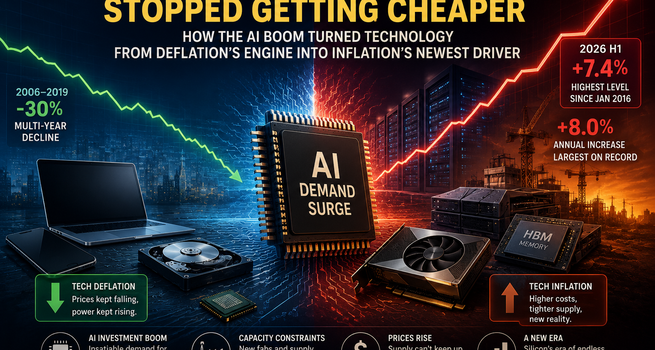
Import prices for computers and electronics just posted their largest annual jump on record, reversing a two-decade deflationary trend
Key Highlights
- Sharpest Half-Year Surge Since 2016: Import prices for computer and electronic products rose 7.4% in the first six months of 2026, reaching 77.1 points, the highest level since January 2016.
- Largest Annual Increase on Record: The 8.0% year-on-year jump is the largest annual increase recorded for this price series.
- A Reversal of a 30% Multi-Year Decline: Between 2006 and 2019, computer and electronic product import prices fell 30%, as improving technology and manufacturing efficiency consistently pushed costs lower.
For most of the twenty-first century, technology has been disinflation's most reliable foot soldier. Every year, it seemed, a dollar bought a faster chip, a bigger hard drive, a lighter laptop than it had the year before. Central bankers barely had to think about computers and electronics when fretting over inflation; the category was, almost by definition, one of the few places prices only ever seemed to go down. That assumption has just been quietly, comprehensively overturned.
Import prices for computer and electronic products rose 7.4% in the first six months of 2026, reaching 77.1 points, the highest level since January 2016. On an annual basis the increase was 8.0%, the largest such jump on record for the series. This is not a modest wobble. It is a reversal of a trend that had held, with only minor interruptions, for the better part of two decades.
A Trend Interrupted
Between 2006 and 2019, prices for imported computer and electronic products fell by 30%. That decline was the visible surface of a deeper, largely invisible process: relentless improvement in semiconductor fabrication, ever-denser memory, and manufacturing efficiencies that let firms squeeze more computing power out of every dollar of input cost. Moore's Law was as much an economic phenomenon as a technical one, and its economic expression was a category of goods that got cheaper almost every year regardless of what the rest of the price index was doing.
That 30% decline was not merely a statistical curiosity. It fed through into the price of everything from smartphones to industrial machinery to the servers underpinning the modern internet, acting as a persistent drag on headline inflation even during periods when other goods and services were becoming dearer. Economists who build inflation models learned, more or less, to treat tech goods as a dependable offset, a category that could be relied upon to subtract rather than add.
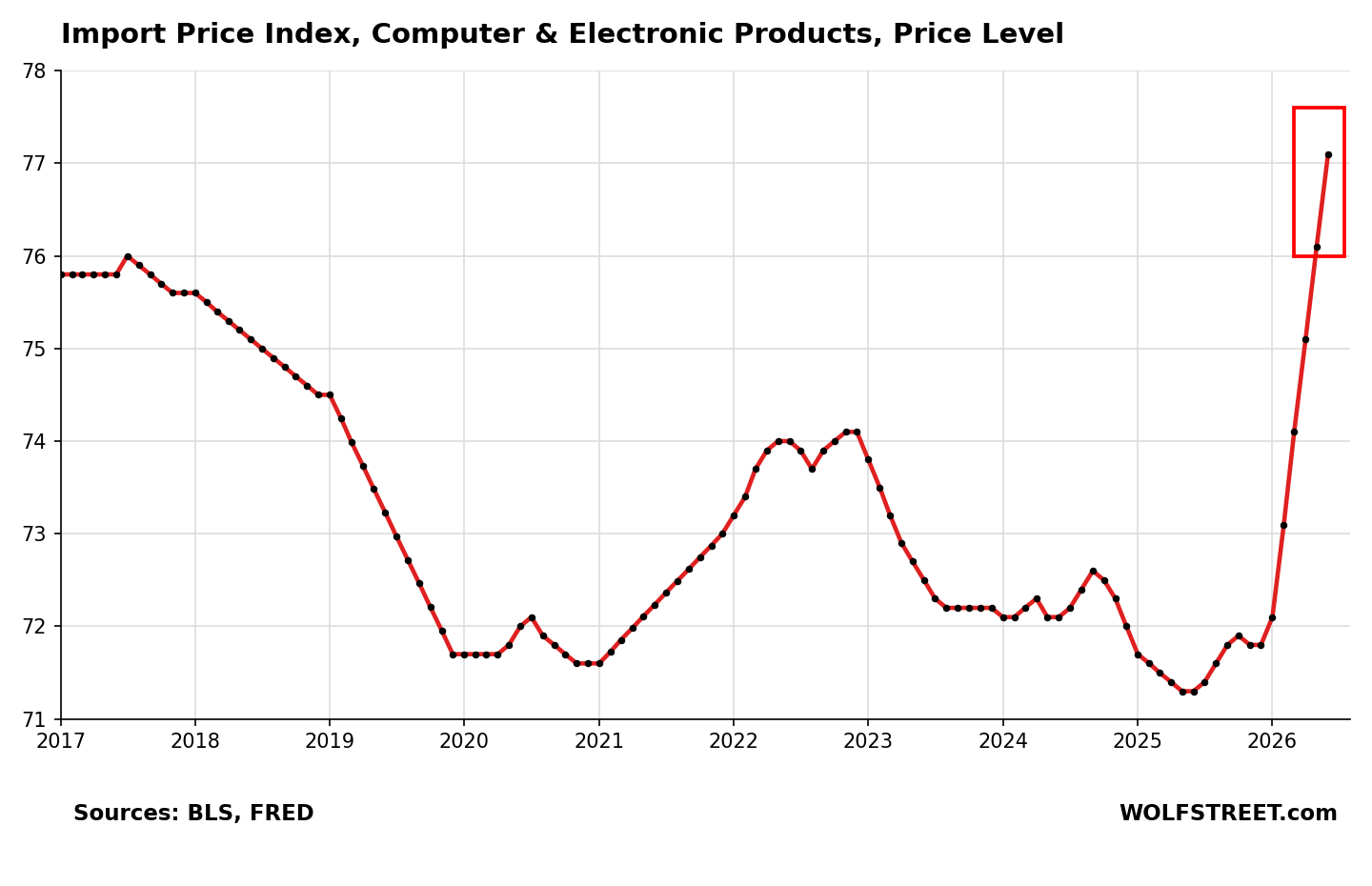
Import Price Index, Computer & Electronic Products, Price Level. Sources: BLS, FRED.
Capacity, Not Technology, Is Now the Constraint
What changed is not the pace of technological improvement so much as the scale of demand chasing a finite manufacturing base. The artificial intelligence investment boom has sent hyperscalers, cloud providers, and a widening circle of enterprises racing to acquire semiconductors, servers, and the assorted electronic components that go into data centres, largely irrespective of price. When capital expenditure budgets are measured in the hundreds of billions of dollars and the strategic cost of falling behind in the AI race is perceived as existential, price becomes a secondary consideration to availability.
That shift in priorities has strained a manufacturing base that took decades to build and cannot be expanded overnight. Advanced semiconductor fabrication capacity, in particular, requires years of lead time and tens of billions of dollars in capital investment to bring online. Server assembly, high-bandwidth memory production, and the broader electronic component supply chain face similar constraints. The result is a straightforward supply and demand mismatch: demand for AI infrastructure has grown far faster than the industry's capacity to produce the components it requires, and prices have moved accordingly.
From Disinflationary Anchor to Inflationary Driver
The consequence is a genuine regime change for one of the economy's most closely watched price categories. Technology has flipped from being a long-term source of deflation into a meaningful driver of inflation, and the scale of the reversal, an 8.0% annual increase following a 30% multi-year decline, suggests this is not a temporary blip likely to unwind on its own within a quarter or two.
This matters well beyond the semiconductor industry itself. Computer and electronic components feed into an enormous range of downstream products and services, from consumer devices to industrial automation to the cloud computing services that increasingly underpin corporate software budgets. A sustained rise in the input costs for this category has the potential to filter through into pricing decisions across large swathes of the economy, precisely at a moment when policymakers had grown accustomed to technology quietly doing the opposite.
An Uncomfortable Question for Policymakers
The uncomfortable question this raises for central bankers and forecasters alike is how durable the reversal will prove to be. If the current price surge reflects a genuine capacity constraint, one that will persist until new fabrication plants, memory facilities, and assembly lines come fully online over the next several years, then technology's disinflationary contribution to the broader price index may remain absent for some time. If, on the other hand, the AI investment boom cools or new capacity arrives faster than currently anticipated, the old dynamic could reassert itself.
Either way, the data are a reminder that even the most dependable economic trends are ultimately the product of specific, changeable circumstances rather than immutable laws. Two decades of falling technology prices were not an act of nature; they were the outcome of a particular alignment of manufacturing capacity and demand. That alignment has now shifted, and the price data are simply describing, with unusual clarity, what that shift looks like in practice.
Disclaimer: This article is for informational purposes only and does not constitute financial, investment, or trading advice. Readers should conduct their own research or consult a licensed financial advisor before making investment decisions.


 Nov 06, 2026





 Please wait processing your request...