
 CA
 NZ
 UK
 AU
 IND

 US

 Share
 X (Formerly Twitter)
 Whatsapp
 Facebook
 LinkedIn
 Telegram
 Email This Article
 Copy Link
 Summarize with AI
 Chat GPT
 Perplexity

Key Highlights
- Oracle (NYSE:ORCL) priced USD 20 billion of shares and notes on November 2, 2026, with notes at coupons from 7.000% to 8.650%, and affirmed about USD 70 billion of full-year Capital spending.
- Meta (NASDAQ:META) raised USD 15 billion through a five-part bond offering on November 3, with published coverage citing yields of 5.85% to 7.53% and orders of as much as USD 58 billion.
- Micron (NASDAQ:MU) reported fiscal fourth-quarter Revenue of USD 54.23 billion with a gross Margin of 86.8%, but fell 5.78% to USD 833.59 on November 2.
- Super Micro Computer (NASDAQ:SMCI) reported unaudited revenue of USD 19.9 billion and guided fiscal 2027 revenue to USD 72 billion to USD 82 billion, but Operating Cash Flow was negative about USD 434 million.
Oracle (NYSE:ORCL): The Borrower That Also Sold Stock
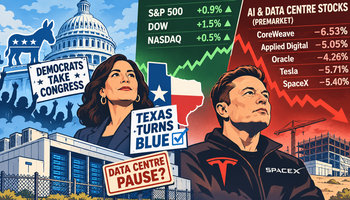
Oracle (NYSE:ORCL) priced the largest raise in this group on November 2, 2026. It sold 86,206,897 shares at USD 116.00, worth about USD 10.0 billion before costs, and USD 10.0 billion of senior notes in tranches reported for 2029, 2031, 2033, 2037 and 2046 with coupons from 7.000% to 8.650%. The share price was about 2.7% below the USD 119.20 close, simple arithmetic, after shares fell about 8.6% that day. Oracle said proceeds are for general corporate purposes, which may include capital expenditures and Debt repayment, and both offerings are expected to close on November 4. Coupons that high for a large technology issuer show how much the market charges to fund AI Data Center spending. Interest on the notes implies an annual cost near USD 0.8 billion, simple arithmetic assuming an average coupon near 8%. Published coverage cites a target of up to USD 50 billion of debt and Equity in 2026. Customer concentration in a small number of large AI contracts adds risk if any of them slips.
Meta (NASDAQ:META): Cheaper Debt, Still a Fixed Claim
Meta (NASDAQ:META) priced a five-part dollar bond offering on November 3, 2026, raising USD 15 billion. Together with Oracle's USD 20 billion, that is USD 35 billion in two days, simple arithmetic on the two published amounts. Published coverage says orders reached as much as USD 58 billion, about 3.9 to 4 times the deal size, with yields from 5.85% on the shortest part to 7.53% on the longest. The 10-year part yielded about 6.55%, roughly 1 point above the average for AA-rated bonds, per that report, and the longest part, due 2056, priced at 2.2 points over Treasuries. Meta also sold a large dollar bond in late April 2026 and reportedly began a debut euro sale on November 4. Reports of a larger equity and preferred raise are single-source and left out. Interest is a fixed claim, so a squeeze on free cash flow is the main risk if AI revenue arrives later than spending. Meta can use debt to preserve cash for Buybacks and capital spending, and market fatigue as Supply grows is a further risk. For benchmark context, the 10-year Treasury Yield was about 4.95% on November 3, which means even AA-rated style borrowers pay a large spread.
Micron (NASDAQ:MU): The Supplier With Extreme Margins
Micron (NASDAQ:MU) benefits when borrowers such as Oracle and Meta spend on servers, because AI data centers pay up for memory capacity. Fiscal fourth-quarter revenue reported on September 30 was USD 54.23 billion, against about USD 11.3 billion a year earlier, with a GAAP gross margin of 86.8%, and fiscal first-quarter 2027 guidance is USD 61.5 billion, plus or minus USD 1.5 billion. Adjusted free cash flow was USD 33.20 billion in the quarter. Margins like that appear when supply is tight, and the mechanism cuts both ways: when a supplier signals slower price increases, investors discount peak profits quickly. That is what happened on November 2, when Micron closed at USD 833.59, down 5.78%, after a cautious outlook from Japanese flash memory maker Kioxia and renewed AI spending worries. It rose about 2.6% on November 3. Net capital spending of USD 10.77 billion in the quarter raises the stakes if Demand softens, and published commentary points to rising capacity at Chinese rivals, which Micron has not confirmed. One report says buyback limits tied to the CHIPS Act may lapse on December 9, 2026, a single-source claim that Micron has not confirmed.
Super Micro Computer (NASDAQ:SMCI): The Server Builder Absorbing the Cash Strain
Super Micro Computer (NASDAQ:SMCI) sits between the borrowers and the chip suppliers, building the servers. Fiscal first-quarter revenue of USD 19.9 billion, in unaudited preliminary figures, compares with USD 5.0 billion a year earlier and USD 11.1 billion in the prior quarter. Gross margin was 12.7% in the release text, against 17.5% in the prior quarter. Operating cash flow was negative at about USD 434 million as receivables and inventory absorbed about USD 6 billion, with customer deposits offsetting roughly half. The company must finance components for enormous orders before customers pay, which strains working capital, so it depends on its customers' ability to raise money. Second-quarter revenue is guided to USD 19.5 billion to USD 21.5 billion against USD 17.4 billion expected, and the full-year outlook was raised to USD 72 billion to USD 82 billion. Shares closed at USD 31.39 on November 3 and rose about 6% to 7% after hours. Customer concentration and the unaudited nature of the figures are the main risks. The company says its financial close is not complete, so final results may change, and one analyst called the results one of the best prints of the season and kept an Overweight rating.
Where Things Stand
The winner from USD 35 billion of AI borrowing is, for now, the supplier with the fattest margin, Micron, but its stock fell 5.78% on a peer's caution, which shows suppliers are exposed to any sign that spending is slowing. Oracle (NYSE:ORCL) carries the largest funding cost, with coupons up to 8.650%. Meta carries a smaller yield, while Super Micro takes the working-capital strain. The balance of evidence is that demand is strong and the cost of funding it is rising. The next catalysts are Oracle's closing on November 4, Meta's euro pricing, Micron's next guidance update and Super Micro's final audited figures. None of this is a forecast of returns.


 Nov 04, 2026




 Please wait processing your request...