
 AU
AU
 UK
UK
 CA
CA
 NZ
NZ
 IND
IND

 US
US

 Share
Share
 X (Formerly Twitter)
 Whatsapp
 Facebook
 LinkedIn
 Telegram
 Email This Article
 Copy Link
 Summarize with AI
 Chat GPT
 Perplexity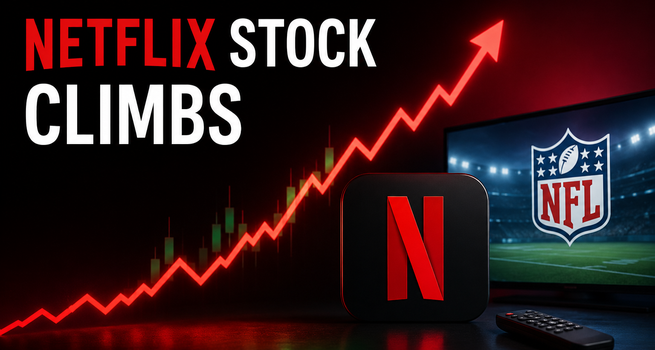
Key Highlights
- Netflix rose about 3% Monday and continued edging higher in pre-market trading
- Bank of America reiterated a Buy rating with a $125 price target
- Netflix’s ad-supported tier has now reached 250 million monthly viewers globally
- Analysts expect Advertising Revenue to potentially double to nearly $3 billion in 2026
- Netflix expanded its NFL streaming Partnership through 2029 and will stream five games during the 2026 season
- Shares are outperforming the broader Communication Services sector amid volatile macro conditions tied to oil prices and rising bond yields
The latest rally in Netflix reflects a growing belief on Wall Street that the streaming giant may be entering a new phase of monetisation — one driven less by subscriber growth alone and more by advertising scale, live sports and platform Economics.
Shares climbed roughly 3% on Monday, outperforming a volatile broader market and continuing higher in pre-market trading, even as the Communication Services sector remained largely flat. The move came as investors digested a wave of increasingly bullish developments surrounding the company’s advertising Business and its expanding partnership with the National Football League.
The broader market backdrop remains fragile. Elevated oil prices and rising Treasury yields tied to the ongoing U.S.-Iran conflict have created renewed pressure across growth equities. Yet Netflix has managed to decouple from much of that weakness, helped by the perception that the company is evolving from a subscription-only streaming platform into a diversified global media ecosystem.
For investors, that distinction is becoming increasingly important.
Advertising is rapidly becoming central to the Netflix story
The most significant shift in the Netflix Investment narrative is no longer subscriber growth. It is monetisation efficiency.
Bank of America reiterated its Buy rating this week alongside a $125 price target, highlighting the rapid expansion of Netflix’s ad-supported tier, which has now reached approximately 250 million monthly viewers globally.
That figure matters not simply because of audience scale, but because it fundamentally changes the economics of the platform.
For years, Netflix resisted advertising entirely, positioning itself as a premium subscription product insulated from the Volatility and commoditisation associated with ad-driven media businesses. That strategy helped build one of the world’s most valuable streaming franchises, but it also limited monetisation flexibility as subscriber growth matured across developed markets.
The introduction of the ad-supported tier altered that equation.
Netflix now possesses something increasingly rare in modern media: a global digital audience with both subscription revenue and high-value advertising inventory. Analysts increasingly believe that combination could become extraordinarily profitable as advertisers redirect budgets away from traditional television and toward streaming environments with measurable engagement.
Bank of America estimates advertising revenue could nearly double to approximately $3 billion in 2026 alone.
That would represent a substantial shift in Netflix’s revenue composition and potentially mark the beginning of a multi-year advertising growth cycle.
The NFL partnership changes the competitive landscape
The company’s expanding relationship with the NFL may prove equally significant.
Netflix announced that it will stream five NFL games during the 2026 season, a meaningful increase from the two Christmas Day games it previously secured. The deal now extends through 2029, reinforcing the company’s growing ambitions in live sports programming.
This is a notable strategic pivot for a business that historically avoided expensive sports rights entirely.
For much of the streaming era, Netflix argued that scripted entertainment offered superior economics relative to live sports, which are costly and often dependent on cyclical advertising Demand. But the competitive environment has evolved. As subscriber growth slows across the industry, live sports increasingly represent one of the few categories capable of reliably attracting large real-time audiences.
That matters enormously in advertising.
Sports content remains among the most valuable inventory in global media because it retains something much of digital entertainment has lost: appointment viewing. Audiences watch live, advertisers pay premium rates and engagement levels remain exceptionally high.
By expanding its NFL presence, Netflix is not simply adding content. It is strengthening its advertising proposition.
The move also positions the company more directly against legacy broadcasters and streaming competitors such as Amazon, Disney and Warner Bros. Discovery, all of which have aggressively pursued sports rights as streaming competition intensifies.
Investors are beginning to reassess Netflix’s valuation
The renewed optimism surrounding Netflix also reflects a broader reassessment of quality media and technology Assets following an extended period of market volatility.
Despite recent gains, Netflix shares still trade well below their 52-week highs. Consensus analyst ratings currently imply meaningful upside from current levels, with the average Wall Street price target standing near $114.82 and the stock maintaining a Moderate Buy consensus.
Part of the previous weakness stemmed from concerns that streaming competition had permanently compressed profitability across the sector. Investors worried that rising content costs, slowing subscriber additions and aggressive pricing competition would erode margins industry-wide.
Netflix increasingly appears to be separating itself from those concerns.
Unlike many streaming rivals, the company has already achieved global scale, significant Leverage/">Operating Leverage and consistent free Cash Flow generation. Its advertising business now introduces an additional monetisation engine layered on top of an already mature subscription platform.
That creates a very different financial profile from many of its competitors.
The NFL expansion further reinforces the idea that Netflix is evolving into something closer to a hybrid media platform — combining subscription streaming, advertising and live-event programming under a single ecosystem.
Macro volatility is testing Growth Stocks again
The timing of Netflix’s relative strength is also notable given the current macroeconomic environment.
Markets remain unsettled by rising geopolitical tensions linked to the ongoing U.S.-Iran conflict. Oil prices have climbed sharply in recent sessions, while Treasury yields continue moving higher as investors reassess Inflation risks and Federal Reserve policy expectations.
Historically, those conditions have been challenging for growth-oriented technology and media equities.
Higher bond yields compress valuations for long-duration growth assets by increasing discount rates applied to future Earnings. Rising energy prices meanwhile threaten consumer spending and corporate advertising budgets.
Yet Netflix’s resilience suggests investors increasingly view the company as possessing more defensive characteristics than many traditional growth names.
Its subscription model provides relatively stable Recurring Revenue, while the advertising business introduces additional upside tied to engagement growth rather than subscriber expansion alone.
Importantly, entertainment spending has historically remained relatively durable during periods of economic uncertainty compared with other discretionary categories.
The next phase of streaming may belong to scale players
The broader implication of Netflix’s recent momentum is that the streaming industry may be entering a new phase — one where scale, advertising infrastructure and live-event capabilities matter more than raw subscriber additions.
The first decade of streaming competition focused primarily on acquiring users at almost any cost. The next phase increasingly appears centred on monetisation quality and ecosystem depth.
Netflix possesses advantages in both areas.
Its global audience scale creates powerful advertising economics. Its technology infrastructure allows rapid international deployment of new products. And its expanding live-event ambitions could help increase engagement while supporting premium advertising pricing.
The company’s challenge now is execution.
Advertising remains cyclical, sports rights are expensive and competition for viewer attention continues intensifying across digital media. There is also the risk that investors become overly optimistic regarding the pace at which advertising revenue can scale.
Nevertheless, Wall Street increasingly appears convinced that Netflix’s strategic position is strengthening rather than weakening.
The investment takeaway
Netflix’s latest rally reflects more than short-term enthusiasm surrounding analyst upgrades or NFL headlines. Investors increasingly appear to believe the company has discovered a second major growth engine through advertising — one that could materially reshape the economics of the business over the coming years.
The expansion of the NFL partnership adds another layer to that thesis, positioning Netflix more aggressively inside the lucrative live-sports ecosystem while strengthening its appeal to advertisers seeking large-scale engaged audiences.
Macro risks remain elevated, and the stock still trades below prior highs amid broader market uncertainty. But the narrative surrounding Netflix is shifting from concerns over streaming saturation toward optimism about platform monetisation and advertising leverage.
For much of the past two years, investors questioned whether the streaming industry had already reached Maturity. Netflix’s recent momentum suggests the market may now be reconsidering how large the company’s next growth chapter could become.


 Jun 04, 2026




 Please wait processing your request...