
 AU
AU
 UK
UK
 CA
CA
 NZ
NZ
 IND
IND

 US
US

 Share
Share
 X (Formerly Twitter)
 Whatsapp
 Facebook
 LinkedIn
 Telegram
 Email This Article
 Copy Link
 Summarize with AI
 Chat GPT
 Perplexity
Key Highlights
- DECK is trading near $102–$112, having fallen approximately 50% from its all-time high of $223 set in early 2025 — a drawdown that has reset valuation to levels not seen since 2023 despite the business delivering its best financial results in company history
- The stock is trading below both the EMA-21 and EMA-50, with both averages declining — a technically damaged structure that reflects persistent institutional selling pressure that has not yet been arrested
- RSI has oscillated in the 35–50 range throughout 2026, consistently failing to sustain readings above 50 — neutral-to-bearish momentum that signals the trend has not yet reversed despite fundamental improvement
- Fiscal 2026 revenue of $5.47 billion set a new company record, up 9.8% year-over-year, with HOKA growing 15.9% to $2.59 billion and UGG growing 8.2% to $2.74 billion — both ahead of consensus expectations
- Diluted EPS of $7.02 for the full fiscal year was a record, and the board approved a $3.5 billion increase to the stock repurchase authorization — bringing total outstanding authorization to approximately $5 billion, more than a third of the current market cap
- Management unveiled a multi-year framework targeting high single-digit revenue CAGR through 2030 with low double-digit EPS compounding — a long-range commitment that CFO Steve Fasching explicitly described as not conservative
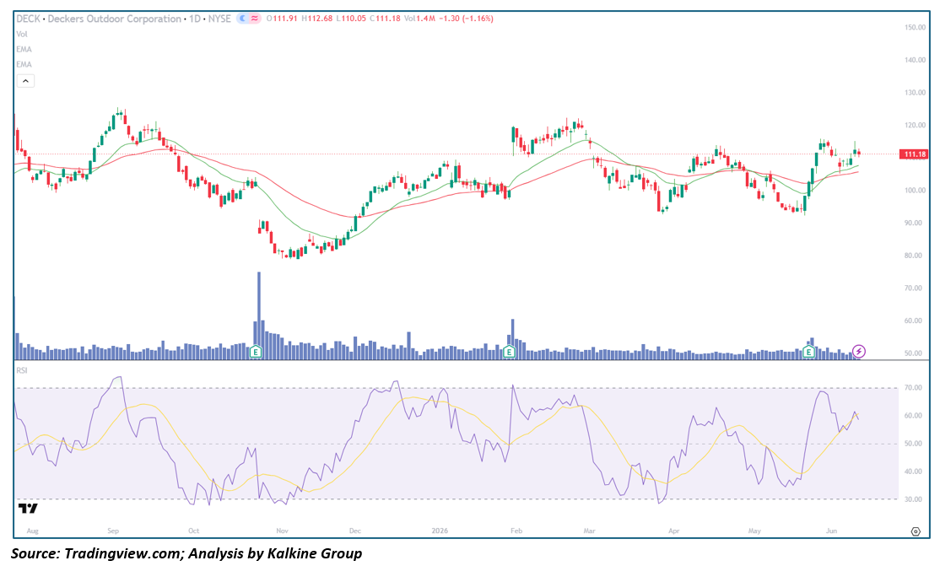
Trend Structure: From All-Time Highs to Deep Value Territory
Phase 1 — Parabolic Advance and Topping (2023 – Early 2025)
Deckers' ascent from the $64 base in late 2022 to the $223 all-time high was one of the most powerful multi-year moves in consumer discretionary — driven by HOKA's explosive brand momentum and the global reacceleration of UGG. The topping process was gradual rather than sharp, with the stock constructing an extended distribution range between $190 and $223 through late 2024 and early 2025.
Phase 2 — Sustained Markdown (2025)
The breakdown from the $190 support zone accelerated through 2025, ultimately producing a $79 cycle low — a 65% decline from peak to trough in a business that was simultaneously delivering record revenue and earnings. The selling was driven by multiple compression in consumer discretionary, tariff fears impacting margin outlook, and a broad de-rating of premium footwear names rather than any deterioration in Deckers' competitive position.
Phase 3 — Base Building Attempt (2026)
The $79 low in November 2025 appears to have been the capitulation extreme, with the stock recovering toward $100–$115 in early 2026. However, the recovery has lacked the volume conviction and momentum characteristics of a sustainable trend reversal — it is base-building, not breakout.
Fundamental Foundation: A Business Priced for Permanent Decline Delivering Permanent Growth
At $105–$110, DECK trades at approximately 15x earnings — a valuation that implies either a severe deterioration in profitability or a permanent slowdown in brand momentum that the last four quarters of results categorically contradict. HOKA delivered its largest quarter ever in Q4 FY2026, and management's explicit confidence in the 2030 framework suggests that current consensus estimates are too conservative.
The $5 billion share repurchase authorization is not window dressing — at current prices, it would retire over 30% of shares outstanding if fully executed, creating extraordinary EPS accretion that would mechanically drive valuation higher even in a zero-growth scenario.
International net sales grew 25.5% in the most recent quarter, led by EMEA and China — markets where HOKA is still in early brand penetration stages relative to its potential. International expansion, not domestic brand saturation, is the correct framework for evaluating HOKA's addressable growth runway.
The HOKA International Catalyst
HOKA's international penetration remains significantly below its North American market share, creating a multi-year runway for expansion in Europe, Asia-Pacific, and China that is not captured in current consensus models which focus excessively on domestic wholesale dynamics. Every HOKA launch event, marathon sponsorship, and retail partnership in EMEA and China is building brand equity that converts to durable, full-price demand — the kind of demand that justifies premium margins and resists competitive pressure.
Key Technical Levels
Resistance: $115–$120 — declining EMA-21 and prior consolidation zone | $128–$133 — EMA-50 and 52-week high resistance
Support: $100–$103 — psychological round number and near-term floor | $90–$95 — prior consolidation zone | $78–$82 — 52-week low and catastrophic bear scenario
Scenario Analysis
- Bullish Reversal: Weekly close above $120 with expanding volume → EMA crossover confirms → targets $133–$140 within one quarter, with fiscal 2027 guidance above consensus as the catalyst
- Continued Base Building: Price oscillates $95–$120 for several months as institutional buyers absorb remaining overhead supply → buyback activity provides mechanical support
- Bearish Retest: Macro deterioration or tariff escalation breaks $95 → retest of the $79 capitulation low → creates the generational entry point in HOKA/UGG at deepest discount in five years
Conclusion
Deckers is a case study in the disconnect between fundamental excellence and technical reality. The business has never been stronger — record revenue, record EPS, a $5 billion buyback, and a management team confidently guiding to 2030 with double-digit EPS compounding. The stock reflects none of this. Above $120 the technical repair is confirmed. The $79–$82 low is the structural floor that the fundamental quality of HOKA and UGG makes essentially indefensible as permanent fair value.

_06_11_2026_00_27_54_996797.jpg)
 Jun 10, 2026




 Please wait processing your request...