
 AU
AU
 UK
UK
 CA
CA
 NZ
NZ
 IND
IND

 US
US

 Share
Share
 X (Formerly Twitter)
 Whatsapp
 Facebook
 LinkedIn
 Telegram
 Email This Article
 Copy Link
 Summarize with AI
 Chat GPT
 Perplexity
Index Update: U.S. equity markets closed sharply lower on Friday amid escalating Middle East tensions and surging oil prices, which heightened stagflation concerns and triggered a broad risk-off sell-off. The Dow Jones fell 1.4% to move over 10% below its recent peak, while the S&P 500 declined 1.4% and the Nasdaq dropped 1.9%, extending its correction. Technology and financial stocks led the losses, with notable declines in Nvidia, Microsoft, Alphabet, Meta, JPMorgan, and Visa, whereas energy stocks such as Exxon Mobil outperformed on the back of rising crude prices, with WTI nearing USD 100 per barrel. Despite a temporary extension in the deadline for potential strikes on Iranian infrastructure, continued disruption in the Strait of Hormuz has reinforced fears of prolonged market weakness and a fifth consecutive weekly decline.
Market Movers: On Friday, the top gainers were Artelo Biosciences, Inc. (+230.41%) and System1, Inc. (142.34%). On the contrary, MKDWELL Tech Inc. (-38.33%) and urban-gro, Inc. (-37.11%) declined the most the same day.
Commodities Update: WTI and Brent crude oil futures rebounded toward USD 100 per barrel, paring earlier gains of over 3%, as markets reacted to mixed signals from the U.S., where President Donald Trump hinted at a potential de-escalation in Iran while simultaneously warning of significant strikes if the Strait of Hormuz remains blocked. Earlier price strength was driven by escalating geopolitical tensions, including additional U.S. troop deployments and Iran-backed Houthi involvement, which have disrupted flows through the Hormuz passage—a critical route for nearly one-fifth of global oil supply. Now in its fifth week, the conflict has intensified regional attacks and triggered a sharp rally of around 50% in oil prices over March, marking one of the most pronounced monthly increases in recent history. Gold and silver prices turned volatile, reversing earlier losses to trade near USD 4,500 per ounce and USD 70 per ounce respectively, as the Middle East conflict entered its fifth week with escalating hostilities, including Iran-backed Houthi attacks and rising risks to key shipping routes and energy infrastructure. Despite geopolitical tensions typically supporting safe-haven demand, both metals remain significantly below their March peaks, with gold down over 15% and silver nearly 30%, as the sharp surge in oil prices has fueled inflation concerns and shifted monetary policy expectations toward potential interest rate hikes. This shift, along with a slowdown in central bank gold purchases and increased liquidity measures by major economies, has weighed on precious metals, reflecting a broader recalibration in market expectations from earlier rate cut assumptions to a more hawkish outlook.
Macro Updates: The US dollar index remained above 100, extending gains for a fourth consecutive session, driven by safe-haven demand amid escalating Middle East tensions and growing prospects of prolonged conflict. Rising oil prices have reinforced expectations of a more hawkish Federal Reserve stance, with markets now considering the possibility of a rate hike this year. Meanwhile, geopolitical developments, including potential US military escalation and broader regional involvement, have supported the dollar’s strength, as investors await key labor market data such as JOLTS, ADP payrolls, and the March jobs report for further direction.
Bonds Commentary: The US 10-year Treasury yield declined by about 6 basis points to 4.37%, retreating from recent highs as investors assessed Middle East developments and their impact on growth and monetary policy. Rising oil prices, now at multi-year highs, have heightened concerns over economic strain, leading markets to scale back expectations for Fed tightening, with the probability of a 2026 rate hike falling to around 20% from 35%. Focus now shifts to upcoming key economic data, including the ISM Manufacturing PMI and the jobs report, for further direction on the economic outlook.
Futures Update: U.S. equity futures moved higher on Monday, with S&P 500, Dow, and Nasdaq 100 contracts rising 0.7%, supported by easing pressure in Treasury yields as investors continued to evaluate the broader economic impact of elevated energy prices.
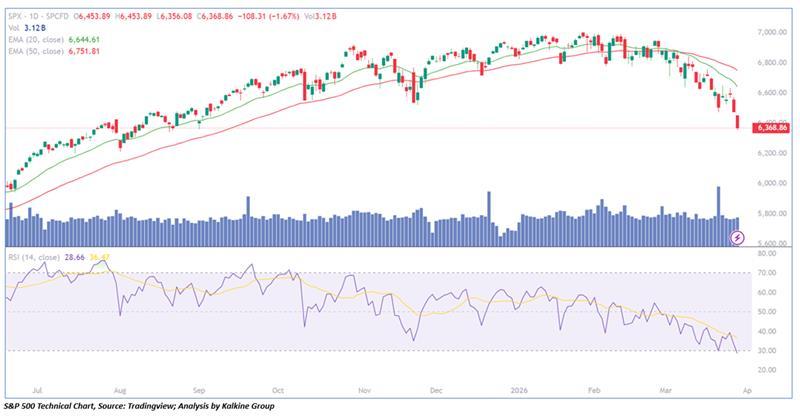
Stocks declined sharply on Friday, extending the significant losses from the previous session. The major indices moved lower early in the day and continued to weaken as trading progressed. The S&P 500 dropped 108.31 points, or 1.67%, to finish at 6,368.86. From a technical perspective, the index encountered resistance at key levels and gradually trended downward, signaling the possibility of further near-term weakness. That said, a short-term relief rally could emerge in today’s session. The formation of lower highs since late February points to a developing corrective phase, while the recent bounce near the 6,300 level suggests initial signs of support, though not a confirmed reversal. Additionally, the 21-day and 50-day exponential moving averages (EMAs) are sloping downward, indicating weakening momentum and acting as resistance zones. The 14-period RSI is in oversold territory, which may support a near-term upward move. Key levels to watch include support at 6,520 and resistance around 6,590.


 Jun 05, 2026


 Please wait processing your request...