
 AU
AU
 UK
UK
 CA
CA
 NZ
NZ
 IND
IND

 US
US

 Share
Share
 X (Formerly Twitter)
 Whatsapp
 Facebook
 LinkedIn
 Telegram
 Email This Article
 Copy Link
 Summarize with AI
 Chat GPT
 Perplexity
Index Update
US equity markets ended on a mixed note but remained close to record levels, with the S&P 500 and Nasdaq 100 advancing by 0.3% and 0.9%, respectively, supported by strong corporate earnings and easing oil prices. In contrast, the Dow Jones Industrial Average declined 0.2% due to weakness in defensive sectors. Apple gained 3.4% following robust earnings driven by strong iPhone demand and growth in China. Oracle surged nearly 7%, while Meta stabilized as investors evaluated the durability of AI-led spending amid mixed results from hyperscalers. Energy giants ExxonMobil and Chevron reported better-than-expected profits, though their stock performance remained subdued due to reduced oil price concerns after Iran proposed a potential agreement with the US. Overall, continued investment in artificial intelligence remained a key driver supporting economic growth, offsetting signs of moderating consumer demand.
Market Movers
Among individual stocks, AIOS Tech Inc. led the gains with a sharp rise of 136.05%, followed by Cue Biopharma, Inc., which surged 106.38%. On the downside, Cel-Sci Corporation declined by 25.73%, while Summit Therapeutics Inc. dropped 24.91%, making them the session’s top laggards.
Commodities Update
Crude oil prices rallied significantly, with Brent and WTI futures climbing over 3%. Brent reached approximately $112.3 per barrel, marking a four-year high, while WTI moved above $105, driven by escalating geopolitical tensions in the Middle East. Reports surrounding a potential missile strike on a US warship—later denied—along with Iran’s IRGC Navy claiming control over critical sections of the Strait of Hormuz, heightened concerns over global supply disruptions and shipping security. Additional support came from statements regarding efforts to release stranded cargo vessels, while OPEC+’s modest production increase of 188,000 barrels per day failed to alleviate supply concerns amid the evolving conflict.
Gold and silver prices moved lower, with gold declining to around $4,540 per ounce—its lowest level since late March—and silver falling more than 2% to $73 per ounce. Rising geopolitical tensions and surging oil prices increased inflation expectations, putting pressure on non-yielding assets. Although central banks continued to accumulate gold in the first quarter, both metals have experienced notable declines since the onset of the conflict, with gold down approximately 13% and silver falling around 20%.
Macro Updates
Dollar Strengthens on Safe-Haven Demand and Policy Outlook
The US dollar index rebounded to 98.4, recovering from recent lows as geopolitical tensions and rising oil prices supported demand for the currency. Market participants are closely monitoring upcoming Federal Reserve commentary and key economic indicators, particularly the April jobs report, which is expected to show a slowdown in job creation to around 60,000 from 178,000 in March. Expectations suggest the Fed will likely keep interest rates unchanged for most of the year, with only a limited probability of a rate hike in December. Meanwhile, the US Treasury is anticipated to maintain its quarterly borrowing target at $125 billion, while traders remain watchful of potential intervention by Japanese authorities to stabilize the yen.
US-EU Trade Frictions Intensify
Trade tensions between the US and the European Union escalated after President Donald Trump proposed increasing tariffs on EU automobiles to 25% from 15%, citing alleged non-compliance with existing agreements. The European Commission rejected these claims and warned of possible retaliatory measures, raising concerns over renewed disruptions in global trade relations and increased uncertainty for the automotive sector.
Bonds Commentary
The yield on the US 10-year Treasury rose to approximately 4.41%, nearing a four-week high, as rising oil prices and geopolitical risks fueled inflation concerns. Investors remain focused on upcoming Treasury borrowing plans, Federal Reserve signals, and economic data releases, particularly the labor market report. Market expectations largely indicate a stable interest rate environment, with only a slight chance of tightening later in the year.
Futures Update
US equity futures declined modestly, with contracts linked to the S&P 500, Dow, and Nasdaq 100 falling up to 0.4% as heightened geopolitical tensions and rising energy prices dampened risk sentiment. Uncertainty surrounding reported incidents in the Strait of Hormuz added to market caution. Technology stocks, including Nvidia, Microsoft, and Tesla, traded lower in pre-market activity, while financials such as Visa, JPMorgan, and Goldman Sachs also weakened amid rising yields. In contrast, Palantir gained around 3% ahead of its earnings announcement.
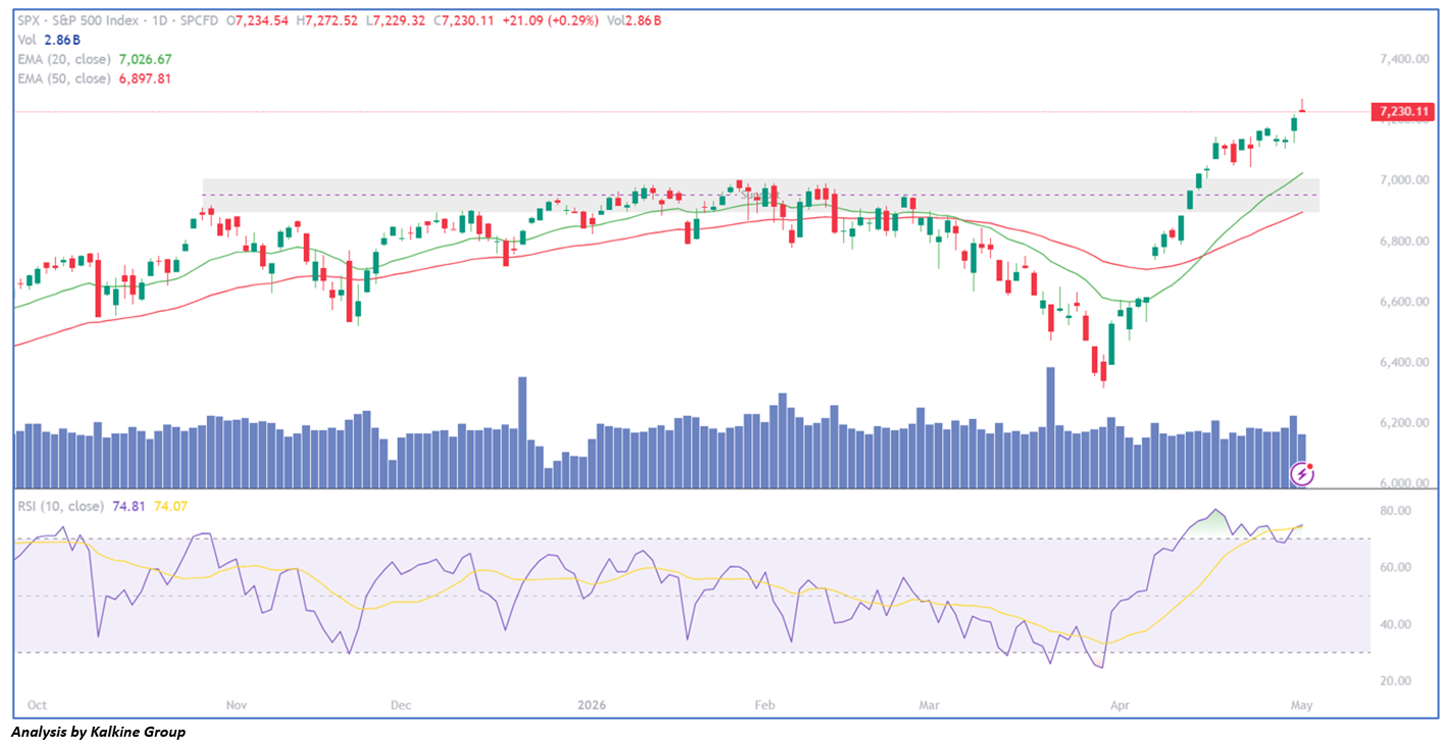
After showing a strong move to the upside early in the session, stocks gave back ground over the course of the trading day on Friday. The major averages pulled back well off their highs of the session, with the Dow sliding into negative territory. The major averages eventually ended the day mixed. The S&P 500 rose 21.09 points, or 0.29%, to settle at 7230.11. From a technical perspective, S&P 500 is showing a strong bullish continuation, with price sustaining above the 7,200 level after a sharp upward move, indicating persistent buying interest; the index is trading well above its 20-day (~7,005) and 50-day (~6,884) moving averages, reinforcing a positive trend structure, while the recent breakout above the prior resistance zone near 6,950–7,000 now acts as immediate support, suggesting a classic breakout-and-hold pattern; however, with RSI around 73, the index is entering overbought territory, which could lead to minor intraday pullbacks or sideways consolidation, but unless price slips back below the breakout zone, the overall bias remains firmly bullish with potential for further upside extension.


 Jun 05, 2026


 Please wait processing your request...