
 AU
AU
 UK
UK
 CA
CA
 NZ
NZ
 IND
IND

 US
US

 Share
Share
 X (Formerly Twitter)
 Whatsapp
 Facebook
 LinkedIn
 Telegram
 Email This Article
 Copy Link
 Summarize with AI
 Chat GPT
 Perplexity
Index Update: U.S. equities were mixed on Tuesday, with the Dow slightly lower while the S&P 500 and Nasdaq posted modest gains, as escalating tensions around Iran and a deadline to reopen the Strait of Hormuz kept investors cautious. Heightened geopolitical risks, including warnings of potential large-scale conflict and U.S. strikes, supported oil prices and weighed on sentiment. Stock-specific moves were mixed, with Broadcom rising on AI-related deals and Apple declining on product delay concerns, while broader market gains remained limited amid uncertainty despite stable consumer credit data.
Market Movers: On Tuesday, the top gainers were Corvex, Inc. (+59.31%) and LanzaTech Global, Inc. (52.51%). On the contrary, SMX (Security Matters) Public Limited Co. (-37.31%) and Focus Universal Inc. (-34.23%) declined the most the same day.
Commodities Update: WTI and Brent crude futures declined sharply by over 15% on Wednesday, falling below USD 95 and toward USD 90 per barrel, respectively, after the U.S. delayed potential strikes on Iran and signaled progress toward a temporary ceasefire. The proposed two-week truce, contingent on Iran reopening the Strait of Hormuz, alongside a reported negotiation framework, eased concerns over supply disruptions through the critical route that handles around 20% of global oil flows. The de-escalation reduced fears of an energy-driven inflation spike and broader economic slowdown, leading to a swift correction in oil prices. Gold and silver prices rose sharply on Wednesday, with gold gaining nearly 2% to around USD 4,790 per ounce and silver surging over 5% to about USD 76.70 per ounce, as a temporary ceasefire between the U.S. and Iran eased fears of energy-driven inflation. The agreement, which includes a negotiation framework and reopening of the Strait of Hormuz, led to a decline in energy prices and prompted investors to revise interest rate expectations, with the Federal Reserve now likely to hold rates steady. Despite the rally, both metals remain lower since the onset of the conflict, reflecting the broader impact of earlier high interest rate expectations on non-yielding assets.
Macro Updates: Mortgage Rates Ease but Housing Demand Remains Weak
The average U.S. 30-year fixed mortgage rate declined to 6.51% for the week ending April 3, 2026, marking its first drop in over a month as Treasury yields fell amid rising concerns over the economic impact of Middle East tensions. Despite lower rates, mortgage activity continued to weaken, with total applications falling 0.8% and extending a sharp multi-week decline, led by a 2.8% drop in refinancing demand. Purchase applications showed modest resilience with a slight weekly increase, though they remained lower on a year-on-year basis, reflecting subdued consumer sentiment and heightened uncertainty despite easing rate pressures.
Dollar Weakens on Ceasefire Hopes and Cooling Inflation Concerns
The U.S. dollar index fell below 99 to a four-week low as easing geopolitical tensions following a proposed U.S.-Iran ceasefire reduced demand for safe-haven assets. The delay in potential strikes and progress toward reopening the Strait of Hormuz led to a sharp decline in oil prices, alleviating near-term inflation concerns. The dollar weakened broadly, with notable declines against the Australian dollar and British pound, while investors turned their focus to upcoming U.S. CPI data for further clarity on inflation trends.
Bonds Commentary: U.S. 10-year Treasury yields declined to around 4.25%, a near three-week low, as easing geopolitical tensions following a conditional U.S.-Iran ceasefire reduced concerns over energy-driven inflation. The drop in yields was supported by a sharp fall in energy prices and expectations of lower borrowing costs, despite mixed economic signals including rising consumer inflation expectations and higher transportation costs. Investors now await upcoming CPI data for clearer direction on inflation trends.
Futures Update: U.S. stock index futures surged sharply on Wednesday as optimism over a potential ceasefire between the U.S. and Iran boosted market sentiment. A significant decline in oil prices, following a delay in planned U.S. strikes, eased inflation concerns and strengthened expectations of possible Federal Reserve rate cuts. Lower Treasury yields further supported equities, with S&P 500, Nasdaq 100, and Dow Jones futures rising strongly in early trading.
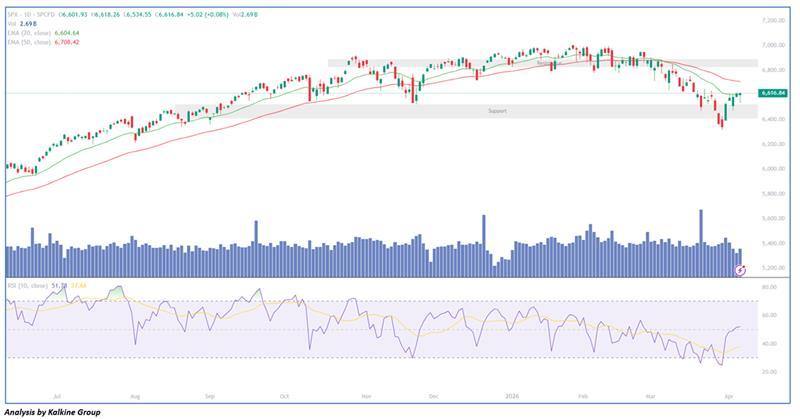
After facing early pressure, stocks recovered through Tuesday’s session, with major indices rebounding from their intraday lows to finish narrowly mixed. The S&P 500 found support at key levels and closed near the day’s high, gaining 5.02 points (0.08%) to settle at 6,616.84. News of a US–Iran ceasefire is influencing pre-market sentiment, with major indices poised for a strong start. If the index manages to reclaim its 50-period EMA on a closing basis, it could signal a near-term reversal and potentially drive further upside. Immediate resistance near 6,800 and strong support around 6,575.


 Jun 05, 2026

 Please wait processing your request...