
 AU
AU
 UK
UK
 CA
CA
 NZ
NZ
 IND
IND

 US
US

 Share
Share
 X (Formerly Twitter)
 Whatsapp
 Facebook
 LinkedIn
 Telegram
 Email This Article
 Copy Link
 Summarize with AI
 Chat GPT
 Perplexity
Image Source : Krish Capital Pty Ltd
Index Update: U.S. stock futures were mostly flat as investors weighed concerns over the nation’s fiscal outlook following the House’s narrow approval of President Trump’s tax bill, which is projected to increase the deficit by $3 billion and raise the debt ceiling by $4 trillion. Attention now turns to the Senate vote and upcoming S&P Global PMI data for insights into May’s business activity. In premarket trading, most major tech stocks were little changed, with Nvidia, Amazon, Meta, and Alphabet posting modest gains.
Market Movers: On Wednesday, the top gainers were GCL Global Holdings Ltd (+24.07%), followed by Arq, Inc. (+12.23%). On the contrary Cipher Mining Inc (-8.47%) and New Fortress Energy Inc (-8.17%) declined the most the same day.
Commodities Update: Crude oil prices fell to two-week lows amid concerns over rising supply and weakening market sentiment. WTI dropped toward $60 per barrel and Brent slipped below $64 after reports that OPEC+ may increase production by 411,000 barrels per day in July. This potential boost comes on top of an unexpected rise in U.S. crude inventories and a broader financial market sell-off driven by worries over the expanding U.S. deficit. Investor attention also turned to upcoming U.S.-Iran nuclear talks, which eased fears of Middle East supply disruptions despite recent tensions.Gold prices declined nearly 1% to around $3,290 per ounce, ending a three-day rally as a stronger U.S. dollar and profit-taking weighed on the market. While the dollar's strength reduced gold's appeal, concerns over U.S. fiscal health remain a supportive factor. Moody’s downgraded the U.S. credit rating due to its $36 trillion debt, and Trump’s advancing tax-cut bill has raised fears of further deficit spending. Meanwhile, China’s gold imports surged 73% in April, driven by strong demand and increased quotas amid ongoing trade tensions with the U.S.
Macro Update: The U.S. dollar index edged up to 99.7, ending a three-day losing streak but remaining near two-week lows as fiscal concerns persisted. Investor sentiment was cautious after the House passed President Trump’s tax bill, expected to widen the deficit by $3 billion, and following Moody’s downgrade of the U.S. credit rating due to rising debt. Ongoing trade tensions and lack of progress in negotiations also dampened confidence, leading to increased risk aversion. Meanwhile, Japan’s finance minister confirmed no foreign exchange discussions occurred during the G7 summit.
Futures Update: U.S. stock index futures traded in a muted fashion, stabilizing after a sharp market selloff driven by concerns over rising U.S. debt levels. The Dow Jones Futures dipped slightly, while the S&P 500 and Nasdaq 100 Futures posted modest gains. The previous market decline was triggered by a surge in U.S. Treasury yields, fueled by worries that a tax bill proposed by President Donald Trump could significantly increase the national debt. Additionally, weak demand for a 20-year Treasury bond auction contributed to the rise in yields.
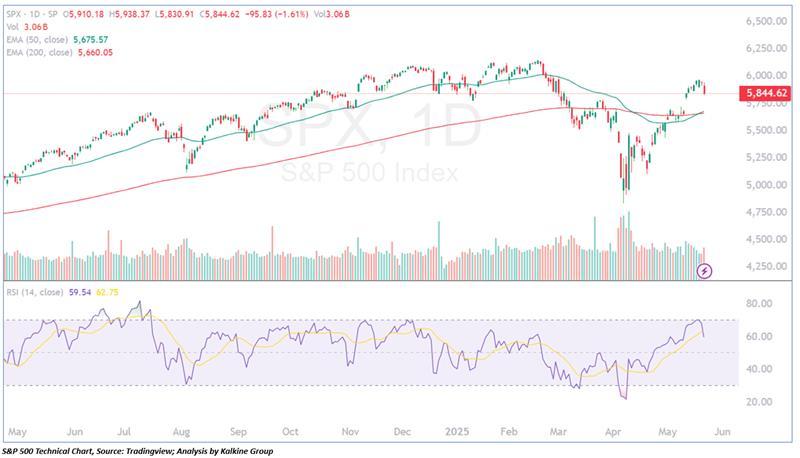
After a moderate pullback earlier in the session, stocks underwent a more pronounced decline during Wednesday's trading. The S&P 500 fell by 9.83 points, or 1.61%, closing at 5,844.62. Technical analysis shows that the current price encountered resistance at a confluence zone and continued to drift lower, indicating a potential period of short-term consolidation with a bearish bias, as previously highlighted. Nonetheless, the golden cross of key moving averages suggests a potential shift toward a more bullish trend, which could serve as a support level in the near future. Support is anticipated around 5,755, with resistance near 5,944.


 Jun 05, 2026




 Please wait processing your request...