
 AU
AU
 UK
UK
 CA
CA
 NZ
NZ
 IND
IND

 US
US

 Share
Share
 X (Formerly Twitter)
 Whatsapp
 Facebook
 LinkedIn
 Telegram
 Email This Article
 Copy Link
 Summarize with AI
 Chat GPT
 Perplexity
Image Source : Krish Capital Pty Ltd
Index Update
US stock futures rose between 0.7% and 1%, rebounding from the previous session’s sharp losses, supported by strong bank earnings. JPMorgan reported record Q1 revenues, while BlackRock, Wells Fargo, and BNY Mellon also exceeded profit expectations. Despite the bounce, bond markets continued to decline and other sectors lagged, as concerns about economic contraction persisted amid escalating US-China trade tensions. China raised tariffs on US goods to 125% after the US hiked its own to 145%. Uncertainty over future US economic policy remains high, though major indices still posted weekly gains of 3% to 5% following a historic rally on Wednesday.
Market Movers
On Thursday, the top gainers were Newmont Mining (+4.34%), followed by MarketAxess (+3.44%). On the contrary Charles River Laboratories (-28.85%) and CarMax (-16.51%) declined the most the same day.
Commodities Update
WTI and Brent crude oil futures both fell sharply this week—over 3% and 3.5% respectively—extending their declines to the lowest levels since April 2021. The drop was driven by escalating US-China trade tensions, with China raising tariffs on US goods to 125% and the US confirming total tariffs on Chinese imports at 145%. These tensions have raised fears of weakening global demand. The US Energy Information Administration revised down its global oil demand forecasts, while OPEC+ unexpectedly accelerated its output increase, sparking concerns of a supply glut.
Meanwhile, gold surged toward a record high of $3,200 per ounce, buoyed by a weaker US dollar and increased demand for safe-haven assets amid the trade war. The trade conflict now affects nearly $700 billion in annual trade. Expectations for Federal Reserve rate cuts, following signs of disinflation, also supported gold prices.
Macro Update
The U.S. dollar index fell over 1% to 99.2, hitting its lowest level in nearly three years, as investors pulled back from U.S. assets amid escalating trade tensions and rising recession fears. China raised tariffs on U.S. goods to 125% in retaliation for Washington’s 145% tariff hike. Additional U.S. tariffs on global imports remain in place, adding to economic uncertainty. Although a temporary 90-day trade truce offered brief optimism, the dollar weakened notably against major currencies—especially the euro, yen, and Swiss franc—posting a 2% weekly decline, its worst since November 2022.
Futures Update
U.S. stock index futures rose in volatile trading, rebounding from earlier losses as investors processed escalating trade tensions between the U.S. and China. Major indices, including the Dow, S&P 500, and Nasdaq, posted gains between 0.6% and 1%. This came after a sharp decline in the previous session, where the S&P 500 fell 3.5%, the Dow dropped 2.5%, and the Nasdaq slid 4.3%, following a temporary U.S. tariff reprieve. Despite recent volatility, all three indices were on track for their first weekly gain in three weeks, up between 3% and 5.2%, largely due to a strong rally earlier in the week. Investor sentiment remains fragile as the U.S. raised tariffs on Chinese imports to 145%, and China retaliated with a 125% tariff on U.S. goods, fueling concerns over global economic fallout.
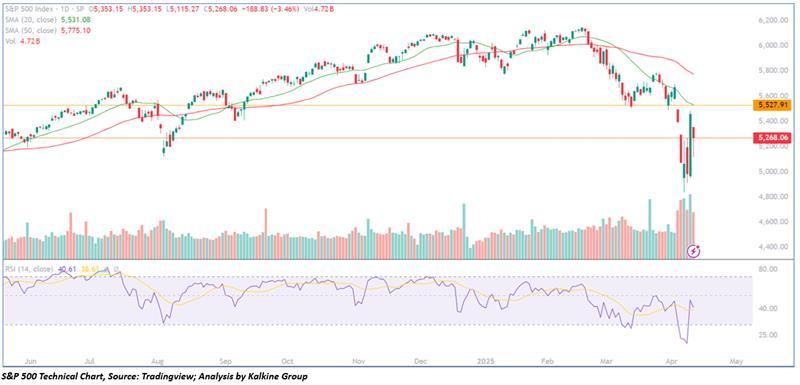
Wall Street's turbulent journey, influenced by tariff policies, persisted following a historic rally. Anxiety returned as volatility increased and technology stocks lost ground, with the Trump administration upholding its 10% global tariff. Although the major indices suffered significant losses, they remain considerably higher than their recent lows. The S&P 500 index fell by 188.83 points (3.46%), closing at 5,268.06. The index found support at key levels and continues on an upward trajectory, suggesting the potential for short-term gains, with support at approximately 5,268 and resistance at 5,527. Additionally, the 14-period RSI has recovered from oversold territory and may keep rising in the near term.

 Jun 05, 2026
 Please wait processing your request...