
 AU
AU
 UK
UK
 CA
CA
 NZ
NZ
 IND
IND

 US
US

 Share
Share
 X (Formerly Twitter)
 Whatsapp
 Facebook
 LinkedIn
 Telegram
 Email This Article
 Copy Link
 Summarize with AI
 Chat GPT
 Perplexity
Index Update: U.S. equities rallied on Monday, with the S&P 500 and Dow Jones rising 1.2% and the Nasdaq gaining 1.5%, as easing Middle East tensions boosted risk sentiment. A temporary pause in U.S. military action against Iran reduced fears of a broader energy conflict, leading to a sharp decline in oil prices and supporting sectors such as airlines, industrials, and financials. Technology stocks also rebounded, while the overall market reacted positively to signals of a potential diplomatic approach aimed at stabilizing global trade conditions.
Market Movers: On Monday, the top gainers were PTL LTD (+87.59%) and bioAffinity Technologies, Inc. (73.26%). On the contrary, Ambitions Enterprise Management Co. L.L.C. (-50.72%) and Swarmer, Inc. (-28.19%) declined the most the same day.
Commodities Update: Crude oil prices rebounded modestly on Tuesday, with WTI trading near USD 91 per barrel and Brent around USD 102, recovering part of the sharp declines seen in the previous session amid continued market volatility. The uptick was driven by escalating geopolitical tensions in the Middle East, as Saudi Arabia and the UAE adopted a firmer stance against Iran following regional attacks, raising concerns over potential military escalation and broader Gulf involvement. Meanwhile, Iran indicated it would not restore normal conditions in the Strait of Hormuz and ruled out negotiations with the U.S., although ongoing diplomatic discussions among regional ministers in Riyadh suggest efforts to contain the situation. Gold and silver prices remained volatile on Tuesday, with gold holding above USD 4,400 per ounce and silver trading above USD 69, as heightened Middle East tensions and uncertainty around potential negotiations continued to drive market sentiment. Iran denied engaging in talks with the U.S. while escalating attacks, alongside ongoing Israeli strikes, sustaining geopolitical risk. Although both metals rebounded sharply in the previous session after a delay in planned U.S. strikes, uncertainty around the Strait of Hormuz and persistent inflation concerns—amid rising energy prices and expectations of further rate hikes—have kept pressure on prices, with gold and silver still significantly below their March peaks.
Macro Updates: Dollar Rebounds Amid Renewed Geopolitical Uncertainty and Inflation Risks
The dollar index edged higher toward 99.5 on Tuesday, recovering from prior losses as Iran denied negotiations with the U.S. and escalated attacks, while ongoing Israeli strikes kept tensions elevated. Earlier weakness followed a temporary pause in U.S. military action, but persistent uncertainty around the Strait of Hormuz and regional energy supply has revived inflation concerns and the potential for further rate hikes. Investors are now closely watching upcoming U.S. manufacturing data for insights into economic resilience amid heightened geopolitical risks.
Construction Spending Weakens Amid Private Sector Slowdown
U.S. construction spending declined 0.3% month-over-month in January 2026 to a seasonally adjusted annual rate of USD 2.19 trillion, missing expectations of a modest increase and reversing part of December’s gains. The weakness was driven by a 0.6% drop in private construction, with residential and nonresidential segments falling 0.8% and 0.4%, respectively. In contrast, public construction rose 0.6%, supported by a strong increase in highway spending, partially offset by a slight decline in educational construction.
Bonds Commentary: U.S. 10-year Treasury yields rose back above 4.37% on Tuesday, reversing earlier declines as renewed Middle East tensions and Iran’s denial of negotiations with the U.S. heightened uncertainty. While yields had eased following a temporary pause in planned U.S. strikes, ongoing geopolitical risks and potential disruptions to energy supply have revived inflation concerns and strengthened expectations of possible rate hikes. Investors are now focused on upcoming U.S. manufacturing data for further insight into economic conditions amid elevated global risks.
Futures Update: U.S. stock futures declined on Tuesday as renewed Middle East tensions weighed on sentiment, with Iran denying negotiations and escalating attacks alongside ongoing Israeli strikes. The pullback follows a strong rally in the previous session, when major indices gained on a temporary delay in U.S. military action and hopes of diplomatic progress. Investors are now focusing on upcoming U.S. manufacturing data and key earnings reports for further market direction.
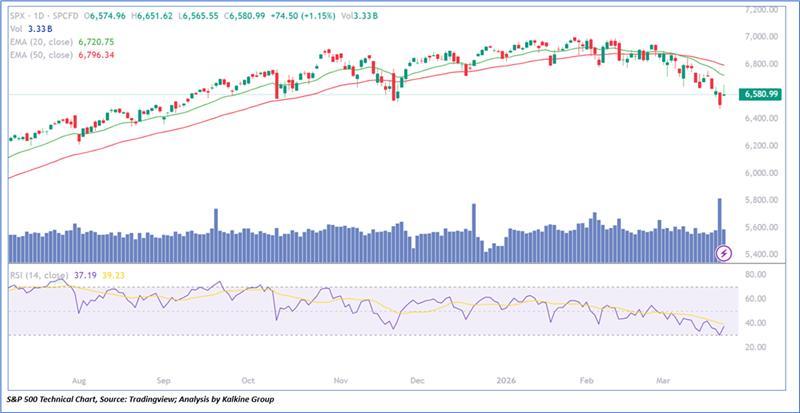
On Monday, stocks experienced a sharp rise early on, then pulled back somewhat throughout the trading session, yet overall maintained a strong performance. All the major averages recovered after hitting their lowest points in several months at the end of last Friday's trading. By the close, the indices were well below their session highs but still posted significant gains. The S&P advanced by 74.50 points (1.15%) to reach 6,580.99. From a technical perspective, the index is near a critical support level, with the RSI indicating oversold conditions, which could point to a short-term relief rally. However, the 21- and 50-day EMAs are trending downward, suggesting a change in momentum and serving as resistance levels. Important levels to monitor are support at 6,500 and resistance around 6,655.


 Jun 05, 2026


 Please wait processing your request...