
 AU
AU
 UK
UK
 CA
CA
 NZ
NZ
 IND
IND

 US
US

 Share
Share
 X (Formerly Twitter)
 Whatsapp
 Facebook
 LinkedIn
 Telegram
 Email This Article
 Copy Link
 Summarize with AI
 Chat GPT
 Perplexity
Index Update: U.S. equity markets were mixed on Monday, with the Dow rising 0.6% and the S&P 500 edging higher, while the Nasdaq 100 lagged due to weakness in technology stocks. A pullback in Treasury yields supported traditional sectors, lifting financials such as JPMorgan, American Express, and Blackstone, while chipmakers declined sharply amid concerns over demand following developments in more compute-efficient AI models. Meanwhile, rising oil prices driven by Red Sea disruptions and continued geopolitical tensions with Iran kept inflation risks elevated, although easing bond yields संकेत growing concerns over potential economic slowdown.
Market Movers: On Monday, the top gainers were PMGC Holdings Inc. (+113.17%) and Astrotech Corporation. (96.20%). On the contrary, FibroBiologics, Inc. (-42.01%) and Cyabra, Inc (-35.23%) declined the most the same day.
Commodities Update: WTI and Brent crude oil prices surged toward USD 105 and USD 108 per barrel, respectively, amid escalating geopolitical tensions in the Gulf following Iran’s attack on a Kuwaiti oil tanker near Dubai and continued disruptions to shipping routes. While reports suggest the U.S. may scale back military operations in Iran without reopening the Strait of Hormuz, uncertainty remains high due to ongoing regional conflict, troop movements, and risks of further strikes on energy infrastructure. Consequently, both oil benchmarks have rallied over 50% this month, marking their strongest gains since May 2020 as markets price in elevated supply risks and geopolitical uncertainty. Gold and silver edged higher on Tuesday, with gold nearing USD 4,600 per ounce and silver rising above USD 72, supported by easing oil prices; however, both metals remain on track for steep monthly declines, with gold down around 13% and silver over 20%, marking their worst performances in years. The weakness has been driven by an oil-led inflation shock that reinforced a more hawkish interest rate outlook, reducing the appeal of non-yielding assets. Despite ongoing geopolitical tensions, including the prolonged Middle East conflict and closure of the Strait of Hormuz, Federal Reserve Chair Jerome Powell indicated that long-term inflation expectations remain anchored, with policy well positioned to assess the economic impact of the crisis.
Macro Updates: The U.S. dollar index rose above 100, reaching its highest level since May last year, as escalating Middle East tensions and Red Sea disruptions boosted demand for the greenback as a safe-haven asset. Persistent strength in oil and fuel prices reinforced expectations of a more hawkish Federal Reserve stance, supported by a resilient labor market and rising input costs for manufacturers. Additionally, the U.S.’s position as a major energy exporter and increased global demand for dollars to finance oil and LNG imports further strengthened the currency relative to peers like the yen and Swiss franc.
Bonds Commentary: The 10-year U.S. Treasury yield declined to 4.3%, retreating from a recent high of 4.44% as rising concerns over the economic impact of the Persian Gulf conflict boosted demand for safe-haven bonds. While ongoing attacks on oil tankers have heightened fears of prolonged supply disruptions, worries that the conflict could slow global growth have tempered inflation expectations and pulled yields lower. This comes after yields had risen about 40 basis points in March due to surging energy prices and expectations of prolonged restrictive monetary policy, alongside added pressure from potential increases in U.S. defense spending and fiscal deficits.
Futures Update: U.S. stock futures moved higher on Tuesday, supported by easing geopolitical concerns after reports suggested President Donald Trump may consider exiting the Iran conflict without fully reopening the Strait of Hormuz. As of early trading, Dow futures rose 0.8%, S&P 500 futures gained 0.8%, and Nasdaq 100 futures advanced 0.7%, reflecting improved market sentiment.
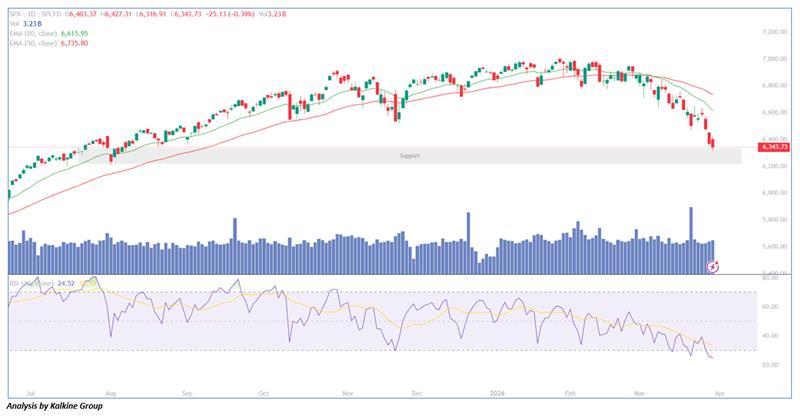
Stocks surged early in Monday’s session but lost momentum as the day progressed, with the major indices retreating from their intraday highs. Both the Nasdaq and the S&P 500 ended in negative territory, reflecting the late-session pullback. The S&P 500 declined by 25.13 points, or 0.39%, closing at 6,343.73. From a technical standpoint, the index faced resistance at key levels and gradually trended lower, suggesting potential near-term weakness. However, some consolidation may occur as prices hover near an immediate support zone. The pattern of lower highs since late February indicates a developing corrective phase. Meanwhile, the 21-day and 50-day exponential moving averages (EMAs) are trending downward, signaling weakening momentum and acting as resistance. On the other hand, the 14-period RSI has entered oversold territory, which could support a short-term bounce. Key levels to monitor include support around 6,280 and resistance near 6,500.


 Jun 05, 2026


 Please wait processing your request...