
 AU
AU
 UK
UK
 CA
CA
 NZ
NZ
 IND
IND

 US
US

 Share
Share
 X (Formerly Twitter)
 Whatsapp
 Facebook
 LinkedIn
 Telegram
 Email This Article
 Copy Link
 Summarize with AI
 Chat GPT
 Perplexity
Index Update: U.S. stocks rallied sharply on Wednesday, supported by optimism around a tentative two-week ceasefire between the U.S. and Iran and expectations of upcoming diplomatic talks. The Dow surged over 1,300 points or 2.85%, marking its strongest session since April 2025, while the S&P 500 gained 2.5% and the Nasdaq rose 2.8%. Improved risk sentiment was aided by declining oil prices and stable bond yields, despite lingering geopolitical tensions and stagflation concerns flagged in FOMC minutes. Gains were led by AI and technology stocks such as Nvidia, Meta, Tesla, AMD, and Micron, which advanced between 4% and 10%, while airline stocks also climbed, with Delta rising 6% following its earnings and improved fuel cost outlook.
Market Movers: On Wednesday, the top gainers were U Power Limited. (+331.63%) and Beasley Broadcast Group, Inc. (80.57%). On the contrary, Ridgetech, Inc. (-26.17%) and Jet.AI Inc. (-25.84%) declined the most the same day.
Commodities Update: WTI and Brent crude futures rose more than 3% to around USD 98 per barrel on Thursday, rebounding from prior losses as renewed Israeli strikes on Lebanon heightened concerns over the stability of a fragile Middle East ceasefire. Tensions escalated with reports that oil tanker traffic through the Strait of Hormuz—responsible for roughly 20% of global crude and gas flows—has been largely suspended, marking a significant disruption to global energy markets. Iran cited multiple ceasefire violations, particularly over Lebanon, while uncertainty persists despite signals from U.S. officials that the strait could begin reopening ahead of upcoming diplomatic talks between the U.S. and Iran. Gold held near USD 4,700 per ounce while silver slipped to around USD 73.5 on Thursday, as investors navigated heightened volatility driven by uncertainty over a fragile Middle East ceasefire and disruptions in the Strait of Hormuz. Reports of halted tanker traffic and alleged ceasefire breaches kept geopolitical risks elevated, though expectations of potential reopening and upcoming U.S.-Iran talks provided some offset. Despite safe-haven demand, gains in oil prices, a firmer dollar, and rising bond yields weighed on precious metals, with both gold and silver retreating after sharp prior-session rallies driven by initial ceasefire optimism.
Macro Updates: PCE Inflation Signals Persistent Price Pressures
The U.S. PCE price index is expected to rise 0.4% month over month in February 2026, slightly higher than January’s 0.3% increase, with core PCE also projected at 0.4%. On an annual basis, headline inflation is seen holding at 2.8%, while core inflation may ease marginally to 3% from 3.1%. Overall, the data suggests inflation remains elevated and above the Federal Reserve’s 2% target, indicating persistent price pressures ahead of the Iran conflict.
Dollar Rebounds Amid Geopolitical Uncertainty and Rate Outlook
The dollar index rose above 99 on Thursday, recovering from prior losses as uncertainty surrounding a fragile U.S.-Iran ceasefire and disruptions in the Strait of Hormuz supported cautious sentiment. While the dollar had weakened earlier on easing oil prices, renewed geopolitical tensions and inflation concerns lent support. Additionally, Fed minutes signaled that some policymakers see the possibility of a rate hike, though others still expect a cut. Investors now await key inflation data, including PCE and CPI, for further direction
Bonds Commentary: The 10-year U.S. Treasury yield rose to around 4.3%, rebounding from recent lows as uncertainty around a fragile U.S.-Iran ceasefire revived inflation concerns, particularly amid disruptions in the Strait of Hormuz. While yields had declined earlier on easing oil prices following the ceasefire announcement, renewed geopolitical tensions and potential supply risks pushed them higher. Additionally, Fed meeting minutes indicated a growing inclination among some policymakers toward a rate hike to manage inflation, even as others still expect a possible cut. Markets are now focused on upcoming inflation data, including PCE and CPI, for further direction.
Futures Update: U.S. stock index futures edged lower on Thursday following a strong prior session, as investors turned cautious amid uncertainty over a fragile two-week Iran ceasefire. While the Dow had posted its best performance in a year on initial signs of de-escalation, tensions persisted due to reported violations involving Israel’s continued operations in Lebanon. Markets are closely monitoring upcoming U.S.-Iran talks, with Iranian negotiators set to engage in discussions later this week. However, uncertainty remains elevated after President Donald Trump indicated U.S. forces would stay positioned near Iran until a more permanent agreement is secured. Reflecting this cautious sentiment, S&P 500 and Nasdaq 100 futures declined by 0.3% each, while Dow Jones futures fell 0.4% in premarket trading.
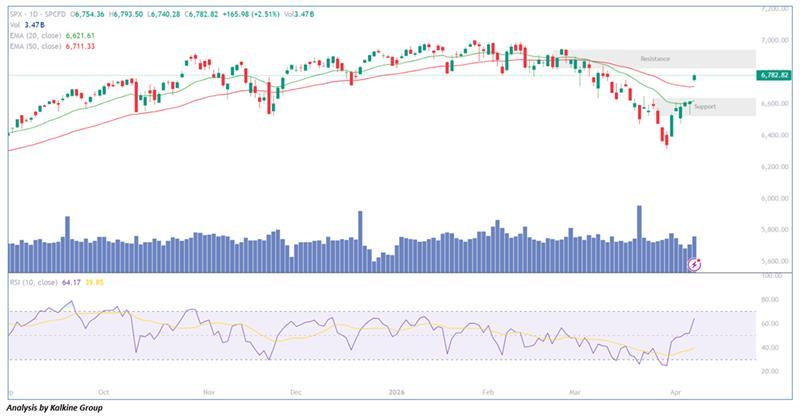
Stocks experienced a notable rally at the start of trading on Wednesday and maintained strong upward momentum throughout the session. Consequently, the major indices ended the day at their highest closing levels in approximately a month. All major averages posted significant gains after ending Tuesday’s trading with mixed results. The S&P 500 surged 165.98 points, or 2.51%, closing at 6,882.82. The index found support at key levels and gradually moved higher, supported by news of a US–Iran ceasefire. However, the market may now be entering a period of consolidation as prices are near immediate resistance levels and could potentially retrace to fill the price gap. The rising moving averages are expected to serve as support in the near term. Immediate resistance is around 6,855, with strong support near 6,600.

 Jun 05, 2026
 Please wait processing your request...