
 AU
AU
 UK
UK
 CA
CA
 NZ
NZ
 IND
IND

 US
US

 Share
Share
 X (Formerly Twitter)
 Whatsapp
 Facebook
 LinkedIn
 Telegram
 Email This Article
 Copy Link
 Summarize with AI
 Chat GPT
 Perplexity
Index Update: U.S. equities surged on Tuesday, with the S&P 500 rising 3%, the Nasdaq Composite gaining 3.5%, and the Dow Jones advancing 2.6% in its strongest session since May, driven by optimism around potential de-escalation in Middle East tensions. The rally was led by technology stocks, with Nvidia and Microsoft posting notable gains, as investors responded to signals that Iran may be open to ending hostilities. However, the rebound follows a highly volatile March in which the S&P 500 declined 5.3%, its worst monthly performance since 2022, amid energy market disruptions and geopolitical risks, with Brent crude remaining elevated at USD 118 despite some moderation in WTI prices.
Market Movers: On Tuesday, the top gainers were Apellis Pharmaceuticals, Inc. (+135.40%) and U-BX Technology Ltd. (112.63%). On the contrary, CDT Equity Inc. (-45.45%) and Battalion Oil Corporation (-28.83%) declined the most the same day.
Commodities Update: WTI and Brent crude oil futures declined in the first trading session of April, with WTI falling over 2.5% below USD 99 per barrel and Brent dropping to around USD 102 per barrel, as markets reacted to expectations of potential de-escalation in the Middle East following indications that U.S. forces could withdraw from Iran within weeks. Sentiment was further shaped by mixed signals, including continued U.S. troop deployment and Iran’s conditional openness to ending the conflict despite no formal peace talks. Geopolitical risks remained elevated after Iranian drone strikes targeted fuel infrastructure in Kuwait, while a sharp build in U.S. crude inventories of 10.263 million barrels added additional downward pressure on prices after the strong rally seen in March. Gold prices edged higher to around USD 4,700 per ounce amid tentative signs of de-escalation in Middle East tensions, though gains remained capped by a strong US dollar and elevated Treasury yields, which reduced safe-haven demand. Despite the uptick, gold remains significantly weaker after a sharp decline of over 13% in March and trades well below its January highs, with markets now focused on upcoming US economic data and Federal Reserve signals for rate direction. Meanwhile, silver extended its steep sell-off, falling to around USD 74 per ounce after dropping more than 20% in March and nearly 40% from peak levels, as persistent inflation concerns, disrupted energy markets, and a shift toward a more hawkish interest rate outlook continued to weigh on sentiment despite early signs of geopolitical easing.
Macro Updates: Rising Mortgage Rates Weigh on U.S. Housing Demand
The average U.S. 30-year fixed mortgage rate rose for a fourth consecutive week to 6.57% for the week ending March 27, 2026, its highest level since late August, driven by higher Treasury yields amid geopolitical tensions and elevated oil prices that have reinforced inflation expectations. The sharp increase in borrowing costs has significantly impacted housing activity, with mortgage applications declining 10.4% following a 10.5% drop in the prior week, marking the third consecutive double-digit decline. Refinancing activity was particularly affected, plunging around 17% week-on-week and nearly 40% over the month, while purchase applications fell modestly by approximately 2.5% to 3%. The sustained rise in rates and heightened economic uncertainty have weakened buyer confidence, reflecting growing pressure on the U.S. housing market.
Dollar Weakens Amid De-escalation Hopes Despite Persistent Uncertainty
The dollar index declined to 99.5 at the start of April, marking a one-week low as optimism around a potential resolution to the Middle East conflict weighed on safe-haven demand. Sentiment improved after indications that the U.S. could conclude its military campaign in Iran within weeks, although caution persisted due to continued troop deployments and the ongoing closure of the Strait of Hormuz. Despite the recent pullback, the dollar had strengthened by 2.3% in March, supported by geopolitical tensions and reduced expectations of Federal Reserve rate cuts amid rising inflation concerns driven by higher oil prices. Markets are now focused on upcoming developments, including President Trump’s address and further signals from the Federal Reserve, with policymakers maintaining that long-term inflation expectations remain anchored.
Bonds Commentary: The 10-year U.S. Treasury yield eased to 4.28%, marking a third straight decline as investors shifted focus toward potential economic slowdown risks stemming from the prolonged Middle East conflict. While the war has heightened concerns around inflation due to elevated oil prices, reassurances from Federal Reserve Chair Jerome Powell that long-term inflation expectations remain anchored have reduced the urgency for policy tightening. Despite this recent pullback, yields had risen sharply by around 39 basis points in March, reflecting earlier inflation fears driven by the surge in energy prices.
Futures Update: U.S. stock futures moved higher on Wednesday, with Dow, S&P 500, and Nasdaq 100 futures gaining around 0.5% to 0.6%, following a strong rally in the previous session. Investor sentiment improved on expectations that the U.S. may soon step back from its involvement in the escalating Iran-related conflict, reducing the risk of broader regional instability. Meanwhile, oil prices recovered modestly after earlier declines, reflecting cautious optimism around potential de-escalation in the Middle East.
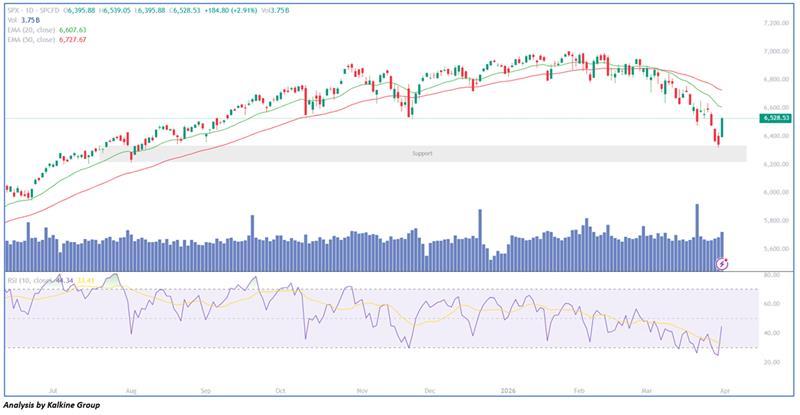
Stocks moved sharply higher early in Tuesday’s session and continued to gain strength throughout the day. The major indices posted solid advances, led by the tech-heavy Nasdaq, and finished close to their intraday highs. The S&P 500 jumped 184.80 points, or 2.91%, to close at 6,528.53. From a technical perspective, the index found support in the highlighted zone and trended upward, suggesting potential for near-term gains. However, the pattern of lower highs since late February points to an ongoing corrective phase. Additionally, the 21-day and 50-day exponential moving averages (EMAs) are sloping downward, indicating weakening momentum and acting as resistance levels. On the positive side, the 14-period RSI has moved reversing from oversold territory, which may help drive a short-term rebound. Key levels to watch are support around 6,475 and resistance near 6,700.

 Jun 05, 2026
 Please wait processing your request...