
 AU
AU
 UK
UK
 CA
CA
 NZ
NZ
 IND
IND

 US
US

 Share
Share
 X (Formerly Twitter)
 Whatsapp
 Facebook
 LinkedIn
 Telegram
 Email This Article
 Copy Link
 Summarize with AI
 Chat GPT
 Perplexity
US Equity futures rose broadly on Tuesday, with contracts on the S&P 500, Dow Jones and Nasdaq 100 each adding roughly 0.5%, as investors looked past Monday's modest retreat to focus on a resilient Earnings season and growing confidence that US-Iran tensions will stop short of full escalation.
The moves come after Wall Street closed marginally lower on Monday, when diplomatic friction over Iran negotiations sapped the momentum from a prolonged rally. The S&P 500 slipped 16.92 points, or 0.24 per cent, to 7,109.14 — ending a five-session winning run — while the Nasdaq Composite shed 64.09 points, or 0.26 per cent, to 24,404.39, breaking a 13-day advance. The Dow Jones Industrial Average was essentially unchanged, finishing at 49,442.56.
Technology leads the pre-market bounce
Amazon was the standout mover in pre-market trade, adding 3 per cent after committing a further $20bn to its Investment in Anthropic, cementing its position as the dominant cloud backer of large-scale AI infrastructure. Apple held steady following the disclosure that hardware chief John Ternus will succeed Tim Cook as chief executive in December. GE Aerospace and UnitedHealth both edged higher on the back of solid quarterly results. The broad tech complex, however, remained divided: Meta fell 2.6 per cent, Tesla 2.0 per cent, Alphabet 1.2 per cent and Broadcom 1.7 per cent. JPMorgan bucked the financial sector's mixed tone, rising 2.2 per cent. Materials, energy and financials outperformed; communications services, utilities and healthcare lagged.
Haven metals struggle as deal hopes complicate the picture
Gold remained capped below $4,800 a troy ounce, having shed more than 8 per cent since the outbreak of Middle East hostilities — a counterintuitive decline explained by the simultaneous rise in Inflation expectations and rate-hike bets that conflict-driven energy disruption has stoked. Silver traded below $79 an ounce, off roughly 15 per cent since the start of the conflict, as the same dynamic weighed on precious metals broadly.
The diplomatic backdrop offered tentative relief. Talks between Washington and Tehran resumed in Pakistan under Vice-President JD Vance after Iran reversed an earlier decision to boycott negotiations. President Trump nonetheless warned that he would not extend Tuesday's truce deadline unless Tehran made a firm commitment to a deal, leaving the Strait of Hormuz closure — and its considerable energy premium — unresolved for now.
Yields tick higher on sticky Inflation
Treasury yields edged up on Tuesday, reflecting persistent inflationary pressure from the Middle East energy shock even as de-escalation flickers through the diplomatic channel. The move reinforced market expectations of a prolonged Federal Reserve tightening cycle, bearing down on rate-sensitive sectors and tempering any broader enthusiasm.
Outlook
Futures markets appear willing to give diplomacy the benefit of the doubt — for now. The session's direction will likely hinge on any signal from Islamabad and whether the Earnings momentum that has underpinned equities through April can withstand further geopolitical uncertainty.
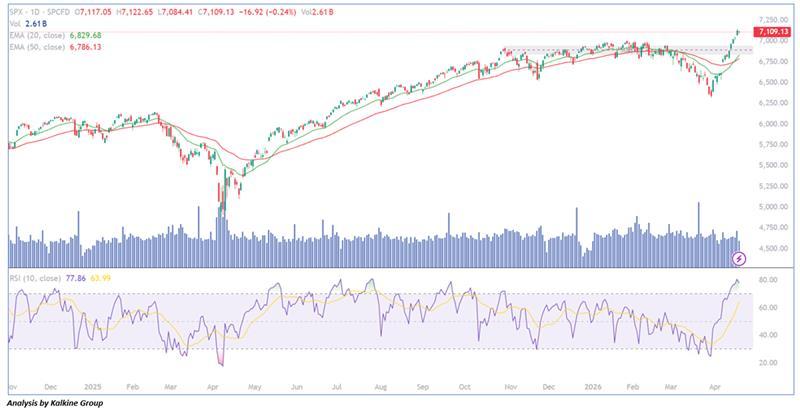
Following a significant rally last week, stocks experienced a modest decline during Monday's Trading session. All major averages moved lower, though selling pressure remained relatively modest. By the end of the day, the indexes recovered from their session lows but still closed in negative territory. The S&P 500 dropped 16.92 points (0.24%) to close at 7,109.13. From a technical standpoint, the S&P 500 is currently oversold, but there is still potential for further upward movement. However, the 14-period RSI remains in overbought territory, indicating caution and suggesting a possible pause in the rally's momentum. Immediate resistance is seen near 7,200, with support around 6,955.

 Jun 05, 2026
 Please wait processing your request...