
 AU
AU
 UK
UK
 CA
CA
 NZ
NZ
 IND
IND

 US
US

 Share
Share
 X (Formerly Twitter)
 Whatsapp
 Facebook
 LinkedIn
 Telegram
 Email This Article
 Copy Link
 Summarize with AI
 Chat GPT
 Perplexity
index Update
US Equity markets ended Thursday on a mixed note as strength in technology shares helped offset weakness across broader sectors amid persistent Inflation concerns. The S&P 500 and Nasdaq Composite gained more than 0.5%, supported by continued enthusiasm surrounding artificial intelligence-driven growth, while the Dow Jones Industrial Average declined by nearly 200 points. Investor sentiment remained cautious after producer inflation rose more than expected in April, highlighting the broader economic impact of elevated energy prices linked to tensions in the Middle East and ongoing tanker disruptions in the Persian Gulf. Despite inflationary pressures, optimism around AI-related Earnings continued to support market performance, with major hyperscaler stocks advancing following SoftBank’s strong gains tied to its private OpenAI Investment. Nvidia also rose 2.5% after CEO Jensen Huang joined US officials and technology executives during trade-related discussions with China.
Market Movers
Among the session’s strongest performers, Dreamland Limited surged 876.69%, while Robo.ai Inc gained 103.91%. On the downside, WORK Medical Technology Group LTD fell 58.56%, while Bitcoin Depot Inc. declined 43.66%, making them the weakest-performing stocks of the session.
Commodities Update
WTI Crude Oil futures traded near $100 per barrel, while Brent Crude remained around $105 per barrel as investors monitored geopolitical developments in the Middle East and discussions between US President Donald Trump and Chinese President Xi Jinping. Oil prices remained supported by concerns over tightening global supplies after reports showed that crude and fuel shipments through the Strait of Hormuz declined by nearly 6 million barrels per day during the first quarter. The International Energy Agency warned that the global oil market could remain undersupplied until October even if regional tensions ease in the coming months. Reports also indicated that Iran allowed certain Chinese vessels to transit through the Strait, while the US encouraged China to help restore shipping activity in the region. Additional support for oil prices came after Saudi Arabia informed OPEC that its oil production had fallen to the lowest level since 1990.
Gold prices remained below $4,700 per ounce after declining for two consecutive sessions, while silver climbed toward a two-month high near $88 per ounce. Investors continued to assess elevated US inflation data and the implications for Federal Reserve policy. Stronger-than-expected producer and consumer inflation readings increased expectations that the Fed may keep interest rates elevated for longer or potentially raise rates again before year-end, leading markets to fully rule out rate cuts in 2026. Higher interest rates weighed on gold due to its non-yielding nature, although geopolitical uncertainty surrounding the Iran conflict and US-China discussions continued to support safe-haven Demand. Silver outperformed other precious metals as improving industrial demand prospects, particularly from the electronics and solar industries, supported prices despite India increasing Import tariffs on gold and silver from 6% to 15%.
Macro Updates
US Dollar Gains on Hawkish Fed Expectations
The US Dollar Index hovered near 98.5 on Thursday and remained sharply higher for the week as stronger inflation data reinforced expectations that the Federal Reserve could maintain higher interest rates for an extended period or potentially implement another rate hike before the end of the year. Producer inflation accelerated at its fastest pace since 2022, while consumer inflation rose to 3.8%, the highest level since May 2023, prompting markets to fully dismiss the possibility of Fed rate cuts in 2026. Investors also focused on the Senate’s narrow confirmation of Kevin Warsh as Federal Reserve chair and the potential impact on the Central Bank’s policy independence. Market Participants additionally monitored the upcoming meeting between President Trump and President Xi, with trade discussions expected to remain the primary focus.
US Crude and Gasoline Inventories Fall Sharply
US crude oil inventories declined by 4.306 million barrels to 452.9 million barrels in the week ended May 8, exceeding market expectations for a 2.1 million barrel decline. Inventories at the Cushing, Oklahoma delivery hub also fell by 1.702 million barrels. Refinery activity improved during the week, with crude processing increasing by 370,000 barrels per day and refinery utilisation rates rising by 0.5 percentage points. Gasoline inventories dropped by 4.084 million barrels to 215.7 million barrels, surpassing expectations for a 2.85 million barrel decline and indicating solid fuel demand. Meanwhile, distillate inventories, including diesel and heating oil, recorded a modest increase of 0.190 million barrels to 102.5 million barrels, while net US crude imports declined by 318 thousand barrels per day.
Bonds Commentary
The Yield on the US 10-year Treasury note remained close to 4.46%, hovering near its highest level since June last year as stronger inflation data reinforced expectations of a prolonged higher Interest Rate environment. US wholesale inflation accelerated at its fastest pace since 2022, while consumer inflation climbed to 3.8%, its highest reading since May 2023, leading markets to completely price out the possibility of Fed rate cuts in 2026. Investors also continued to evaluate the Senate confirmation of Kevin Warsh as Federal Reserve chair and the potential implications for Monetary Policy direction amid increasing political scrutiny.
Futures Update
US equity futures moved higher on Thursday, with S&P 500 and Nasdaq futures gaining 0.3% to reach fresh record highs, while Dow futures climbed above the 50,000 mark as strong earnings and continued optimism surrounding artificial intelligence supported investor sentiment. Technology shares remained the primary driver of gains, with Cisco surging 15% in premarket trading after reporting robust earnings, issuing strong guidance, and announcing plans to reduce approximately 4,000 jobs to improve efficiency. Nvidia also advanced 2%, extending its monthly gains after the US approved exports of H200 chips to several Chinese firms during President Trump’s visit to Beijing. Investor confidence remained resilient despite elevated energy prices associated with Persian Gulf disruptions and expectations of a prolonged higher interest rate environment following stronger US retail sales data for April.
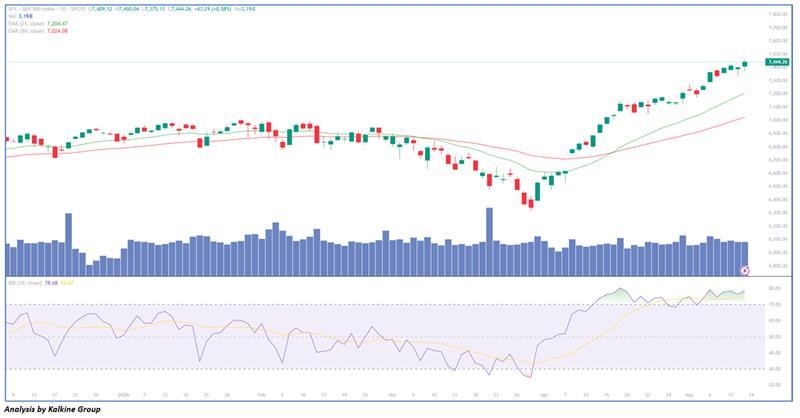
With technology stocks moving sharply higher on the day, the Nasdaq showed a strong move back to the upside during trading on Wednesday, reaching a new record closing high. The S&P 500 also climbed to a new record closing high, although the narrower Dow edged slightly lower after posting a modest gain on Tuesday. The S&P 500 (SPX) Daily Chart into May 13, 2026 shows a powerful bullish trend, closing at a fresh all-time high of 7,444.26 while trading well above its 21-day (7,204) and 50-day (7,024) EMAs, confirming strong upward momentum after a sharp V-shaped recovery from March lows near 6,400; however, with RSI(10) elevated at ~78, the market is deeply overbought and increasingly stretched, suggesting elevated risk of a near-term pause or consolidation even as momentum remains intact. Heading into May 14, futures point to a modestly higher open around 7,477, supported by strength in tech and catalysts like Cisco earnings and Boeing optimism tied to the Trump–Xi narrative, but with prior session breadth weak (most stocks declining despite index gains), the setup reflects a fragile rally where continuation is possible yet chasing new longs carries higher risk given extended price action and persistent overbought conditions.


 Jun 05, 2026




 Please wait processing your request...