
 CA
 NZ
 UK
 AU
 IND

 US

 Share
 X (Formerly Twitter)
 Whatsapp
 Facebook
 LinkedIn
 Telegram
 Email This Article
 Copy Link
 Summarize with AI
 Chat GPT
 Perplexity
Key Highlights
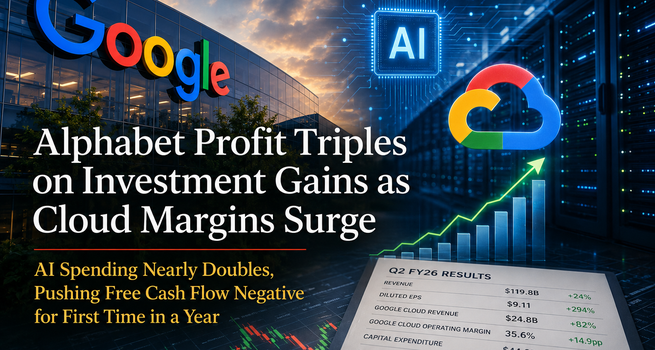
- Alphabet reported revenue of $119.8 billion, up 24% year-on-year, extending its streak of double-digit quarterly growth.
- Diluted EPS surged 294% to $9.11, largely because of a one-time gain on equity investments rather than operating performance.
- Google Cloud delivered an 82% increase in revenue, while operating margins expanded from 20.7% to 35.6%.
- Google Services continued to finance Alphabet's AI ambitions, generating nearly $40 billion in operating profit.
- Capital expenditure almost doubled to $44.9 billion, resulting in negative quarterly free cash flow for the first time in four quarters.
- Alphabet raised approximately $74 billion through equity and debt markets to support its accelerated AI infrastructure build-out.
Technology companies often promise that today's investment will become tomorrow's competitive advantage. Alphabet Inc. (NASDAQ: GOOGL) has decided that waiting is no longer an option.
Its second-quarter fiscal 2026 results present a company willing to sacrifice near-term cash generation in pursuit of long-term dominance in artificial intelligence. Revenue continues to expand at an enviable pace, Google Cloud has evolved from an ambitious experiment into a highly profitable business, and the balance sheet remains among the strongest in corporate America. Yet beneath the headline numbers lies a more consequential story: Alphabet is fundamentally changing how it finances growth.
The quarter was impressive. Whether it was exceptional is another question.
Revenue increased 24% year-on-year to $119.8 billion, while operating income climbed 30% to $40.8 billion, lifting operating margins to 34%. On the surface, diluted earnings per share of $9.11, up 294%, suggest an extraordinary acceleration in profitability.
But markets, like economists, should distrust unusually large numbers until they understand where they came from.
The Earnings Explosion Was More Accounting Than Economics
The headline EPS figure deserves context before celebration.
Alphabet recorded a $99 billion gain on equity securities, a mark-to-market adjustment that dramatically inflated reported earnings. After accounting for taxes, this investment gain contributed roughly $77 billion to net income, adding approximately $6.26 to diluted earnings per share.
Strip away this accounting windfall and the picture becomes rather more conventional.
Underlying earnings growth appears broadly consistent with the company's operating performance. Revenue advanced 24%, operating profit rose 30%, and operating margins improved modestly. These are excellent results by the standards of large-cap technology firms, but they are far removed from the near-tripling implied by headline EPS.
For investors seeking to understand Alphabet's economic engine rather than its accounting outcomes, operating income remains the more meaningful measure.
Google Cloud Is No Longer Merely Growing—It Is Becoming Exceptionally Profitable
The most significant development was not revenue growth but the remarkable improvement in Google Cloud's economics.
Revenue climbed 82% to $24.8 billion, continuing a period of extraordinary expansion driven by enterprise demand for AI infrastructure, machine learning platforms, and Gemini-powered software.
Growth, however, is only part of the story.
Operating margins expanded from 20.7% to 35.6%, transforming Google Cloud from a rapidly growing business into one generating meaningful economic returns.
Only a few years ago, Google's cloud division was widely viewed as an expensive attempt to challenge larger incumbents. Today it contributes $8.8 billion in quarterly operating profit—more than triple the figure reported a year earlier.
Scale has finally begun to work in Alphabet's favour.
Management noted that Gemini Enterprise is now being used by nearly 90% of Fortune 100 companies, suggesting that generative AI is becoming less an experimental technology and more an enterprise necessity.
This shift matters because margins, rather than revenue alone, ultimately determine whether massive infrastructure investments create shareholder value.
Advertising Still Pays the Bills
For all the excitement surrounding artificial intelligence, Alphabet remains fundamentally an advertising company.
Google Services—which includes Search, YouTube, Android, Chrome, Maps, Play, and hardware—generated $94.5 billion in revenue, growing 15% from a year earlier.
Search revenue increased 17%, while YouTube advertising expanded 13%, demonstrating that digital advertising remains resilient despite growing competitive pressures.
More importantly, Google Services generated $39.5 billion in operating income.
That figure comfortably exceeds Google Cloud's contribution and underlines an important reality frequently overlooked in discussions about AI: Alphabet's advertising franchise continues to finance nearly all of its technological ambitions.
The company's future may depend on artificial intelligence, but its present still depends on advertising.
Elsewhere, Other Bets—including autonomous driving business Waymo—continued to consume capital, with operating losses widening to $1.8 billion.
That remains manageable only because Google's core businesses remain extraordinarily profitable.
Cash Flow Reveals the True Cost of the AI Race
Income statements often tell investors how profitable a company appears.
Cash flow statements reveal what those profits actually cost.
Here, Alphabet's quarter looks markedly different.
Capital expenditure reached $44.9 billion, almost double the $22.4 billion invested during the same period last year. The spending reflects an unprecedented expansion of AI infrastructure, including hyperscale data centres, networking equipment and computing capacity.
Operating cash flow totalled $39.1 billion.
The arithmetic is straightforward.
Capital spending exceeded internally generated cash, leaving Alphabet with negative free cash flow of $5.9 billion for the quarter.
This is not evidence of financial weakness. It is evidence of strategic choice.
Alphabet has decided that delaying AI investment would prove more expensive than temporarily sacrificing free cash flow.
Whether that judgment proves correct will become one of the defining investment questions of this decade.
Financing Growth in a New Way
Perhaps the least discussed—but arguably most important—development is how Alphabet financed this investment surge.
Historically, the company funded expansion almost entirely through internally generated cash.
That has changed.
During the quarter, Alphabet raised roughly $74 billion through common stock issuance, mandatory convertible preferred shares, and senior unsecured debt.
Long-term debt consequently increased from $46.5 billion to $98.2 billion.
Ordinarily, investors might interpret such borrowing as a warning sign.
Yet Alphabet's balance sheet hardly resembles that of a company under financial strain. Cash, cash equivalents and marketable securities increased to $242.5 billion, providing enormous financial flexibility despite the heavier investment programme.
The company also maintained shareholder returns, declaring quarterly dividends on both common and newly issued preferred shares.
The Real Question Is No Longer Whether Alphabet Can Afford AI
Alphabet's results illustrate a broader shift taking place across the technology industry.
The debate has moved beyond whether companies should invest heavily in artificial intelligence.
That argument has effectively been settled.
Instead, investors increasingly ask whether unprecedented capital expenditure can produce returns commensurate with unprecedented spending.
Alphabet has offered perhaps the clearest answer yet.
Google Cloud's improving profitability suggests that AI demand is already becoming commercially meaningful. At the same time, negative quarterly free cash flow illustrates that even companies with extraordinary cash-generating abilities cannot fund unlimited investment without consequences.
For now, shareholders appear willing to accept lower cash generation in exchange for greater strategic positioning.
Whether that patience endures will depend less on future revenue growth than on continued evidence that AI infrastructure is becoming an increasingly profitable business rather than merely an increasingly expensive one.
Alphabet's second-quarter results therefore represent more than another strong earnings report.
They mark the moment when the economics of artificial intelligence began to matter as much as the technology itself.
Why did Alphabet's EPS increase by 294%?
Most of the increase came from a $99 billion gain on equity securities, which significantly boosted reported net income. Core operating performance grew at a much more moderate pace.
Why is Google Cloud's margin improvement important?
Operating margins expanded from 20.7% to 35.6%, indicating that Google Cloud is becoming a highly profitable business rather than simply a fast-growing one.
Why did Alphabet's free cash flow turn negative?
Capital expenditure reached $44.9 billion, exceeding operating cash flow of $39.1 billion, largely because of accelerated investment in AI infrastructure and data centres.
How did Alphabet finance its increased AI spending?
The company raised approximately $74 billion through common stock issuance, mandatory convertible preferred shares and senior unsecured debt while maintaining a substantial cash position.
What is the biggest takeaway from the quarter?
The results suggest that Alphabet's AI investments are beginning to generate meaningful profitability through Google Cloud, but they are also reshaping the company's cash flow profile and capital structure in ways investors will need to monitor closely.


 Nov 03, 2026





 Please wait processing your request...