
 CA
 NZ
 UK
 AU
 IND

 US

 Share
 X (Formerly Twitter)
 Whatsapp
 Facebook
 LinkedIn
 Telegram
 Email This Article
 Copy Link
 Summarize with AI
 Chat GPT
 Perplexity
Key Highlights
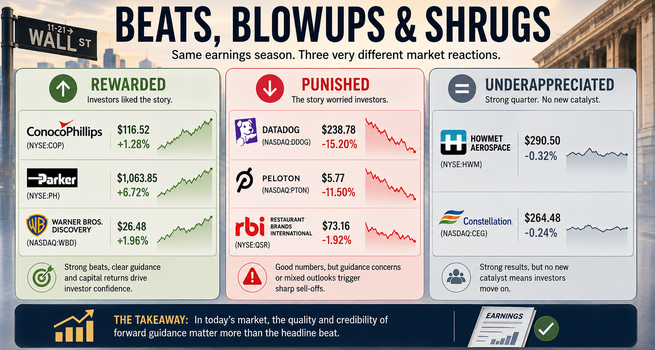
- ConocoPhillips, Parker-Hannifin and Warner Bros. Discovery are all trading higher after clean earnings beats this morning.
- Datadog is down more than 15%, on pace for its largest single-day decline on record, despite beating on revenue, earnings and raising full-year guidance.
- Peloton and Restaurant Brands also fell after beating estimates, as soft forward guidance and mixed segment detail overshadowed the headline numbers.
- Howmet Aerospace and Constellation Energy both delivered beat-and-raise quarters of their own, yet shares are essentially flat, faded from earlier intraday gains.
- The split underscores a market treating the quality and credibility of forward guidance as more decisive than the headline beat itself.
The Beats
ConocoPhillips (NYSE:COP) is trading modestly higher, up 1.28% to $116.52, after second-quarter adjusted earnings per share of $3.24 beat the $2.88 estimate and revenue of $19.52 billion topped the $18.79 billion consensus. Realized prices rose 36% year over year to $62.33 per barrel of oil equivalent, while the company doubled its quarterly share buyback pace to $2.0 billion and reaffirmed full-year guidance. The report also came with a leadership transition, chief executive Ryan Lance will retire after 14 years, handing the role to chief financial officer Andrew O'Brien effective September 1. Investors are also weighing progress toward a $5 billion non-core asset disposition target completed ahead of schedule, along with expansion moves into Iraq's Kirkuk region and a re-entry into Syria, even as easing oil price pressure from potential Strait of Hormuz developments tempers the broader energy sector backdrop.
Parker-Hannifin (NYSE:PH) surged 6.72% to $1,063.85 after delivering record fiscal fourth-quarter and full-year 2026 results that topped Wall Street expectations across the board. Fourth-quarter revenue rose 9.9% year over year to $5.88 billion against a $5.68 billion estimate, while adjusted earnings per share jumped 21% to a record $9.27, beating the $8.29 consensus by nearly 12%. Segment operating margin expanded 260 basis points, driven by strength in the company's aerospace and engineered materials businesses. Management's fiscal 2027 guidance of $34.25 to $35.25 in adjusted earnings per share also cleared the $34.05 consensus, and the company raised its long-term adjusted segment operating margin target by 300 basis points to 30% by fiscal 2031, having already surpassed its prior fiscal 2029 goal ahead of schedule.
Warner Bros. Discovery (NASDAQ:WBD) rose 1.96% to $26.48 on a surprise second-quarter profit that overshadowed a revenue miss. The company posted earnings per share of $0.06 against consensus expectations for a loss, driven by 10% constant-currency streaming revenue growth and strong HBO Max subscriber gains, even as overall revenue fell to $8.78 billion, an 5.78% miss against the $9.38 billion estimate, on weak linear and studio results. Streaming segment revenue exceeded $3 billion for the first time, with streaming adjusted EBITDA more than 60% higher year over year at a nearly 17% margin. Sentiment was further supported by the UK Competition and Markets Authority's clearance of the pending Paramount Skydance acquisition, with the deal's binding timeline still centered on a March 2027 U.S. antitrust trial with state attorneys general.
The Blowups
Datadog (NASDAQ:DDOG) is down more than 15%, on pace for its largest single-day decline on record, surpassing the roughly 17.8% drop from March 2020, despite a quarter that beat expectations across the board. Second-quarter revenue grew 36% year over year to $1.12 billion, beating the $1.08 billion consensus, non-GAAP earnings per share of $0.65 topped the $0.58 estimate, and management raised full-year guidance for both revenue and earnings per share. Investors sold anyway, reacting to concerns about decelerating growth optics and AI-related consumption pricing questions after the stock had hit a record intraday high above $292 in the prior session. One large AI-native customer showed a usage reduction heading into the third quarter, a headwind management said was fully accounted for in guidance, and excluding that customer the underlying business continued to accelerate. The selloff extended to peers including HubSpot, Snowflake and MongoDB, all of which face similar questions about the durability of consumption-based software pricing in an AI-driven usage environment.
Peloton (NASDAQ:PTON) tumbled 11.50% to $5.77 despite posting its first full fiscal year of positive net income and beating fourth-quarter estimates on both revenue and earnings per share. Revenue of $607.7 million beat the $596.6 million consensus, and adjusted earnings per share of $0.13 topped the $0.11 estimate, with full-year adjusted EBITDA up 16% and free cash flow up 17% year over year. Shares fell anyway once management guided first-quarter fiscal 2027 revenue to $545 million to $565 million, below the $568.7 million consensus, and issued a full-year outlook of $2.3 billion to $2.4 billion in revenue against roughly $2.44 billion expected. The soft guidance reinforced concerns about continued declines in connected fitness hardware demand and a subscriber base that has yet to demonstrate a durable turnaround, even as the company's underlying profitability metrics improved.
Restaurant Brands International (NYSE:QSR) fell 1.92% to $73.06 despite an earnings beat, as investors focused on uneven detail beneath the headline numbers. Adjusted earnings per share of $1.07 topped the $1.03 estimate, though revenue of $2.58 billion came in essentially in line with consensus. Burger King's U.S. turnaround accelerated sharply, with comparable sales surging 8.5% against just 1.5% a year earlier, and international Burger King sales rose 5.4%. That strength was offset elsewhere: system-wide sales growth decelerated to 3.8% from 10.7% a year ago, Tim Hortons Canada comparable sales were roughly flat, and Popeyes U.S. same-store sales fell 5.2%. The mixed segment picture tempered enthusiasm about the breadth of the recovery, even as management reiterated its full-year operating income growth target.
The Shrugs
Howmet Aerospace (NYSE:HWM) delivered a genuine beat-and-raise second quarter, yet shares are essentially flat, down 0.32% to $290.50 after fading from premarket highs above $306. Revenue grew 24% year over year to $2.58 billion, beating the $2.48 billion estimate, and adjusted earnings per share of $1.33 topped the $1.24 consensus by more than 7%. Management raised full-year 2026 guidance to $10.05 billion in revenue and $5.27 in adjusted earnings per share, both above prior consensus, driven by broad-based strength across commercial aerospace, up 28%, defense aerospace, up 11%, gas turbines, up 38%, and commercial transportation, up 12%. The results stood in sharp contrast to peer Honeywell Aerospace, which recently cut its own 2026 forecast on supply-chain issues, yet the market's reaction amounted to little more than a shrug once the stock's earlier premarket enthusiasm faded through the morning session.
Constellation Energy (NASDAQ:CEG) posted a similar pattern, an adjusted earnings beat and raised guidance that produced almost no net move, with shares down 0.24% to $264.48 after fading from an earlier intraday gain. Adjusted operating earnings per share of $2.55 topped the $2.36 estimate by more than 8%, even as revenue of $7.58 billion missed the $7.78 billion consensus. Management raised full-year 2026 adjusted operating earnings per share guidance to $11.50 to $12.50, up from a prior $11.00 to $12.00 range, citing rising Commonwealth Edison rate base contributions and new long-term nuclear power purchase agreements, including a first-of-its-kind deal with Walmart. The company also completed its final Department of Justice-mandated divestiture tied to the Calpine acquisition. Despite the constructive detail, shares remain well below the roughly $360 median analyst price target, and today's session added little to that gap either way.
What the Divergence Signals
The eight reports split into three distinct outcomes, and the dividing line was rarely the headline beat itself, all eight companies beat or roughly matched estimates on their most closely watched metric. ConocoPhillips, Parker-Hannifin and Warner Bros. Discovery each paired their results with guidance or strategic developments that gave investors a clear, uncomplicated reason to buy. Datadog, Peloton and Restaurant Brands each beat cleanly but surfaced a specific concern, valuation and AI-pricing questions in Datadog's case, soft forward guidance in Peloton's, uneven segment detail in Restaurant Brands', that gave the market a reason to sell despite the strong headline print.
Howmet and Constellation occupy a third category worth noting on its own. Both delivered results at least as strong as the clear winners, in Howmet's case arguably stronger, yet neither produced a lasting market reaction. That pattern suggests a genuine beat and raised guidance are no longer sufficient by themselves to move a stock meaningfully when expectations were already largely priced in ahead of the print, a dynamic distinct from the active punishment seen in Datadog's case. The Datadog reaction in particular, a record-setting decline on a quarter that beat every metric and raised guidance, is the clearest signal yet that valuation and forward growth durability, not the quarter just reported, are now driving price action across richly valued software and technology names.
Conclusion
Today's session produced three beats rewarded, three beats punished, and two beats that barely moved the needle, a spread that captures just how selectively the market is now trading earnings results. ConocoPhillips, Parker-Hannifin and Warner Bros. Discovery show that a clean story still works.
Datadog's record decline despite an across-the-board beat shows that valuation and AI-related growth durability questions can override even a genuinely strong quarter. And Howmet and Constellation Energy show that sometimes strong execution alone, without a fresh catalyst, is not enough to move a stock either direction. How durable each of these reactions proves is likely to depend on whether the specific concerns raised today, guidance credibility, AI pricing sustainability, and segment-level softness, resolve favorably in the quarters ahead.
This article is for informational purposes only and does not constitute financial or investment advice. Readers should conduct their own research or consult a licensed financial advisor before making investment decisions.


 Nov 14, 2026





 Please wait processing your request...