
 AU
AU
 UK
UK
 CA
CA
 NZ
NZ
 IND
IND

 US
US

 Share
Share
 X (Formerly Twitter)
 Whatsapp
 Facebook
 LinkedIn
 Telegram
 Email This Article
 Copy Link
 Summarize with AI
 Chat GPT
 Perplexity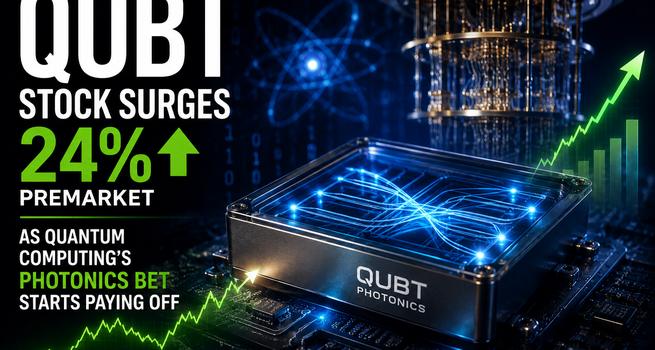
Quantum Computing Inc's QUBT stock surged nearly 24% in premarket trading after the company reported fiscal Q1 Revenue of $3.7 million, crushing analyst estimates by nearly 20%. The Luminar Semiconductor Acquisition added in-house photonics Manufacturing, while rival Rigetti's cost surge dampened its own beat. Here is what separates the two quantum plays and why the market is rewarding one far more decisively than the other.
Key Highlights
- QUBT stock surged approximately 24% in premarket trading after Q1 revenue hit $3.7 million, nearly 100 times the year-ago figure.
- Revenue beat FactSet consensus of $3.13 million by roughly 18%, a rare positive surprise in early-stage deep tech.
- The Luminar Semiconductor acquisition gives QUBT rare in-house manufacturing control over photonic chips.
- Rival Rigetti beat revenue estimates too, but tripling costs and mounting losses pushed sentiment to "bearish" on Stocktwits.
- QUBT's Partnership with POET Technologies positions it at the intersection of quantum photonics and high-speed AI optical infrastructure.
A Quarterly Result That Changes the Narrative
There are quarters that simply confirm what the market already believes, and then there are quarters that force a genuine re-rating of what a company actually is. Quantum Computing Inc's fiscal first quarter of 2026 belongs firmly in the second category.
QUBT reported revenue of $3.7 million for the quarter ended March 2026, against just $39,000 in the same period a year earlier. That is not a growth story in the conventional sense. That is a company crossing the threshold from pre-commercial prototype to genuine revenue-generating technology Business. Analysts polled by FactSet had pencilled in $3.13 million. QUBT delivered 18% above that figure, and the premarket market reaction, a surge of approximately 24%, reflected not just the beat but the credibility that a beat of this magnitude confers on the broader photonics thesis management has been advancing for the past two years.
Net loss for the quarter came in at $4.1 million, compared to a profit of nearly $17 million in the year-ago period. But investors who sold on that headline missed the context entirely. The prior-year profit was a one-time accounting gain from a Merger transaction, not Operating Income. Strip that out, and what you see in the latest quarter is a company with rapidly scaling revenue, controlled operating losses, and a newly acquired manufacturing capability that most of its peers can only dream of.
Why the Luminar Acquisition Is the Real Story
Quantum Computing completed the acquisition of Luminar Semiconductor during the quarter, and this is perhaps the most strategically significant development the company has announced in its short listed history. In-house semiconductor manufacturing is extraordinarily rare among early-stage quantum companies. Most players in this space, including several far better capitalised ones, depend entirely on external foundries and contract manufacturers for their photonic components. QUBT no longer does.
The implications compound quickly. Vertical integration in photonics means QUBT can iterate on chip design faster, control unit Economics more tightly, and offer customers Supply chain certainty that a fabless competitor simply cannot match. In defence and telecom markets, where procurement cycles are long and counterparty reliability is weighted heavily, this matters enormously.
The company's core technology revolves around Thin Film Lithium Niobate, or TFLN, a material that enables ultra-fast optical processing without the cryogenic cooling requirements that make competing quantum architectures prohibitively expensive for field deployment. QUBT's quantum hardware can operate in real-world commercial and defence environments today. That is not a claim most quantum companies can make without significant qualification
POET Technologies Partnership Adds an AI Dimension
In November 2025, QUBT and POET Technologies announced a joint development agreement to co-develop 3.2 Terabit per second optical engines. POET is itself a closely watched name in AI infrastructure circles, given growing Demand for high-bandwidth, low-latency optical interconnects as data centre architectures evolve around large language models and edge inference workloads.
The QUBT-POET collaboration places Quantum Computing squarely at the intersection of two of the most Capital-intensive infrastructure build-outs of this decade: quantum communications and AI optical networking. The NeuraWave edge-AI processing platform and the eShield-Q quantum encryption product, both built on TFLN architecture, are the commercial embodiments of this dual positioning. Defence contractors and telecom operators are the natural first customers, and both segments have demonstrated willingness to pay significant premiums for certified, domestically manufactured photonic hardware.
Rigetti's Quarter Tells a Cautionary Tale
Rigetti Computing reported its own Q1 results alongside QUBT, and the contrast is instructive. Rigetti posted revenue of $4.4 million, tripling year-on-year and beating the $4.09 million consensus. On the surface, a comparable performance. But costs also tripled to $3.02 million, and the company's accumulated Deficit and dependence on external capital remained prominent risk disclosures in its filing.
Rigetti's stock had already rallied 8.3% during Monday's regular session ahead of results, which may partially explain why the premarket reaction was a 1.5% decline rather than a rally. The Stocktwits retail community shifted sentiment on RGTI from "bullish" to "bearish" overnight, while QUBT's sentiment moved from "bullish" to "extremely bullish." Markets are efficient enough, over short intervals, to distinguish between revenue growth that comes with Operating Leverage and revenue growth that simply brings more costs along for the ride.
Valuation Context and What to Watch Next
Year to date through last close, QUBT stock was down approximately 1% and RGTI down 7.4%, meaning both stocks entered Earnings week having largely disappointed investors since January. The premarket surge in QUBT therefore represents a genuine inflection in market perception, not a continuation of existing momentum.
The variables that will determine whether this re-rating holds are straightforward. Investors will want to see Luminar integration proceed without material cost overruns, TFLN chip Yield rates improve toward commercial-scale economics, and at least one significant defence or telecom contract announced within the next two quarters. If QUBT can deliver on even two of those three, the current valuation will look conservative in retrospect.
Quantum computing has spent a decade promising commercial relevance. QUBT's Q1 2026 results suggest that for photonics-based architectures at least, the lab is finally making way for the market.
This article is for informational purposes only and does not constitute Investment advice.


 Jun 04, 2026




 Please wait processing your request...