
 CA
 NZ
 UK
 AU
 IND

 US

 Share
 X (Formerly Twitter)
 Whatsapp
 Facebook
 LinkedIn
 Telegram
 Email This Article
 Copy Link
 Summarize with AI
 Chat GPT
 Perplexity
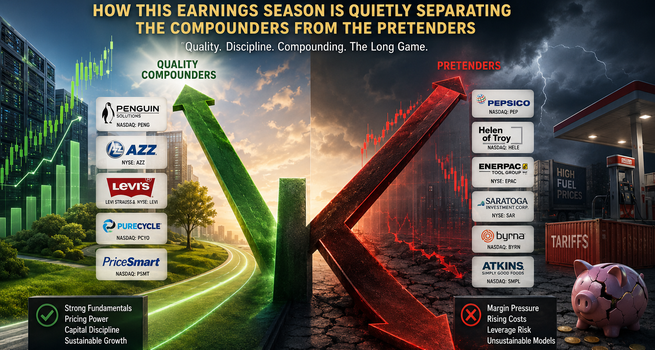
A quality-investing read on the latest earnings season — written in the analytical spirit of the "Consistent Compounders" philosophy associated with Marcellus Investment Managers, not as a statement by any individual.
Key Highlights
- Penguin Solutions (NASDAQ: PENG) delivered a 48% revenue surge and raised guidance twice in two quarters — AI memory demand is not decelerating, it is compounding.
- AZZ Inc. (NYSE: AZZ) and Levi Strauss & Co. (NYSE: LEVI) posted textbook "quality compounder" quarters: margin expansion, cash generation, and management credibility — with almost none of the drama.
- PepsiCo (NASDAQ: PEP) and Helen of Troy (NASDAQ: HELE) show a consumer economy that is growing in aggregate but fracturing underneath — volume is up, but the quality of that volume is under pressure from fuel prices, tariffs, and currency.
- Enerpac Tool Group (NYSE: EPAC) is a caution against mistaking acquisition-led growth for organic strength — leverage is climbing to 2.8x to fund the SFE Group deal even as core guidance was cut.
- Saratoga Investment Corp. (NYSE: SAR) is the clearest example this season of a yield that looks attractive on a dividend yield screen but is not being earned by underlying income — a classic value trap for income investors.
- Byrna Technologies (NASDAQ: BYRN) and Simply Good Foods (NASDAQ: SMPL)'s Atkins brand illustrate how quickly a "story stock" or a legacy brand can unravel once household penetration and marketing support fall away.
- Pure Cycle Corporation (NASDAQ: PCYO) and PriceSmart, Inc. (NASDAQ: PSMT) are reminders that in niche, capital-light, high-return businesses, boring can be beautiful — even when nobody is talking about them.
The Season That Split In Two
Every earnings season tells a story, but this one is telling two stories at once, and the gap between them is the widest it has been in years. On one side sits a small cluster of businesses compounding capital at rates that would have seemed implausible three years ago. On the other sits a much larger group of companies grinding through tariffs, currency swings, a Middle East-driven demand shock, and a consumer who is spending — but spending carefully. The investor's job this quarter is not to find "growth." Growth is everywhere in the headlines. The job is to distinguish quality growth — the kind built on pricing power, capital discipline, and repeatable unit economics — from growth that is borrowed, refunded, or one-off.
That distinction is the entire philosophy behind identifying "Consistent Compounders": businesses with high and sustainable return on capital, conservative accounting, and management teams who treat shareholder capital as if it were their own. This earnings season offers an unusually clean set of examples of both ends of that spectrum.
Exhibit A: What a Genuine Structural Tailwind Looks Like
Start with Penguin Solutions (NASDAQ: PENG). A 48% year-over-year jump in net sales to $479 million, non-GAAP EPS up 79%, and — more tellingly — a full-year guidance raise that took net sales growth from 12% to 22% and EPS from $2.15 to $2.60 at the midpoint, all inside a single reporting cycle. That is not a company beating a conservative bar. That is a company whose own forecasting models are being outpaced by real-world demand.
The detail that matters most for a quality investor is not the headline growth rate — it is the composition of that growth. AI-driven revenue is now 74% of the company's total sales and growing 104% year-on-year, with integrated memory revenue up 111%, driven by both volume and price. Pricing power alongside volume growth is the single best signal of a durable moat; it means customers are not simply buying more units at a discount, they are paying more per unit because supply cannot keep up with demand. When Penguin Solutions tells investors it expects a preliminary fiscal 2027 outlook of ~30% growth in both revenue and EPS off an already-raised base, that is a management team with genuine visibility, not promotional optimism. The one blemish — a CFO departure mid-cycle — is worth watching but is a governance footnote against a business this structurally strong.
Exhibit B: The Quiet Compounders Nobody Is Talking About
If Penguin Solutions is the loud story, AZZ Inc. (NYSE: AZZ) and Levi Strauss & Co. (NYSE: LEVI) are the quiet ones — and quiet compounders are usually where the best risk-adjusted returns hide, because the market has not yet re-rated them for consistency.
AZZ Inc. (NYSE: AZZ) beat consensus EPS estimates of $1.69 with an actual print of $1.85 — a surprise of nearly 10% — while revenue of $448.5 million beat expectations of $434.5 million. This is now six beats in the last seven quarters. Segment strength was broad: Metal Coatings sales rose 12.3% and consolidated adjusted EBITDA margin held at a healthy 22.2%, all while net leverage sat at a conservative 1.4x. Management didn't just meet the moment — they raised full-year EPS guidance to $6.75–$7.15, above the prior consensus, and lifted the dividend by 20%. That combination — a beat, a raise above consensus, a strong balance sheet, and a dividend hike — is precisely the profile a quality-focused investor screens for. It rarely makes headlines because there is no drama in it. That is exactly the point.
Levi Strauss & Co. (NYSE: LEVI) tells a similar story from the consumer discretionary side. Seventeen consecutive quarters of comparable sales growth is not a fluke — it's a demonstrated ability to keep a legacy brand culturally relevant, quarter after quarter, through fashion cycles that have killed weaker apparel names. Organic revenue grew 6%, adjusted EBIT margin expanded 70 basis points to 9%, and adjusted free cash flow jumped nearly 60% to $231 million. Crucially, growth is diversifying: women's business grew 11%, white denim surged 70%, and non-bottoms categories now contribute roughly a third of total growth. A single-category dependency is a real risk for any apparel brand; Levi Strauss & Co. (NYSE: LEVI) is visibly de-risking that dependency while still raising guidance for the second consecutive quarter. That is what disciplined execution looks like in a discretionary category everyone assumes is structurally challenged.
Exhibit C: The Consumer Is Growing, But Not Evenly
PepsiCo (NASDAQ: PEP) posted its fastest volume growth since 2022 — global food volumes up 3%, beverage volumes up 2% — which on the surface looks like a strong quarter. Dig one layer deeper and the picture is more nuanced. North America underperformed because of softness in convenience and gas channels, directly tied to elevated gasoline prices affecting footfall and conversion. International, on the other hand, is now on track to surpass $40 billion in revenue with margins expanding a full point. This is a genuinely global business where the domestic engine is stalling and the international engine is compensating — useful to know for anyone assessing PepsiCo (NASDAQ: PEP) purely on a "how's the U.S. consumer doing" thesis, because the more important answer today lies outside the U.S. Add to this an expected one-point EPS benefit from tariff refunds, and it becomes clear that a meaningful chunk of this year's earnings support is a refund, not a re-rating of the core business.
Helen of Troy (NASDAQ: HELE) shows the same pattern in miniature. Net sales grew 8.2%, ahead of expectations, but management was transparent that $4–5 million of that came from favourable order phasing tied to an earlier Prime Day — in other words, revenue pulled forward rather than newly created. Layer on $9.2 million of phase-one tariff refunds being more than offset by commodity inflation, an unfavourable yuan, and higher freight, and you get a company where the reported number looks better than the underlying trajectory. Management's own guidance — low-to-mid single-digit growth in H1, a low single-digit decline in H2 at the midpoint — is the company effectively telling investors not to extrapolate the headline beat. That kind of candour is itself a quality signal, even when the news is soft.
Simply Good Foods (NASDAQ: SMPL) rounds out the consumer picture with a cautionary internal contrast. The Quest brand within its portfolio is working — retail takeaway up 1.4%, household penetration up 120 basis points, chips up 17%, milkshakes up nearly 50%. But Atkins, in the same portfolio, saw net sales fall 24.6% on continued household penetration losses and what management candidly called "insufficient marketing support." Two brands, one holding company, two completely different trajectories — a reminder that portfolio-level revenue numbers can mask which specific franchises actually retain pricing power and consumer loyalty, and which are being allowed to decay.
Exhibit D: Where Growth Is Being Bought, Not Earned
Enerpac Tool Group (NYSE: EPAC) is this season's clearest example of the difference between organic strength and acquisition-assisted optics. Core IT&S product sales grew a modest 5% organically, services declined 8%, and even the EPS beat — $0.60 versus $0.51 a year ago — included an $0.08 tariff-recovery benefit that flatters the underlying number. Meanwhile, the company is taking on debt to fund the ~$472 million SFE Group acquisition, pushing net leverage to approximately 2.8x at close, with a stated multi-quarter path back to its 1.5x–2.5x target range. None of this makes Enerpac Tool Group (NYSE: EPAC) a bad business — the SFE deal genuinely expands the addressable market and could be accretive by fiscal 2027 — but it does mean this quarter's growth story is substantially inorganic, funded by a stretched balance sheet, against a backdrop where full-year guidance was simultaneously cut to 1–2% organic growth. Buying growth while guiding down organic growth is a pattern quality investors should always flag, not dismiss.
Exhibit E: The Yield That Isn't Being Earned
Few examples this season illustrate a yield trap as cleanly as Saratoga Investment Corp. (NYSE: SAR). Adjusted NII fell 25% year-over-year to $0.47 per share, NAV per share declined from $24.42 to $23.23, and the company still declared a $0.75 quarterly dividend — a 14% annualised yield on the current stock price. The dividend is not covered by current earnings; it's being sustained by a spillover buffer of roughly five quarters. Add to that $0.92 per share of net realised losses and unrealised depreciation this quarter alone, including a write-down of Pepper Palace to zero, and the picture is one of a portfolio under real credit stress dressed up by a headline-grabbing yield. A 14% yield should always prompt the question "yield on what, and is it sustainable" — and here, the honest answer is: not yet, and not without further NAV erosion if current trends persist.
Exhibit F: When the Story Stops Working
Byrna Technologies (NASDAQ: BYRN) is the sharpest reminder this season that momentum-driven consumer stories can unwind faster than they built. Revenue fell from $28.5 million to $16.4 million year-over-year, e-commerce sales dropped 35%, and the domestic dealer channel fell 47%. Reported gross margin collapsed to 11% after inventory write-downs and an equipment impairment tied to shutting its ammunition facility, and the company swung to a $10.1 million net loss from a $2.4 million profit a year earlier. Management's own framing — that fiscal 2026 "will not be a revenue growth year" — is refreshingly honest, but it also underscores how quickly a business built on retail momentum and website traffic can lose its footing once that traffic slows.
Exhibit G: Boring, Niche, and Still Compounding
Finally, two smaller names worth noting simply because they rarely get attention. Pure Cycle Corporation (NASDAQ: PCYO) posted $8.2 million in quarterly revenue at a 52% gross margin, reaffirmed full-year guidance, and continues to benefit from a genuinely scarce asset — water rights and land development capacity in a supply-constrained region — with lot deliveries running roughly 70% ahead year-over-year. PriceSmart, Inc. (NASDAQ: PSMT), reporting the same day as AZZ Inc. (NYSE: AZZ), carries a mixed history of only 2 beats in its last 7 quarters, but its prior quarter's 7.6% comparable sales growth and continued warehouse-club expansion into Guatemala and the Dominican Republic show a steady, capital-disciplined regional retailer — the kind of business that will never dominate a headline but can quietly compound shareholder capital for a decade.
The Takeaway
Strip away the noise and this earnings season offers a genuinely useful checklist. Ask, for every name above: is growth coming with pricing power (Penguin Solutions, NASDAQ: PENG) or without it (Enerpac Tool Group, NYSE: EPAC)? Is the beat organic or refund/phasing-assisted (AZZ Inc., NYSE: AZZ vs. Helen of Troy, NASDAQ: HELE)? Is the yield earned or borrowed from spillover (Saratoga Investment Corp., NYSE: SAR)? Is brand strength broadening or narrowing (Levi Strauss & Co., NYSE: LEVI vs. Simply Good Foods' Atkins brand, NASDAQ: SMPL)? The answers to these questions matter far more than whether a company "beat" or "missed" this quarter — because beats built on refunds, phasing, or leverage tend to reverse, while beats built on pricing power, capital discipline, and management candour tend to compound.
This analysis is written in an editorial style inspired by quality/compounding-focused investment frameworks. It reflects general commentary based on publicly reported earnings details and is not investment advice, a research report, or a statement made by any named individual or firm. Always consult a licensed financial advisor before making investment decisions.


 Nov 02, 2026





 Please wait processing your request...