
 AU
AU
 UK
UK
 CA
CA
 NZ
NZ
 IND
IND

 US
US

 Share
Share
 X (Formerly Twitter)
 Whatsapp
 Facebook
 LinkedIn
 Telegram
 Email This Article
 Copy Link
 Summarize with AI
 Chat GPT
 Perplexity
Bimergen Energy Corporation (NYSE American:BESS) added 40.49% to USD 3.47 on 13 May 2026 as relative Volume jumped to 27.86 times normal — a profile suggesting that the small-cap energy name had moved sharply into the spotlight of speculative traders.
Key Takeaways
- BESS closed the screener at USD 3.47, up 40.49% on the session.
- Volume of 1.24 million shares ran at 27.86× normal activity.
- Market Capitalisation was reported at approximately USD 24.54 million.
- Trailing twelve-month diluted EPS was -USD 1.18.
- Clean-energy and storage-themed names remain sensitive to policy, sentiment, and Capital-cycle shifts.
What Happened
Bimergen Energy Corporation (NYSE American:BESS) was among the notable gainers on 13 May 2026. The screener recorded a single-session price change of 40.49%, closing at USD 3.47, with reported volume of 1.24 million shares. Although the absolute volume figure is modest in comparison with some of the day's micro-cap leaders, the relative volume reading of 27.86 indicates that activity was running at roughly 28 times the stock's typical pace.
With a market capitalisation of approximately USD 24.54 million, BESS sits firmly within the micro-cap segment. The combination of a low absolute share price (USD 3.47) and a small market cap means that even relatively modest dollar inflows can produce sharp percentage moves — a pattern frequently observed in speculative energy-themed names.
Market Context
The clean-energy and battery-storage theme has been one of the most volatile sectors in the US Equity market over the past several years. Cycles of optimism — driven by policy announcements, technology milestones, and large project awards — have repeatedly alternated with periods of de-rating as Supply-chain bottlenecks, financing concerns, and execution issues have come to the fore.
Within this thematic landscape, smaller and less-established issuers tend to experience the most pronounced swings. Their stock prices are sensitive to broader sentiment toward the energy transition, even when company-specific catalysts are absent.
On 13 May 2026, BESS's appearance on the gainers list took place against a backdrop of other thematic small-caps performing well. The clustering of small-cap movers from various sectors suggests that risk-on sentiment was broadly distributed, with capital flowing into stories ranging from biotechnology to advanced Manufacturing.
More broadly, the macroeconomic environment for clean-energy financing has continued to evolve, with interest-rate dynamics, government policy, and corporate capital allocation all shaping the operating context for both established and emerging companies in the space.
Company Overview
Bimergen Energy Corporation is a US-listed company, under the ticker BESS, with a screener-referenced market capitalisation of approximately USD 24.54 million prior to the 13 May 2026 session. The ticker itself is suggestive of battery energy storage system (BESS) applications, although the screener does not provide a detailed Business description and this article does not extrapolate beyond the data shown.
The trailing twelve-month diluted EPS figure of -USD 1.18 indicates that the company has been operating at a loss on a trailing basis. This is not unusual for early-stage or transition-stage clean-energy companies, which typically incur significant operating and project-development costs before achieving sustained profitability.
Investors interested in BESS beyond the headline screener move should consult the company's filings, Investor relations materials, and any exchange disclosures to assess the underlying operational structure, Revenue base, and strategic positioning.
Screener Data
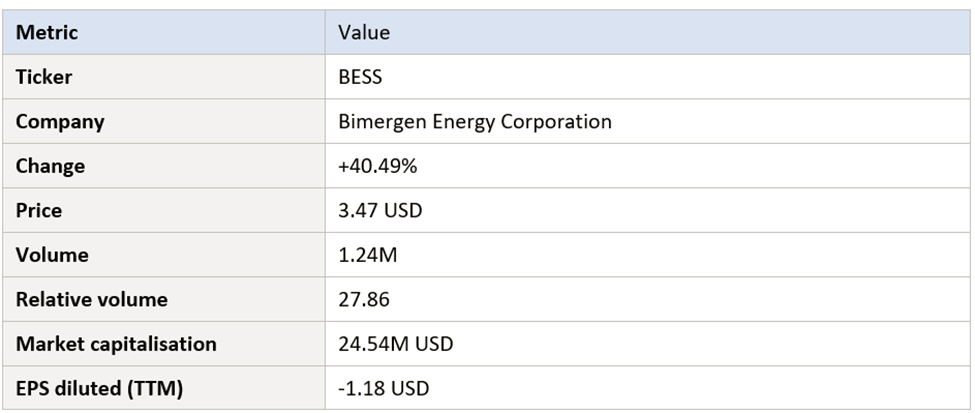
While BESS's reported volume of 1.24 million shares is smaller than many of the other names on the day's screener, the relative volume reading of 27.86 emphasises just how unusual that activity is for this particular stock. In effect, BESS saw nearly thirty times its normal trading pace in a single session.
The pairing of this relative-volume reading with a 40% price gain illustrates a recurring pattern in micro-cap energy names: when attention turns to the stock, even modest absolute flows can produce significant price impact. That same dynamic, however, can work in reverse when sentiment cools.
The trailing EPS reading of -USD 1.18 should be interpreted with care. As with many small-cap clean-energy companies, the figure reflects an evolving business that has not yet achieved sustained operating profitability, but the screener does not provide enough information to assess the trajectory of the underlying drivers.
Risks to Watch
Thematic and policy sensitivity
Clean-energy and battery-storage names are sensitive to policy frameworks, including subsidies, tax credits, and grid-modernisation initiatives. Changes in these frameworks can rapidly alter the Economics of underlying projects.
Project execution and financing
Many small-cap energy companies depend on the successful execution of long-duration projects and on access to external financing. Delays in deployment or in capital raises can pressure operations and the share price.
Reversal risk after a sharp move
A 40% single-session move on extreme relative volume can be followed by significant Volatility in subsequent sessions, particularly when no confirmed catalyst underpins the move.
Trading Patterns and Liquidity
Beyond the headline +40.49% change, the trading pattern visible provides a useful lens on how Bimergen Energy Corporation actually moved through the session. The combination of a 3.47 USD reference level, reported volume of 1.24M, and a relative volume reading of 27.86 is informative in itself. Each of these figures captures a different facet of the market's reaction: price reflects the marginal valuation, volume measures aggregate participation, and relative volume contextualises that participation against the stock's own history.
In a market cap band reported at 24.54M USD, sustained moves typically require either a meaningful change in the perceived fundamental story or a substantial shift in the composition of the stock's investor base. One-day spikes that are not anchored in confirmed catalysts can be informative about market psychology but provide limited evidence about durable value creation. Traders evaluating BESS in the days that follow will want to watch whether the elevated volume profile is sustained, whether intraday ranges narrow, and whether bid-ask spreads tighten as the session's enthusiasm normalises.
Liquidity considerations also matter. When a stock's traded volume runs at multiples of its average, the order book can briefly look very different from its usual state. In particular, market depth — the size of resting orders at each price level — can appear larger than it really is during the spike and thinner than it really is once the rush fades. For BESS, that means execution conditions encountered during the 13 May 2026 session may not be representative of typical days, and investors should plan position sizing and exit strategies accordingly.
How This Move Compares to Other Top Gainers
Placing BESS's +40.49% move in context with other names on the 13 May helps highlight what made the session distinctive. On the same day, leaderboard names ranged from deeply micro-cap issuers such as Dreamland Limited (TDIC) and Fitness Champs Holdings (FCHL) to larger small- and mid-caps like Ouster (OUST) and SELLAS Life Sciences (SLS). That breadth — both in sector and in market capitalisation — suggests the day's risk-on tone was broadly distributed rather than confined to a single theme.
Within that mixed cohort, BESS sat alongside companies from healthcare, advanced manufacturing, energy transition, and financial services. Although each of these names has its own operating story, their simultaneous appearance on the screener illustrates a pattern frequently observed in US markets: when small- and micro-cap appetite returns, capital tends to disperse across themes rather than concentrate in one. That dispersion can itself be a signal worth tracking, because it differentiates broad-based risk-on sessions from sentiment events focused on a single sector.
The relative-volume reading of 27.86 for BESS should be read against the wide range observed in the day's gainers. Some names featured relative volumes in the high 20s, 30s, and even above 70, while others showed more moderate spikes in the 2–6 range. Where a particular stock sits in that distribution offers a clue about how unusual the day's activity was for that specific name — a more meaningful comparison than focusing solely on the headline percentage gain.
Investor Outlook
For BESS, the immediate outlook centres on whether the 13 May 2026 move marks the beginning of a sustained re-rating or whether it represents a single-session burst of speculative activity. Without explicit catalysts attached to the screener entry, both scenarios remain plausible.
Investors with a longer-term thesis on battery storage and clean energy will continue to focus on fundamental indicators such as project pipelines, contract structures, capital availability, and the broader policy backdrop. None of these can be assessed solely from a screener row.
Short-term traders may keep an eye on the stock's behaviour around the levels set during the rally, the consistency of volume on follow-on sessions, and any corporate disclosures that emerge. As ever, careful position sizing and clearly defined risk parameters are particularly important in micro-cap energy names.
More broadly, BESS's appearance on the screener offers a useful illustration of how thematic enthusiasm can periodically lift small-cap energy stocks well above their recent trading ranges, even in the absence of identifiable single-company catalysts.


 Jun 05, 2026




 Please wait processing your request...