
 CA
 NZ
 UK
 AU
 IND

 US

 Share
 X (Formerly Twitter)
 Whatsapp
 Facebook
 LinkedIn
 Telegram
 Email This Article
 Copy Link
 Summarize with AI
 Chat GPT
 Perplexity

Key Highlights
• Citizens' net charge-off ratio fell to 0.37% with nonaccrual loans declining, while KeyCorp's nonperforming loans rose to 0.73% of loans from 0.62%.
• KeyCorp earned $472 million with Revenue up 6.7% to $1.96 billion; Citizens earned $587 million with revenue up 12% to $2.28 billion.
• Both banks released reserves as Credit improved, with KeyCorp's provision falling to $92 million and Citizens' to $134 million.
Credit quality has become one of the biggest swing factors for KeyCorp (NYSE:KEY) and Citizens Financial Group (NYSE:CFG) because both banks have now returned to healthy revenue growth, so the size of their Loan losses matters more than ever for profits and Shareholder returns. Their second-quarter 2026 results show two different credit paths. At Citizens, net charge-offs fell to 37 basis points of loans and nonaccrual loans declined. At KeyCorp, charge-offs stayed within guidance but nonperforming loans rose sharply from the previous quarter. How each lender handles that divergence could shape the next chapter for both S&P 500 regional banks.
Two Regional Lenders, Similar Footprint, Different Mix
Both companies are classified as Financials, Regional Banks, and both are S&P 500 constituents listed on the New York Stock Exchange. KeyCorp, based in Cleveland, Ohio, leans heavily towards commercial lending, Investment Banking and commercial payments. Citizens, headquartered in Providence, Rhode Island, runs a more balanced book.
At June 30, 2026, Citizens reported commercial loans of about $77.3 billion and retail loans of about $70.2 billion. KeyCorp's average loans were $110.1 billion in the quarter, with commercial and industrial lending driving growth. That difference matters: commercial losses tend to arrive in lumpier, borrower-specific events, while retail losses usually move more gradually with employment and household finances.
What the Second Quarter Showed
In the three months to June 30, 2026, reported on July 21, 2026, KeyCorp earned $472 million, or $0.44 per diluted share, against $387 million, or $0.35, a year earlier. Revenue rose 6.7% to $1.96 billion and net interest income rose 9.4%.
Citizens, reporting on July 16, 2026, earned $587 million, or $1.30 per share, compared with $436 million, or $0.92, in the second quarter of 2025. Revenue grew 12% year on year to $2.28 billion, and net interest income rose 14% to $1.63 billion.
Reading the Credit Numbers
A net charge-off is a loan written off as uncollectable, net of recoveries. Nonperforming or nonaccrual loans are those on which the bank has stopped recognising interest because repayment is in doubt, so they are an earlier warning sign than charge-offs.
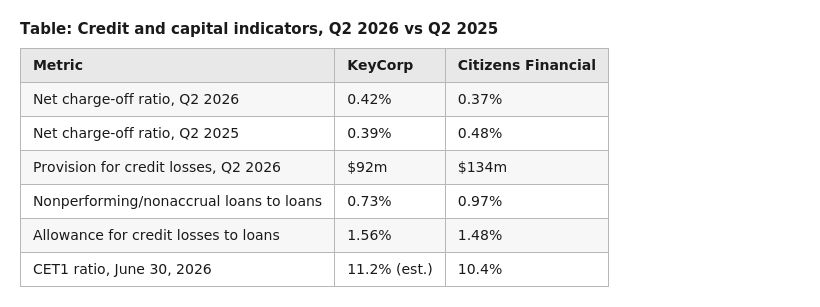
Citizens' figures point in one direction. Its charge-off ratio fell 11 basis points year on year, and nonaccrual loans dropped from $1.52 billion a year earlier to $1.44 billion. The bank described continuing favorable credit trends. Management said third-quarter charge-offs were expected to be stable to slightly lower, and that general office Commercial Real Estate balances would keep shrinking.
KeyCorp's picture is more mixed. Charge-offs rose to $115 million from $102 million a year earlier, and nonperforming loans climbed to $809 million, or 0.73% of loans, from 0.62% at the end of March. Management called the increase idiosyncratic and tied to specific borrowers with limited expected loss, while criticised loans fell to 4.9% from 5.7% a year earlier. KeyCorp also held its full-year charge-off guidance at 40 to 45 basis points.
KeyCorp's commercial real estate charge-offs were 46 basis points, with the allowance covering 109% of nonperforming commercial property loans. In other words, the bank says it has already reserved for the loans that have gone bad, which is why a jump in problem loans need not translate into an equal jump in losses.
How Credit Feeds Through to Earnings and Capital
The link from credit to shareholder value runs through the provision line. When a bank expects fewer losses, it can set aside less money, which lifts pre-tax profit directly. Citizens' provision fell 18% year on year to $134 million, while KeyCorp's dropped to $92 million from $138 million.
Both banks have also let their allowance ratios drift lower, to 1.56% at KeyCorp and 1.48% at Citizens. Releasing reserves supports earnings, but it leaves less cushion if the economy weakens. Citizens covers its nonaccrual loans 1.52 times with reserves, up from 1.45 times a year earlier.
Credit also affects buybacks. Fewer losses preserve CET1 capital, the core buffer regulators monitor. KeyCorp repurchased $341 million of shares in the quarter and Citizens $225 million, with Citizens signalling about $125 million for the third quarter.
Growth Ambitions Raise the Stakes
Both banks are leaning into loan growth. KeyCorp raised its 2026 guidance for average loan growth to 4-5% and for commercial loans to 8-10%. Its management remains confident of reaching a return on tangible common Equity above 15% by the end of 2027.
Citizens is expanding its Private Bank, which held about $17.8 billion of deposits at quarter-end and contributed $0.15 to earnings per share. It also agreed in February 2026 to acquire the Assets of Matrix Capital Markets Group, a Richmond, Virginia advisory firm, through its Citizens JMP Securities arm.
Risks to This Reading
KeyCorp's rise in nonperforming loans could prove less isolated than management expects, especially if higher-for-longer rates strain leveraged commercial borrowers. Citizens still has the higher nonaccrual ratio of the two, reflecting commercial real estate workouts, and office property values remain uncertain.
Lower allowance ratios mean both banks are more exposed if Unemployment rises. Strong net interest income also depends partly on the rate outlook, and a sharp fall in rates could squeeze margins just as credit costs normalise.
Credit-Quality Markers to Watch
For KeyCorp, watch whether nonperforming loans stabilise, whether criticised loans keep falling, and whether charge-offs stay within the 40-45 basis-point range. For Citizens, key markers are third-quarter charge-offs against the stable-to-lower guidance, further office loan run-off and the performance of newer fund-finance lending.


 Nov 20, 2026





 Please wait processing your request...