
 CA
 NZ
 UK
 AU
 IND

 US

 Share
 X (Formerly Twitter)
 Whatsapp
 Facebook
 LinkedIn
 Telegram
 Email This Article
 Copy Link
 Summarize with AI
 Chat GPT
 Perplexity

Key Highlights
• U.S. Bancorp grew average loans 7.1% year on year almost entirely organically, while PNC grew 13%, helped by its FirstBank acquisition.
• U.S. Bancorp posted record net Revenue of $7.71 billion with Net Income up 20% to $2.18 billion.
• PNC's noninterest expense rose 21% due to FirstBank integration costs, including $127 million of one-time charges.
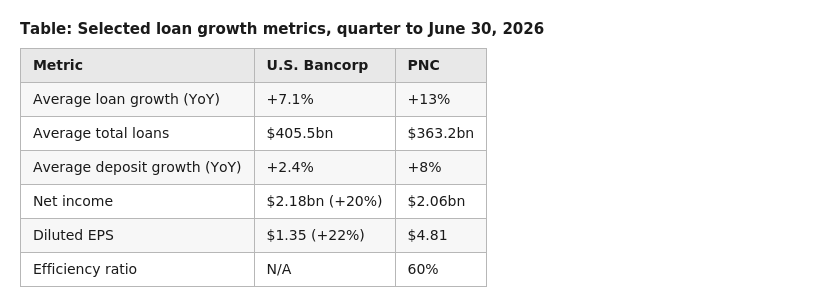
Loan growth is doing much of the work behind higher Earnings at U.S. Bancorp (NYSE:USB) and The PNC Financial Services Group, Inc. (NYSE:PNC), but it is coming from different places, which is why a closer look matters. U.S. Bancorp grew average loans by 7.1% year on year in the three months to June 30, 2026, almost entirely organically. PNC grew average loans by 13%, helped by its January 2026 Acquisition of FirstBank. Both are S&P 500 constituents classified as diversified banks, and separating acquired, organic, commercial and consumer growth changes how their results read.
Why Loans Matter More Than the Headline Profit
Loans are a bank's main earning asset. Net interest income, the difference between interest earned on loans and securities and interest paid on deposits and borrowings, is the largest revenue line at both banks. When loans grow faster than funding costs, net interest income rises, and the net interest Margin can widen.
Growth is only valuable if it is priced properly, funded sensibly and repaid. That is why the composition of lending, the deposits behind it and the Credit costs attached to it matter as much as the headline rate.
Timing matters too. Under the US current expected credit loss accounting standard, a bank must set aside reserves for expected lifetime losses when it books a loan, while the interest arrives over years. Rapid growth can therefore depress reported earnings at first, before income catches up.
U.S. Bancorp (NYSE:USB): Organic Growth Led by Commercial Clients
U.S. Bancorp reported its second-quarter results on July 16, 2026: record net revenue of $7.71 billion, net income of $2.18 billion, up 20%, and Diluted Earnings per Share of $1.35, up 22%. Chief executive Gunjan Kedia cited strong Loan growth as a driver of positive operating leverage, meaning revenue grew faster than expenses.
Average total loans reached $405.5 billion, up 3.0% on the first quarter. Commercial loans, at $157.4 billion, rose 14.1% year on year, reflecting higher corporate loans and loans to financial institutions. Commercial Real Estate grew 5.8% on commercial Mortgage originations, and credit card balances rose 8.4% on higher sales volumes. Residential mortgages grew just 1.4%, and other retail lending was broadly flat, up 0.5%.
Taxable-equivalent net interest income rose 7.5% to $4.39 billion, and the margin widened to 2.79% from 2.66%. U.S. Bancorp also completed its acquisition of BTIG, an Investment Banking and institutional trading firm, on June 1, 2026. That deal adds fee capabilities rather than loans, so it does not flatter the lending figures.
PNC (NYSE:PNC): Separating FirstBank From New Business
PNC reported on July 15, 2026, net income of $2.06 billion and diluted EPS of $4.81, up from $3.85, or $4.85 as adjusted for FirstBank integration costs and significant items. Average loans rose $40.4 billion year on year to $363.2 billion.
Part of that increase is purchased. PNC completed the FirstBank acquisition on January 5, 2026, and its first-quarter release put acquired loans at $15.5 billion. On that basis, more than half of the annual increase appears to be organic, although acquired balances will have changed since closing.
The quarter-on-quarter figures are cleaner, because FirstBank was on the books for almost all of the first quarter. Average commercial loans rose $13.0 billion, or 5%, which PNC attributed to strong new production and higher utilisation, meaning clients drew down more of their committed credit lines. In its Corporate & Institutional Banking segment, average loans rose 6%. Consumer loans fell $0.7 billion as mortgage and auto balances declined, partly offset by credit card growth. PNC completed FirstBank's customer conversion on June 22, 2026, covering about 780,000 customers and 95 branches in Colorado and Arizona.
The acquisition adds costs as well as loans. Noninterest expense rose 21% year on year to $4.1 billion, reflecting higher Business activity and FirstBank's operating expenses, and included $127 million of integration costs. PNC's efficiency ratio, expenses as a share of revenue, was 60%, unchanged from a year earlier.
Funding: Are Deposits Keeping Pace?
Loans outpaced deposits at both banks. U.S. Bancorp's average deposits rose 2.4% against 7.1% loan growth. PNC's rose 8% year on year, including roughly $23 billion of deposits acquired with FirstBank, but were broadly flat on the first quarter while loans rose 4%.
By our calculation from average balances, U.S. Bancorp's loan-to-deposit ratio rose to about 79% from about 75% a year earlier, and PNC's to just under 80% from about 76%. Both levels remain moderate, but continued gaps would require more deposit gathering or wholesale funding, which could raise funding costs.
How Credit Quality Compares
Neither bank reported a deterioration in credit quality alongside its loan growth. Both remain within normal ranges for net charge-offs, a pattern management at each bank has attributed to disciplined Underwriting even as balance sheets expand.
The composition of new lending matters for how that credit risk is distributed. U.S. Bancorp's growth concentrated in commercial and card lending, both of which carry different loss profiles from PNC's acquired FirstBank book, which spans commercial, consumer and mortgage lending across Colorado and Arizona.
What Could Undermine the Growth Story
For PNC, integration risk remains live: the FirstBank customer conversion only completed in June 2026, and deposit attrition in newly acquired markets is possible as customers adjust to new systems and pricing. Continued integration costs could also weigh on reported profitability even as adjusted figures look stronger.
For U.S. Bancorp, organic growth depends on continued commercial demand; a slowdown in corporate borrowing or credit card spending would remove the main driver behind its loan expansion. Both banks' growth also depends on funding costs staying manageable as loan-to-deposit ratios climb.
Where Loan Growth Goes From Here
For U.S. Bancorp, watch whether commercial loan growth persists at its current pace and whether the BTIG acquisition begins contributing meaningfully to fee income. For PNC, the key markers are FirstBank deposit retention following the June conversion, and whether integration costs decline as guided in coming quarters. Both banks' third-quarter loan-to-deposit trends will show whether funding is keeping pace with lending ambitions.


 Nov 13, 2026





 Please wait processing your request...