
 CA
 NZ
 UK
 AU
 IND

 US

 Share
 X (Formerly Twitter)
 Whatsapp
 Facebook
 LinkedIn
 Telegram
 Email This Article
 Copy Link
 Summarize with AI
 Chat GPT
 Perplexity

Key Highlights
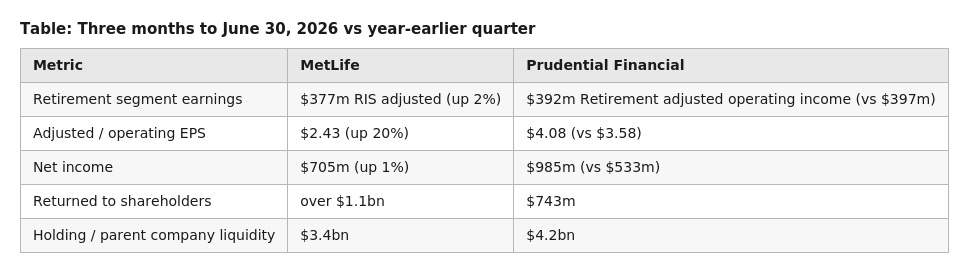
• MetLife's Retirement and Income Solutions adjusted Earnings rose just 2% to $377 million despite premiums excluding pension risk transfer rising 19%.
• Prudential's Retirement adjusted Operating Income was essentially flat at $392 million despite $6.8 billion in sales, including a new registered index-linked annuity.
• Prudential of Japan remains suspended from new sales since February 2026 due to employee misconduct, cutting International constant-dollar sales 33% in the quarter.
For MetLife, Inc. (NYSE:MET) and Prudential Financial, Inc. (NYSE:PRU), the need of savers and pension schemes for lifetime income becomes long-dated liabilities on which both insurers earn an Investment spread. Second-quarter 2026 results show that Demand still growing, but also show it lifts volumes faster than profits: MetLife's retirement earnings rose modestly, while Prudential's were flat despite strong Annuity sales. Both are S&P 500 constituents in the Life & Health Insurance sub-industry.
Two Routes Into the Same Retirement Market
The two groups reach retirement money differently. MetLife's Retirement and Income Solutions segment is largely institutional. It includes pension risk transfer, where a company pays an insurer to take over its defined-benefit pension obligations, alongside structured settlements and longevity reinsurance.
Prudential reorganised its US reporting from January 1, 2026. It moved traditional variable annuities with guaranteed living benefits, plus guaranteed universal life policies, into a new U.S. Legacy Products segment, leaving a Retirement segment that houses both institutional Business and retail annuities sold through financial advisers.
The wider business mix differs too. MetLife's largest earnings contributors in the quarter were Group Benefits and Asia, with Latin America and EMEA adding international diversity. Prudential has a large Japanese business, and its US protection businesses were strong: Group Insurance adjusted operating income rose to $155 million from $125 million, and Individual Life more than doubled to $176 million on record second-quarter sales.
How Retirement Demand Shows Up at MetLife (NYSE:MET)
In the three months to June 30, 2026, reported on August 5, 2026, MetLife said Retirement and Income Solutions adjusted earnings rose 2% to $377 million. It credited favourable recurring interest margins and Volume growth, partly offset by lower variable investment income.
The demand signal is clearer in revenue. Adjusted premiums, fees and other revenues were $1.8 billion; excluding pension risk transfer, they rose 19% to $1.3 billion, driven mainly by UK longevity Reinsurance and structured settlement sales. Total retained Liability exposure grew 3%.
Group-wide, adjusted Earnings Per Share rose 20% to $2.43, but the fastest-growing contributors were Group Benefits, up 25%, and Asia, up 21%, not retirement.
Prudential's (NYSE:PRU) Annuity Engine and Its Japan Problem
Prudential reported on August 4, 2026, that Retirement adjusted operating income was $392 million, essentially unchanged from $397 million a year earlier. Sales totalled $6.8 billion, including $3.6 billion of retail annuities, helped by a registered index-linked annuity launched in December 2025.
Flat earnings reflected higher expenses to support growth and less favourable mortality in a pension risk transfer run-off block, meaning annuitants living longer than assumed, partly offset by net investment spread. Net account values rose 4% to $363 billion.
Prudential's group picture is also shaped by Japan. Prudential of Japan voluntarily suspended new sales from February 9, 2026, to address employee misconduct and, on April 21, 2026, extended the suspension by 180 days. International constant-dollar sales fell 33% in the second quarter, although International adjusted operating income rose to $855 million from $761 million.
Why the Spread Matters More Than Sales
Retirement products are funded up front and paid out over many years. The insurer's profit is chiefly the gap between the Yield on invested assets, typically investment-grade bonds and private credit, and the return credited or implied in the liability, less expenses and the cost of bearing longevity risk.
That is why strong sales do not translate immediately into earnings. New business adds liabilities and Capital needs first; margins emerge as the book matures. It also explains the interest-rate sensitivity: higher yields make annuities more attractive to buyers and support recurring interest margins.
Asset management is the second link. MetLife Investment Management's adjusted earnings rose 6% to $57 million, with Revenue helped by the Acquisition of PineBridge Investments. Prudential's asset manager, PGIM, reported Assets under management of $1.491 trillion and $4.6 billion of third-party net inflows.
What Could Weaken the Case
Several factors could undermine the retirement-demand reading. Pension risk transfer volumes depend on corporate funding levels and board decisions, so they can stall. Lower interest rates could compress spreads and reduce annuity appeal, while sales of index-linked annuities depend partly on equity-market confidence. Longevity experience, as Prudential's run-off block showed, can erode margins.
For Prudential, Japan remains the largest company-specific uncertainty; it has said it would not resume new sales until comfortable that Prudential of Japan's compliance and oversight environment supports doing so. For MetLife, retirement is a smaller earnings driver than Group Benefits and Asia, so strong demand may not dominate group results.
Retirement-Demand Signals Ahead
Useful indicators include MetLife's Retirement and Income Solutions liability exposure growth and revenue excluding pension risk transfer, and whether recurring interest margins keep offsetting weaker variable investment income. For Prudential, retail annuity sales, Retirement net account values and spread commentary matter, along with any update on resuming new sales at Prudential of Japan.


 Nov 13, 2026





 Please wait processing your request...