
 CA
 NZ
 UK
 AU
 IND

 US

 Share
 X (Formerly Twitter)
 Whatsapp
 Facebook
 LinkedIn
 Telegram
 Email This Article
 Copy Link
 Summarize with AI
 Chat GPT
 Perplexity

Key Highlights
• Invesco reported record net long-term inflows of $45.1 billion, driven mainly by ETFs and index products, while its fundamental Equity funds lost $7.7 billion.
• Franklin Templeton gathered $18.4 billion in long-term net inflows, led by alternatives ($9.1 billion) and multi-asset strategies rather than equities.
• Franklin Resources changed its legal name to Franklin Templeton, Inc. effective August 17, 2026, keeping its NYSE ticker BEN unchanged.
Franklin Templeton (NYSE:BEN) and Invesco (NYSE:IVZ) put the active investing debate under a spotlight because both S&P 500 asset managers were built on actively managed funds, yet their fastest growth now comes from areas beyond traditional stock-picking. In the three months to June 30, 2026, Invesco reported record net long-term inflows of $45.1 billion, driven by exchange-traded and index products, while its fundamental equity funds lost $7.7 billion. Franklin Templeton gathered $18.4 billion, led by alternatives and multi-asset strategies rather than equities.
A Corporate Identity Update First
The company behind the BEN ticker changed its legal name from Franklin Resources, Inc. to Franklin Templeton, Inc. with effect from August 17, 2026, keeping the NYSE ticker unchanged. It announced the change alongside its fiscal third-quarter results on July 31, 2026. Franklin's fiscal year ends in September, so its third quarter covers the same April-June period as Invesco's second quarter.
What the Industry Data Say
Active management means portfolio managers choose securities in an attempt to beat a benchmark, charging higher fees for that judgement. Passive, or index, funds simply track a benchmark at low cost. The shift between them has been relentless in equities.
US active mutual funds and ETFs had estimated net outflows of $2 billion in the 12 months to June 30, 2026, against $1,249 billion of inflows into passive funds. Active equities lost $477 billion, while active fixed income gained $416 billion. The debate, in other words, is really about equities; bonds and private Assets remain fertile ground for active managers.
Invesco (NYSE:IVZ): Leaning Into Passive Scale
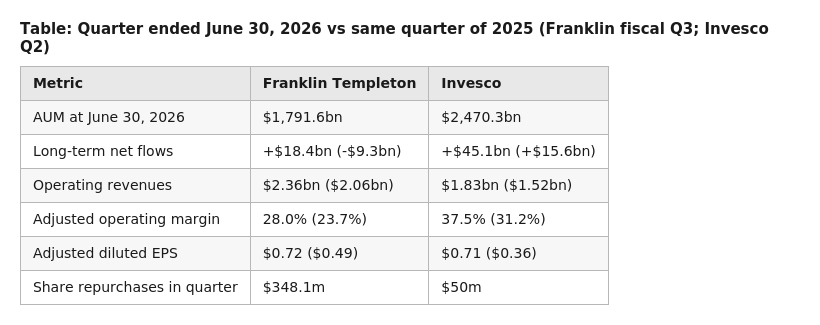
Invesco's second-quarter release, published July 28, 2026, shows how far it has tilted towards index products. ETFs and index strategies drew $30.1 billion of net inflows, including $13.8 billion into QQQ, its large Nasdaq-100 tracker. The China joint venture added $6.9 billion and private markets $1.9 billion, while fundamental equities saw $7.7 billion of outflows. AUM reached $2.47 trillion, up 23.4% year on year.
QQQ is central to the economics. On December 20, 2025, it converted from a unit Investment trust to an open-end ETF, allowing Invesco to earn a management fee. This generated about $130 million of incremental net revenues in the first half, with a net Revenue Yield of roughly 6 basis points after custody and licensing costs.
Active management has not disappeared from the platform. Invesco runs about $25 billion in active ETFs across more than 40 products, launched six during the quarter, and its Global Equity Income Fund in Japan attracted $2.8 billion.
The trade-off is fee dilution. Invesco's overall net revenue yield slipped to 22.4 basis points as flows favoured lower-fee products. Even so, adjusted net revenues rose 20.3% to $1.33 billion and the adjusted Operating Margin widened to 37.5% from 31.2%. Chief executive Andrew Schlossberg described first-half net long-term inflows of $67 billion, or 7% annualised organic growth, as a record.
Franklin Templeton (NYSE:BEN): Redefining Active
Franklin has responded differently, pushing active expertise into newer wrappers and private markets. Of its $18.4 billion of long-term net inflows, alternatives contributed $9.1 billion, multi-asset $4.7 billion, fixed income $2.6 billion and equity $2.0 billion. The total included $4.1 billion of reinvested distributions and $1.1 billion of outflows at Western Asset, its fixed income affiliate.
Management also reported $4.4 billion of net inflows into retail separately managed accounts, portfolios held directly in a client's name. Excluding Western Asset, Franklin's fixed income Business posted a tenth consecutive quarter of positive net flows, totalling $3.5 billion.
ETF assets reached a record $75.6 billion after $7.1 billion of net inflows, with active ETFs accounting for 61% of those flows. Alternatives AUM hit a record $294 billion after $11.8 billion of fundraising, including $10.3 billion in private markets.
Profitability improved from a low base. Operating revenues rose 14% to $2.36 billion, the adjusted operating margin reached 28.0% against 23.7% a year earlier, and adjusted diluted EPS rose to $0.72 from $0.49. The GAAP operating margin was far lower, at 9.2%, reflecting items that the adjusted measure excludes.
How the Debate Reaches the Income Statement
The mechanics are simple but powerful. An active equity fund may charge several times the fee of an index tracker, so every dollar that migrates from one to the other lowers revenue even if total assets are unchanged. Costs do not fall at the same pace. Managers therefore need either much greater volume, as Invesco is pursuing, or higher-fee niches, as Franklin is building in private markets.
Franklin's chief financial officer, Matthew Nicholls, told analysts the effective fee rate should remain in the mid-to-high 37 basis-point range in the fiscal fourth quarter.
Capital Allocation Reflects the Strategies
Franklin repurchased 10.4 million shares for $348.1 million in the quarter and declared a $0.33 dividend. Invesco, which bought back $1.0 billion of preferred stock from MassMutual in the second quarter of 2025, has prioritised balance-sheet repair; it held net Debt of $708.6 million at June 30, 2026, and resumed modest common Buybacks of $50 million.
Where the Interpretation Could Be Wrong
Passive success brings thinner margins per dollar: if Invesco's revenue yield keeps falling, asset growth may not translate into proportionate earnings. Its fundamental equity outflows show that the active side of its business remains under pressure, and management attributed part of them to a few large institutional liquidations that may or may not recur.
For Franklin, private-markets fundraising is lumpy and dependent on investor appetite for Illiquid assets, while Western Asset remains in outflow. Much of the margin improvement is on an adjusted basis; the GAAP picture is weaker.
Signals for the Active-Passive Debate
For Franklin Templeton: fiscal fourth-quarter flows, private-markets fundraising against management's full-year expectations, active ETF growth, Western Asset flows and the effective fee rate. For Invesco: fundamental equity flows, net revenue yield, QQQ inflows, Leverage and whether the adjusted margin can move further into the high 30s, as indicated on the call.


 Nov 20, 2026





 Please wait processing your request...