
 CA
 NZ
 UK
 AU
 IND

 US

 Share
 X (Formerly Twitter)
 Whatsapp
 Facebook
 LinkedIn
 Telegram
 Email This Article
 Copy Link
 Summarize with AI
 Chat GPT
 Perplexity

Key Highlights
• Cincinnati Financial's combined ratio rose to 100.8% from 94.9% as catastrophe losses added 14.4 points, while Erie Indemnity's fee Revenue grew steadily 4.7% to $862.9 million.
• Cincinnati's reported Net Income jumped to $1.26 billion largely on Investment gains, while Erie's Earnings depend entirely on a fixed 25% management fee unaffected by Underwriting losses.
• Erie's Exchange premium growth slowed to 3.3% from 9.2% a year earlier, with policies in force falling 2% even as average premium per policy rose 6.8%.
Cincinnati Financial Corporation (NASDAQ:CINF) and Erie Indemnity Company (NASDAQ:ERIE) both rely on independent insurance agents, yet they sit on opposite sides of the underwriting risk. Cincinnati Financial is an insurer: it sells policies through local agencies, keeps the premiums and pays the claims. Erie Indemnity is a manager: it runs the Erie Insurance Exchange, a policyholder-owned insurer, in return for a fee on the premiums the Exchange writes. That split explains why their second-quarter 2026 results looked so different. Both are S&P 500 constituents, and neither was affected by the index's September 21, 2026, rebalance.
Same Agents, Different Economics
Cincinnati Financial writes business, home and auto insurance through The Cincinnati Insurance Company and two sister carriers. The same local independent agencies may also offer the group's life insurance, fixed annuities and excess and surplus lines, the specialist cover for risks that standard insurers decline.
Erie Indemnity acts as attorney-in-fact for the Exchange. A reciprocal insurer is owned by its policyholders, known as subscribers, and appoints a manager to run it. Indemnity handles sales, underwriting and policy issuance, and its management fee rate was set at 25% for both 2026 and 2025. The group has nearly seven million policies in force across 12 states and the District of Columbia.
How Cincinnati (NASDAQ:CINF) Turns New Agencies Into Premium
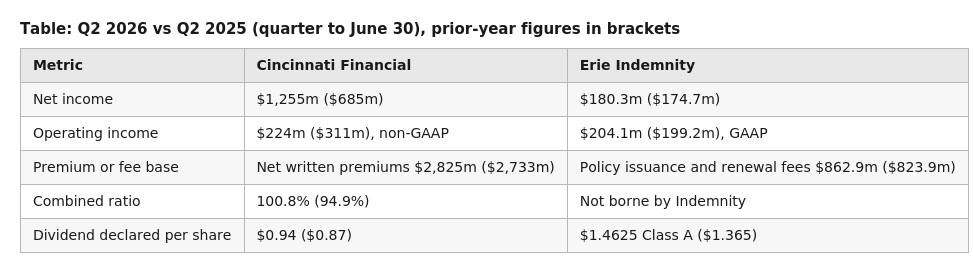
In the three months to June 30, 2026, reported on July 27, 2026, Cincinnati Financial's consolidated net written premiums rose 3% to $2.83 billion. Its main distribution lever is appointing more agencies. It made 220 new appointments in the first half, and agencies appointed since January 2025 produced $31 million, or 9%, of second-quarter new business.
Chief executive Stephen Spray said that with total agency relationships still under 3,000, the company has a lot of runway to fuel growth. That selectivity also means growth varies by line. Commercial lines new Business rose 4% to $208 million and excess and surplus new business rose 6% to $67 million, but personal lines new business fell to $78 million from $141 million.
Management linked slower personal lines growth to normalisation after rapid expansion in recent years and to caution in California following wildfire losses.
Why Cincinnati's Profits Swing
Because Cincinnati keeps the underwriting risk, catastrophes flow straight into its results. Its property-casualty combined ratio, which measures claims and expenses against earned premiums, rose to 100.8% from 94.9%, with catastrophe losses adding 14.4 points. Non-GAAP operating income, which strips out investment gains and losses, fell to $224 million from $311 million.
Reported net income nevertheless jumped to $1.26 billion from $685 million, because after-tax investment gains reached $1.03 billion. Pre-tax investment income rose 12% to $319 million, and Book Value per share reached $108.64. A risk-bearing insurer therefore has two earnings engines, underwriting and investments, and both can be volatile.
Why Erie's (NASDAQ:ERIE) Earnings Follow Premiums, Not Claims
Erie Indemnity's quarter to June 30, 2026, reported on July 30, 2026, looked steadier. Net income rose to $180.3 million from $174.7 million, or $3.45 per diluted Class A share. Management fee revenue for policy issuance and renewal services grew 4.7% to $862.9 million, while the Exchange's direct and affiliated assumed premiums written rose 3.3% to $3.54 billion.
The Exchange's underwriting results do not sit on Indemnity's income statement. The Exchange's combined ratio improved to 103.9% from 116.9%, with policyholder surplus of $10.7 billion. For Indemnity, a stronger Exchange matters indirectly: it can keep writing the business on which fees are earned.
Indemnity's biggest cost is distribution itself. Commission expense rose $44.7 million, driven by higher agent incentive compensation and premium growth, while non-commission expenses fell $8.8 million. Erie's Margin therefore depends on the gap between a fixed-rate fee and what it pays agents and spends running the Exchange.
The Half-Year View and Capital Returns
A single quarter can exaggerate the contrast, so the six months to June 30, 2026, are a useful check. Cincinnati Financial's half-year net written premiums rose 5% to $5.49 billion, led by personal lines, up 7%, and excess and surplus lines, up 8%. Its half-year combined ratio improved to 98.2% from 103.8%, because the first half of 2025 carried heavy catastrophe losses, including the California wildfires.
Erie Indemnity's half-year pattern was smoother: net income rose to $330.8 million from $313.1 million, and policy issuance and renewal fees grew 4.5%. Both companies raised their dividends. Cincinnati declared $0.94 a share for the quarter against $0.87, while Erie's Class A Dividend of $1.4625 compared with $1.365 a year earlier.
Where Each Model Is Exposed
Erie's weakness is concentration. Receivables from the Exchange and its affiliates totalled $753 million at June 30, 2026, and practically all of Indemnity's revenue comes from one relationship. Exchange premium growth has also slowed to 3.3% from 9.2% a year earlier, and policies in force fell 2% while average premium per policy rose 6.8%. If rate increases fade without policy growth returning, fee growth would slow.
Cincinnati's risks are more direct: catastrophe frequency, equity-market swings in its investment portfolio and softer personal lines pricing. Newly appointed agencies also take time to reach full productivity, so appointment numbers do not translate immediately into premium.
Distribution-Model Signals Ahead
For Cincinnati Financial, the key measures are the pace of agency appointments, new business by segment, commercial renewal pricing, which management put at the high end of the low-single-digit range, and catastrophe losses in the combined ratio.
For Erie Indemnity, watch Exchange premium growth against policies in force, commission expense relative to fee revenue, and the management fee rate the board sets for 2027.


 Nov 20, 2026





 Please wait processing your request...