
 CA
 NZ
 UK
 AU
 IND

 US

 Share
 X (Formerly Twitter)
 Whatsapp
 Facebook
 LinkedIn
 Telegram
 Email This Article
 Copy Link
 Summarize with AI
 Chat GPT
 Perplexity

Key Highlights
• Berkley grew net premiums 2.4% and improved its combined ratio to 90.0% from 91.6%, while Arch's net premiums fell 6.9% as its combined ratio rose to 83.5%.
• Arch's Mortgage insurance segment ran a combined ratio of just 22.8%, giving it a Diversification buffer Berkley's pure US commercial lines model lacks.
• Both companies returned significant capital, with Arch repurchasing $1.2 billion of shares and Berkley returning $334.1 million through dividends and buybacks.
Complex, hard-to-place commercial risks that standard carriers avoid, priced account by account, are where Arch Capital Group Ltd. (NASDAQ:ACGL) and W. R. Berkley Corporation (NYSE:WRB) earn most of their Underwriting profit as S&P 500 speciality insurers. Their second-quarter 2026 results show the same theme running in opposite directions. Berkley grew premiums and improved its combined ratio, while Arch deliberately wrote less Business as competition sharpened. That divergence, rather than any single headline, is why the sector deserves a closer look.
What Speciality Means in Practice
Speciality insurance covers risks that do not fit standard policy forms: professional liability, directors' and officers' cover, construction, energy, marine, cyber and many excess and surplus lines, where the insurer has more freedom to set rates and terms. The trade-off is volatility. Claims can take years to settle, so reserving judgement matters as much as pricing.
The key yardstick is the combined ratio, which adds claims and expenses and divides them by earned premiums. A figure below 100 means the insurer made an underwriting profit before counting Investment income. Speciality writers are expected to run well below that line in exchange for taking on harder risks.
Two Very Different Engines
Arch is a Bermuda exempted company with roughly $28.3 billion of capital at June 30, 2026, and it writes insurance, Reinsurance and mortgage insurance worldwide. That three-legged model means speciality insurance is only one Earnings source; property-catastrophe reinsurance and US mortgage insurance can offset weakness elsewhere.
Berkley, founded in 1967 and headquartered in Greenwich, Connecticut, describes itself as one of the largest commercial lines writers in the United States. It reports two segments, Insurance and Reinsurance & Monoline Excess, and the first is by far the larger, at $3.12 billion of the quarter's $3.43 billion net premiums written. Berkley is therefore closer to a pure play on US speciality commercial lines.
The Second-Quarter Scorecard
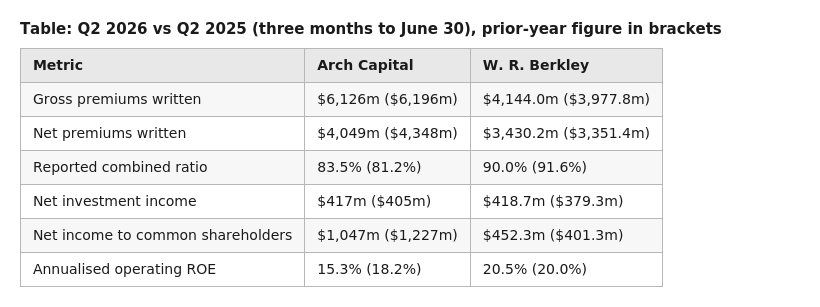
Berkley reported first, on July 20, 2026, for the three months to June 30. Net Income rose 12.7% to $452.3 million, Operating Income increased 18.2% to $497.1 million and the combined ratio improved to 90.0% from 91.6%. Catastrophe losses fell to $62.4 million from $99.2 million.
Arch followed on July 28, 2026. Net income available to common shareholders slipped to $1.05 billion from $1.23 billion, and after-tax operating income per share was broadly flat at $2.56 against $2.58. Its consolidated combined ratio rose to 83.5% from 81.2%, and Underwriting income fell to $657 million from $818 million.
How Pricing Discipline Feeds the Numbers
The contrast in premium growth is a choice, not an accident. Arch's net premiums written fell 6.9%. In insurance, it cited the non-renewal of certain programmes linked to its Acquisition of Allianz's US MidCorp and Entertainment business; in reinsurance, it pointed to non-renewals, reduced shares and more retrocession, meaning reinsurance bought for its own book. Arch's insurance combined ratio excluding catastrophes and prior-year development edged up to 91.6% from 90.6%, a sign that margins are thinning at the edges.
Berkley, by contrast, grew Insurance segment net premiums by 3.7% while shrinking Reinsurance & Monoline Excess by 9.3%. Chief executive W. Robert Berkley, Jr. said the company continues to see attractive opportunities across select Liability lines. Its current accident-year combined ratio excluding catastrophes was 88.1%.
The mechanism is straightforward. When rates are rising faster than expected claims costs, writing more business compounds profit. When competition erodes that gap, shrinking protects the combined ratio but reduces the premium base that generates future underwriting income and investable float, the cash held between collecting premiums and paying claims.
Capital, Ownership and Investment Income
Investment income is the quieter support. Berkley's net investment income reached a record $418.7 million, and management said reinvestment rates still exceed the portfolio's book yield. Arch's net investment income rose to $417 million from $405 million.
Arch's mortgage segment illustrates the value of diversification. Its combined ratio was 22.8%, up from 15.2% a year earlier but still exceptionally low, helped by favourable reserve releases as more delinquent borrowers resumed payments than expected. That income is unrelated to commercial pricing, giving Arch a buffer Berkley lacks.
Capital returns differ in style. Arch repurchased $1.2 billion of shares in the quarter, while Berkley returned $334.1 million through regular dividends, special dividends and buybacks. Berkley's Shareholder base also changed: Mitsui Sumitomo Insurance completed the acquisition of a 15% stake in the company for $3.8 billion in March 2026.
Risks to the Speciality Thesis
The biggest risk is the pricing cycle. Arch's shrinking reinsurance book and higher underlying insurance ratio suggest competition is intensifying in parts of the market, and Berkley's selective growth language points the same way. Softer pricing can take several quarters to show up in loss ratios.
Reserving is the second risk. Arch's quarter benefited from $165 million of favourable prior-year development, meaning earlier claims estimates proved too high. That support is not guaranteed to repeat, and liability lines are exposed to rising legal costs, often called social inflation.
Speciality-Pricing Signals Ahead
Investors can track Arch's insurance combined ratio excluding catastrophes and prior-year development, and whether its net premiums written stabilise; Berkley's Insurance segment premium growth and its accident-year ratio excluding catastrophes; reserve development at both firms; and each company's net investment income trend. Together, these will show whether speciality pricing remains adequate or whether discipline is turning into retreat.


 Nov 10, 2026





 Please wait processing your request...