
 CA
 NZ
 UK
 AU
 IND

 US

 Share
 X (Formerly Twitter)
 Whatsapp
 Facebook
 LinkedIn
 Telegram
 Email This Article
 Copy Link
 Summarize with AI
 Chat GPT
 Perplexity

Key Highlights
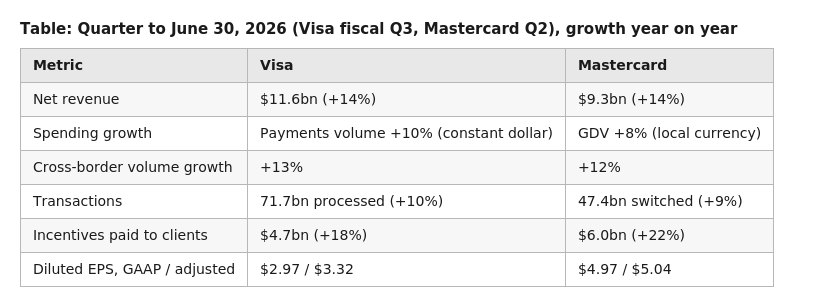
• Visa's net Revenue rose 14% to $11.6 billion and Mastercard's rose 14% to $9.3 billion in their most recent quarters, both S&P 500 Financials constituents.
• Client incentives grew faster than volumes at both companies, up 18% at Visa and 22% at Mastercard, effectively raising the cost of winning each unit of spending.
• A pending merchant interchange settlement, only preliminarily approved as of June 2026, could weaken premium-card acceptance and affect both networks' volumes.
Every payment counts for Visa Inc. (NYSE:V) and Mastercard Incorporated (NYSE:MA) because both companies earn a small fee on almost every card transaction they carry. Neither lends to cardholders, so their revenue rises with the number, value and geography of payments rather than with interest rates or Loan books. Both are S&P 500 constituents in the Financials sector, and their latest quarter, the three months to June 30, 2026, shows how powerful that model is. It also shows its limits: incentives paid to banks are growing faster than volumes, and an increasing share of growth comes from services beyond the core network.
A Toll on Each Transaction
Visa and Mastercard run the rails that connect a shopper's bank, the issuer, with a merchant's bank, the acquirer. Banks, not the networks, set card interest rates and carry Credit risk. The networks charge fees for authorising, clearing and settling each payment, plus assessments linked to the value of spending.
That structure means revenue has several separate engines. Some fees track the dollar value of spending, some track the count of transactions, and some depend on whether a payment crosses a border. A rise in contactless payments for small purchases, for example, adds transactions even if the average ticket is modest.
What Visa (NYSE:V) Reported
In its fiscal third quarter to June 30, 2026, reported on July 28, 2026, Visa said net revenue rose 14% to $11.6 billion. Visa's financial year ends on September 30, so this quarter lines up with calendar Q2 at Mastercard. Payments Volume grew 10% in constant dollars, cross-border volume rose 13%, and processed transactions increased 10% to 71.7 billion.
The revenue lines show how those drivers feed through. Data processing revenue, which is tied mainly to transaction counts, rose 17% to $6.0 billion. Service revenue, linked to prior-quarter payments volume, grew 14% to $4.9 billion. International transaction revenue rose only 6% to $3.9 billion, well below the growth in cross-border volume, while other revenue jumped 45% to $1.5 billion.
GAAP Net Income rose 7% to $5.6 billion, or $2.97 per share. On a non-GAAP basis, which strips out items such as litigation provisions, Earnings Per Share rose 11% to $3.32. Operating expenses grew 19% on a GAAP basis, and the quarter included a $237 million provision for the long-running US interchange litigation.
What Mastercard (NYSE:MA) Reported
Mastercard's second quarter to June 30, 2026, reported on July 30, 2026, produced net revenue growth of 14% to $9.3 billion, or 12% on a currency-neutral basis. Gross dollar volume, the total value of spending on its cards, rose 8% in local currency to about $2.9 trillion. Cross-border volume grew 12% and switched transactions, those Mastercard itself processed, rose 9%.
The earnings presentation splits revenue into two parts. Payment network revenue rose 10% to $5.45 billion, while value-added services and solutions, which include Fraud tools, Data Analytics and consulting, grew 20% to $3.83 billion. GAAP net income was $4.4 billion, or $4.97 per share, and adjusted earnings per share were $5.04.
The geographic detail differs in instructive ways. Mastercard's gross dollar volume grew 6% in the US and 9% in the rest of the world. Visa's results showed US payments volume up 9% for credit and 10% for debit in constant dollars, and it lists far more debit than credit transactions, which ties Visa closely to everyday spending.
The Hidden Cost of Winning Volume
Every payment counts, but not every payment is equally profitable. Both networks pay incentives to banks and large merchants to issue their cards or route volume to them, and these are deducted from gross revenue. Visa's client incentives rose 18% to $4.7 billion, and Mastercard's rebates and incentives rose 22% to about $6.0 billion, both faster than their headline volumes.
That gap matters for profitability. When incentives grow faster than gross revenue, the network is effectively paying more to secure each unit of volume, so Operating Leverage depends on pricing, cross-border mix and new services. Cross-border payments are particularly valuable because they carry higher fees, which is why both companies watch travel and online cross-border spending closely.
Beyond the Card Swipe
The more distinctive shift is the rise of services that sit alongside the payment itself. Mastercard's value-added services grew twice as fast as its payment network revenue, and they now account for roughly two-fifths of net revenue. Visa does not split its figures the same way, but the 45% jump in its other revenue line points to a similar broadening.
These services, such as fraud scoring, tokenisation and data insights, still depend on network scale, because the data come from the payments flowing through. Yet they are less tied to any single transaction fee, which could make revenue somewhat more resilient if spending slows.
Capital Returns and Outlook
Both companies return large amounts of cash. Visa bought back $4.9 billion of shares in the quarter, and Mastercard repurchased $4.9 billion and paid $771 million in dividends. Mastercard guided to full-year 2026 net revenue growth at the high end of low double digits on a currency-neutral basis, while Visa pointed to full-year net revenue growth at the low end of low teens on an adjusted constant-dollar basis.
Risks to the Interpretation
The strongest risk is regulatory. On June 9, 2026, a federal judge in New York granted preliminary approval to a merchant settlement that would lower interchange rates and let merchants decline some premium and commercial credit cards. Interchange flows to issuing banks rather than the networks, but weaker premium-card acceptance could affect volumes and incentive negotiations. Large retailers have objected, and final approval is still pending.
Other risks include a slowdown in travel that hits cross-border fees, currency swings, rising incentive costs and competition from real-time account-to-account payments. Litigation provisions, such as Visa's $237 million charge this quarter, can also recur.
Tracking the Payments Duopoly Forward
Investors can track the gap between incentive growth and volume growth, cross-border volume trends, and the share of revenue from value-added services. The final court decision on the merchant settlement is a key confirmed development to follow, along with each company's next quarterly results and any update to full-year guidance.


 Nov 13, 2026





 Please wait processing your request...