
 AU
AU
 UK
UK
 CA
CA
 NZ
NZ
 IND
IND

 US
US

 Share
Share
 X (Formerly Twitter)
 Whatsapp
 Facebook
 LinkedIn
 Telegram
 Email This Article
 Copy Link
 Summarize with AI
 Chat GPT
 Perplexity
Key Highlights:
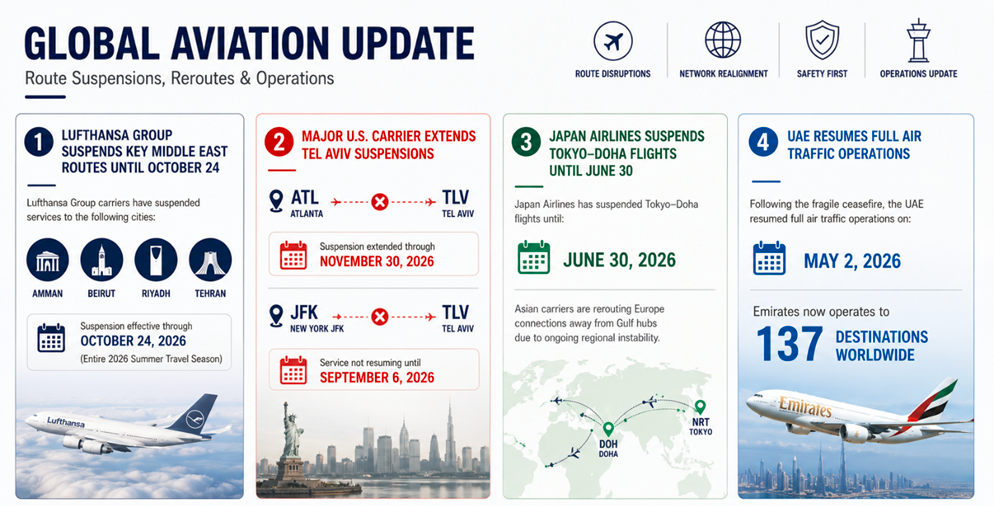
Airlines Cancel Hundreds of Flights as Iran War Reshapes Global Aviation Through 2026
The aviation industry is navigating one of its most operationally disruptive periods since the COVID-19 Pandemic. The outbreak of the U.S.-Israel-Iran war on February 28, 2026, forced a rapid closure of airspace across Iraq, Iran, Syria, and Israel, triggering cascading flight cancellations and route suspensions from carriers spanning six continents. What began as an emergency response has hardened into a structural rerouting of global aviation, with dozens of airlines extending suspensions well into the autumn of 2026 and some cancellations running through late October or even indefinitely. The economic impact on Middle East hubs — particularly Dubai, Riyadh, Doha, and Tel Aviv — is severe, and the ripple effects are reshaping flight Economics from Tokyo to Toronto.

Europe's largest airline groups have been among the most aggressive in extending suspensions. Lufthansa, Swiss, Austrian Airlines, Brussels Airlines, and Edelweiss have all suspended flights to Tel Aviv until May 31 and to Dubai until July 11. Routes to Amman, Beirut, Dammam, Riyadh, Erbil, Muscat, and Tehran across this group are suspended until October 24, covering essentially the entire summer travel season. Air France has halted Tel Aviv, Beirut, and Dubai services until at least May 27, and its KLM Subsidiary has extended suspensions on Riyadh, Dammam, and Dubai routes until June 28. ITA Airways has extended suspensions on Tel Aviv, Riyadh, and Dubai through May 31. The breadth of these cancellations reflects not just safety concerns but a commercial reckoning: the economics of long detours around Iranian airspace are unsustainable at scale.
U.S. Carriers Pull Back Sharply From Israeli and Gulf Routes
American carriers have made some of the most dramatic route adjustments. One major U.S. airline has extended its Atlanta-Tel Aviv service suspension through November 30 — an extraordinary eight-month pause — while its New York JFK-Tel Aviv flights are not expected to resume until September 6. A planned Boston-Tel Aviv route, originally scheduled to launch in late October, has been pushed back indefinitely. Other U.S. carriers have cancelled Dubai flights through May 31. The cumulative effect of these withdrawals is a significant reduction in transatlantic and U.S.-to-Gulf connectivity at a time when Demand for alternative European routing is surging. Qantas, Australia's flag carrier, is capitalizing: it is adding flights to Rome and Paris to meet rising demand, with Paris service increasing to five return flights per week from three.
Asian Carriers Reroute Europe Connections as Gulf Hubs Go Dark
The disruption is acutely felt across Asia-Pacific carriers that traditionally relied on Gulf hubs as connecting points between Asia and Europe. Japan Airlines has suspended Tokyo-Doha flights until June 30 and Doha-Tokyo return flights until July 1. Singapore Airlines has extended its Singapore-Dubai suspension until August 2, while simultaneously expanding the Singapore-London Gatwick and Singapore-Melbourne routes to absorb displaced demand. Cathay Pacific of Hong Kong has suspended Dubai and Riyadh flights until June 30, with cargo freighter services to those cities suspended through May 31. Malaysia Airlines will resume only limited Doha services from June 2. The cumulative rerouting adds hours and significant fuel cost to itineraries, pressuring already thin airline margins.
Gulf Carriers Begin Capacity Recovery; Fragile Ceasefire Aids Gradual Reopening
Despite the widespread international disruptions, Middle Eastern carriers have been ramping up capacity following a fragile ceasefire between the U.S. and Iran. The UAE's General Civil Aviation Authority announced the full resumption of air traffic operations on May 2, and Qatar, Bahrain, and Kuwait have reopened their airspace after large-scale closures that followed the February 28 outbreak of hostilities. Emirates, the UAE's flagship carrier, now operates to 137 destinations. Some European airlines are cautiously planning returns: British Airways targets July 1 for Dubai and Doha service resumption, while Austrian Airlines aims to restart Tel Aviv operations from June 1. Turkey's Pegasus Airlines, one of the most broadly affected carriers, has cancelled flights to Iran, Iraq, Kuwait, Bahrain, Doha, Dammam, Riyadh, Dubai, Abu Dhabi, and Sharjah through June 1.


 Jun 15, 2026




 Please wait processing your request...