
 AU
AU
 UK
UK
 CA
CA
 NZ
NZ
 IND
IND

 US
US

 Share
Share
 X (Formerly Twitter)
 Whatsapp
 Facebook
 LinkedIn
 Telegram
 Email This Article
 Copy Link
 Summarize with AI
 Chat GPT
 Perplexity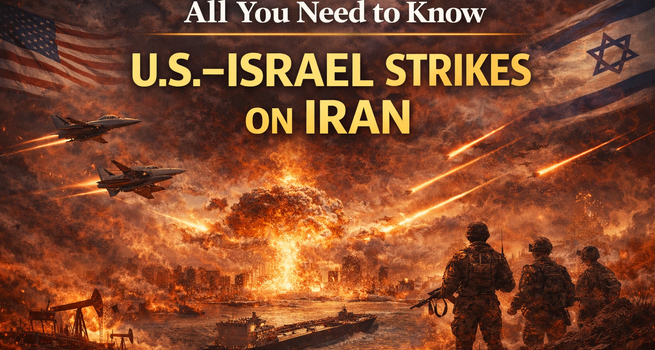
Key Highlights
- The war between the United States, Israel and Iran has entered its fourth day.
- Senior Iranian leaders have been killed in targeted airstrikes.
- The Strait of Hormuz has been effectively closed, shaking global oil markets.
- Oil prices have surged, and global stock markets have fallen sharply.
- The risk of a wider regional war remains high.
What Is Happening Right Now?
As of March 3, 2026, the conflict between the United States, Israel and Iran has intensified into a major regional war. The military campaign began on February 28 with large-scale airstrikes on Iranian targets.
The first phase focused on Iran’s top leadership and strategic facilities. Since then, the fighting has expanded to include missile attacks, drone strikes, and damage to critical infrastructure across the Middle East.
The situation remains fluid. There are no clear signs of immediate de-escalation.
How Did the War Begin?
The operation reportedly started with coordinated US and Israeli airstrikes aimed at Iran’s nuclear facilities, ballistic missile infrastructure, Islamic Revolutionary Guard Corps bases, and senior political and military leadership.
Among those reported killed was Iran’s Supreme Leader, Ayatollah Ali Khamenei. His death has created a major political and constitutional crisis inside Iran.
The campaign was designed to weaken Iran’s nuclear program and its regional military influence.
What Happened in the Past 24 Hours?
The fourth day of fighting saw intense activity across multiple fronts.
US bombers and Israeli fighter jets struck command centers, missile storage facilities, and government buildings in Tehran and other cities. Explosions were reported near key state institutions and military headquarters.
Israel also expanded strikes against Hezbollah targets in Lebanon, aiming to prevent a northern escalation.
Iran responded with ballistic missiles and drones targeting Israel and US-linked sites in the Gulf region. Most projectiles were intercepted by missile defense systems, though some limited damage was reported.
Drone attacks were also reported near diplomatic facilities in Saudi Arabia, prompting embassy closures and evacuations. The conflict has clearly moved beyond direct Iran–Israel exchanges.
The International Atomic Energy Agency confirmed structural damage to Iran’s Natanz nuclear enrichment facility. No radiation leak has been reported, but enrichment operations have reportedly stopped.
Why the Strait of Hormuz Matters
One of the most serious developments is Iran’s declaration that the Strait of Hormuz is closed.
The Strait of Hormuz is a narrow waterway between Iran and Oman. Around 20% of the world’s oil and a large share of liquefied natural gas pass through it every day.
If ships cannot safely transit this route, oil supply falls, energy prices rise, shipping insurance costs surge, and global inflation pressures increase.
Oil prices have already jumped sharply, moving into triple-digit territory in some markets. This is why financial markets reacted immediately.
How Are Financial Markets Reacting?
Global markets have shown strong volatility.
Major US stock indices fell sharply. Asian markets declined even more due to energy dependency. Bond yields rose as investors adjusted inflation expectations. Gold initially rose but later stabilised.
Higher oil prices can increase inflation, which complicates central bank policy decisions. If the energy shock continues, growth could slow while inflation rises, creating a difficult economic environment.
Who Is in Control Inside Iran?
With the death of key leaders, Iran’s political system is under pressure.
A temporary leadership council has reportedly taken formal control. However, the Islamic Revolutionary Guard Corps appears to be consolidating real power.
The IRGC controls missile forces, elite military units, and proxy networks across the region.
Rather than weakening the regime immediately, the strikes may strengthen hardline military control in the short term. This reduces the chances of quick diplomatic talks.
Human Impact
Reports indicate hundreds of deaths inside Iran since the conflict began, with many more injured.
US and Israeli casualties appear significantly lower so far, reflecting the asymmetric nature of the conflict.
Urban damage in Tehran has displaced civilians, and humanitarian concerns are growing, particularly around medical infrastructure and public services.
Which Countries Are Most Affected Economically?
Asian countries such as China, Japan, South Korea and India rely heavily on oil and gas shipments through the Strait of Hormuz. If supply disruptions continue, energy shortages and higher fuel costs could slow economic growth.
Europe depends on liquefied natural gas from Qatar, much of which transits the Gulf. Gas price spikes could hurt industrial production and increase household energy costs.
The United States is less directly dependent on Gulf oil than in the past, but global price increases affect American consumers through higher gasoline prices. Markets are also sensitive to geopolitical uncertainty.
What About Supply Chains?
The Strait of Hormuz is a key global shipping corridor. Disruptions can affect petrochemicals, fertilizers, industrial metals, and container shipping.
Rerouting ships around Africa adds weeks to transit time and increases costs significantly.
Industries such as automotive, aviation and agriculture may face rising input costs if disruptions continue.
Could the War Expand?
There are several risks of escalation. Hezbollah could increase operations from Lebanon. Gulf states could become more directly involved. Cyberattacks could expand. Energy infrastructure could face additional strikes.
So far, there are no confirmed signs of nuclear escalation, but the risk remains part of the broader strategic picture.
The longer the conflict lasts, the greater the chance of regional spillover.
Possible Scenarios
If the Strait of Hormuz reopens quickly and missile exchanges slow, markets may stabilise and oil prices could ease.
If maritime traffic remains restricted for weeks or months, oil prices could stay elevated, inflation could rise globally, and economic growth could weaken.
If additional countries or proxy groups become directly involved, the economic and security impact could deepen significantly.
Conclusion
The US–Israel–Iran war has entered a dangerous phase. Leadership strikes, nuclear site damage, and the closure of the Strait of Hormuz have transformed the conflict into a global economic event.
Oil markets are volatile. Stock markets are under pressure. Diplomatic channels appear limited for now.
Whether the situation stabilises or widens depends largely on maritime access and political decisions in the coming days. The military conflict is regional, but its economic consequences are global.


 Jun 13, 2026




 Please wait processing your request...