
 AU
AU
 UK
UK
 CA
CA
 NZ
NZ
 IND
IND

 US
US

 Share
Share
 X (Formerly Twitter)
 Whatsapp
 Facebook
 LinkedIn
 Telegram
 Email This Article
 Copy Link
 Summarize with AI
 Chat GPT
 Perplexity
Apple Inc. (NASDAQ: AAPL) once again demonstrated why it remains one of the most resilient and powerful business platforms in global technology. In Q1 FY2026, the company delivered a decisive beat-and-raise quarter, showcasing strong demand for its flagship products, accelerating services monetization, and disciplined margin execution. At the same time, Apple offered meaningful insight into its evolving artificial intelligence strategy and acknowledged near-term supply and component cost pressures.
For long-term investors, Apple’s latest earnings confirm that the company is not merely a hardware vendor but a deeply integrated consumer technology ecosystem capable of compounding cash flows across cycles.
Apple Q1 FY26 Earnings Snapshot: A High-Quality Beat
Apple reported quarterly revenue of $143.8 billion, representing 16% year-over-year growth, while diluted EPS reached a record $2.84, up 19% YoY. Both figures comfortably exceeded Wall Street expectations, with revenue beating consensus by approximately 4.6% and earnings surpassing forecasts by more than 6%.
Even more important than the headline beat was margin performance. Gross margin expanded to 48.2%, above guidance, reflecting favorable product mix, pricing discipline, and operating leverage. This level of profitability underscores Apple’s ability to scale earnings faster than revenue.
Following the release, shares edged higher in after-hours trading, signaling that investors viewed the results as a high-quality execution quarter rather than a one-off upside surprise.
Key takeaway: Apple continues to deliver consistent earnings growth while protecting margins in an increasingly competitive and complex technology landscape.
iPhone Strength Drives the Quarter
The defining feature of Apple’s Q1 FY26 performance was a powerful iPhone cycle.
- iPhone revenue: $85.3 billion
- Year-over-year growth: +23%
Management described demand as “staggering,” with record revenue across the Americas, Europe, Japan, and Asia Pacific. Particularly encouraging was the resurgence in Greater China, where revenue surged 38% YoY, driven by record numbers of iPhone upgraders and switchers.
India also stood out as a major growth engine, reinforcing Apple’s long-term opportunity in emerging markets.
Other hardware segments showed mixed performance:
- Mac: $8.4 billion (down 7% YoY) due to tough comparisons
- iPad: $8.6 billion (up 6% YoY) on product refresh momentum
- Wearables, Home & Accessories: $11.5 billion (down 2% YoY), impacted by AirPods Pro supply constraints
Despite softness in certain categories, the scale of iPhone growth more than offset weakness elsewhere, reaffirming the iPhone’s central role in Apple’s ecosystem economics.
Key takeaway: Apple’s product cycle engine remains firmly intact, anchored by iPhone demand across developed and emerging markets.
Services Business Hits Another Record
Apple’s Services segment continues to be the crown jewel of its business model.
- Services revenue: $30.0 billion
- Year-over-year growth: +14%
- Services gross margin: approximately 76.5%
Growth was broad-based across:
- App Store
- Advertising
- Payments
- Cloud services
- Music and video
Equally important, Apple reported that its installed base surpassed 2.5 billion active devices, another all-time high. Each incremental device expands the addressable market for services, reinforcing Apple’s long-term monetization runway.
Services now provide Apple with a powerful stabilizing force. Even if hardware growth moderates in future cycles, high-margin recurring services revenue supports earnings durability and valuation defensibility.
Key takeaway: Apple’s transformation into a services-driven platform is deepening, enhancing the predictability and quality of cash flows.
Apple’s AI Strategy: Measured, Integrated, and Platform-Focused
Rather than racing to release flashy standalone AI products, Apple is embedding artificial intelligence directly into its ecosystem through Apple Intelligence.
Management highlighted increasing adoption of features such as:
- Visual Intelligence
- Live Translation
- Writing and productivity tools
- Smarter on-device experiences
Apple also confirmed collaboration with Google to develop next-generation foundation models that will power future Apple Intelligence features, including a more personalized Siri.
Crucially, Apple continues to emphasize its privacy-first approach, leveraging on-device processing and Private Cloud Compute rather than relying entirely on centralized data centers.
This strategy reflects Apple’s historical playbook: enter new technology waves later than competitors but integrate them more deeply into the user experience.
Key takeaway: Apple’s AI roadmap is evolutionary, not reactive, and focused on enhancing its ecosystem rather than chasing hype.
Rising R&D Signals Long-Term Investment Mode
Operating expenses rose to $18.4 billion, up 19% YoY, driven largely by higher research and development spending.
This increase signals that Apple is deliberately investing in:
- AI and machine learning
- Silicon development
- Platform services
- Future product categories
Importantly, Apple is funding this investment from strength, not necessity. Strong margins and cash flows provide ample flexibility to scale R&D without sacrificing profitability.
Key takeaway: Apple is entering its next platform transition from a position of financial dominance.
Outlook: Strong Demand, Tactical Constraints
For Q2 FY26, Apple guided for revenue growth of 13%–16% YoY.
However, management flagged two key headwinds:
- Supply constraints in advanced node chips
- Rising memory prices, expected to pressure gross margin modestly
Apple exited Q1 with lean inventories and is operating in a “supply chase” environment, meaning demand currently exceeds supply in certain categories.
While these issues may create short-term volatility, they do not appear structural in nature.
Key takeaway: Demand remains robust, but fulfillment timing and component costs introduce near-term noise.
Technical Analysis (Daily Price Chart Analysis)
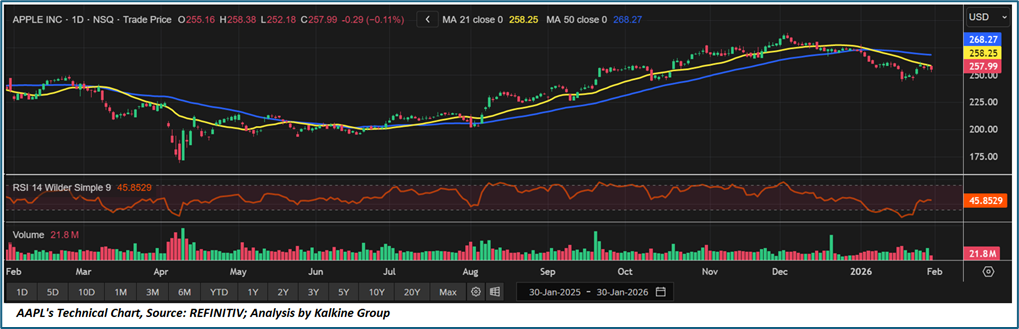
Trend Structure: Uptrend Intact, but Consolidation Dominates
AAPL remains structurally positive over the longer term, but it is clearly in a post-peak correction/consolidation phase. The stock is trading around USD ~258, indicating cooling momentum after the December high. Summary: Long-term uptrend holds, but near-term trend has softened.
Moving Averages: Resistance Overhead, Reclaim Needed
AAPL is currently below both the 21-day MA (~USD 258.25) and 50-day MA (~USD 268.27), which signals a neutral-to-bearish short-term setup. A decisive move back above USD 265–270 is needed to restore bullish confirmation. Summary: Moving averages have turned into key overhead resistance.
Momentum: RSI Weak, but Not Oversold
The RSI ~46 reflects subdued momentum and limited buying conviction, though conditions are not oversold. Volume also suggests orderly selling rather than capitulation, implying the decline is controlled. Summary: Momentum is weak, but stabilization is possible if RSI recovers above 50.
Final Perspective
Overall, Apple’s Q1 FY2026 results represent a high-quality beat driven by iPhone strength, Services scalability, and disciplined margin execution, while the forward outlook highlights two balancing factors: (i) a constructive demand environment with share gains in key markets including China and India, and (ii) supply chain and component-cost constraints that may temporarily cap fulfilment efficiency despite record-level demand. The quarter ultimately reinforces Apple’s core investment narrative—installed-base monetisation, premium product cycle capacity, and services compounding—while demonstrating the company is entering the next phase of its AI roadmap from a position of operating strength rather than strategic urgency.


 Jun 13, 2026




 Please wait processing your request...