
 AU
AU
 UK
UK
 CA
CA
 NZ
NZ
 IND
IND

 US
US

 Share
Share
 X (Formerly Twitter)
 Whatsapp
 Facebook
 LinkedIn
 Telegram
 Email This Article
 Copy Link
 Summarize with AI
 Chat GPT
 Perplexity
Key Highlights
- AMAT stock jumped ~8% after a strong earnings beat despite a slight revenue decline.
- AI-driven demand for advanced chips and high-bandwidth memory boosted equipment outlook.
- Margins stayed near 49% while operating and free cash flow rose sharply.
- Technical trend remains bullish with price above key moving averages.
Applied Materials, Inc. (NASDAQ: AMAT) shares rose approximately 8% on Friday following the company’s fiscal first-quarter 2026 earnings release, which highlighted strong profitability, resilient cash flow, and sustained demand tied to artificial intelligence (AI) infrastructure. The market reaction reflects increased investor focus on semiconductor equipment suppliers that enable advanced chip manufacturing, particularly as AI computing accelerates investment in logic, memory, and advanced packaging technologies. Although total revenue declined modestly year over year, Applied Materials’ earnings growth, margin stability, and expanding exposure to AI-related semiconductor demand underscored its positioning within a structurally evolving industry.
Applied Materials Earnings Analysis: EPS Growth, Margins, and Cash Flow Strength
Applied Materials reported fiscal first-quarter 2026 revenue of USD 7.01 billion, representing a 2% decline compared with the same period a year earlier. Despite little flat topline performance, profitability improved significantly. GAAP’s net income rose to USD 2.03 billion, reflecting a 71% year-over-year increase, while diluted earnings per share increased 75% to USD 2.54. These figures indicate that earnings growth was driven by operational efficiencies, favorable product mix, and cost management rather than revenue expansion alone.
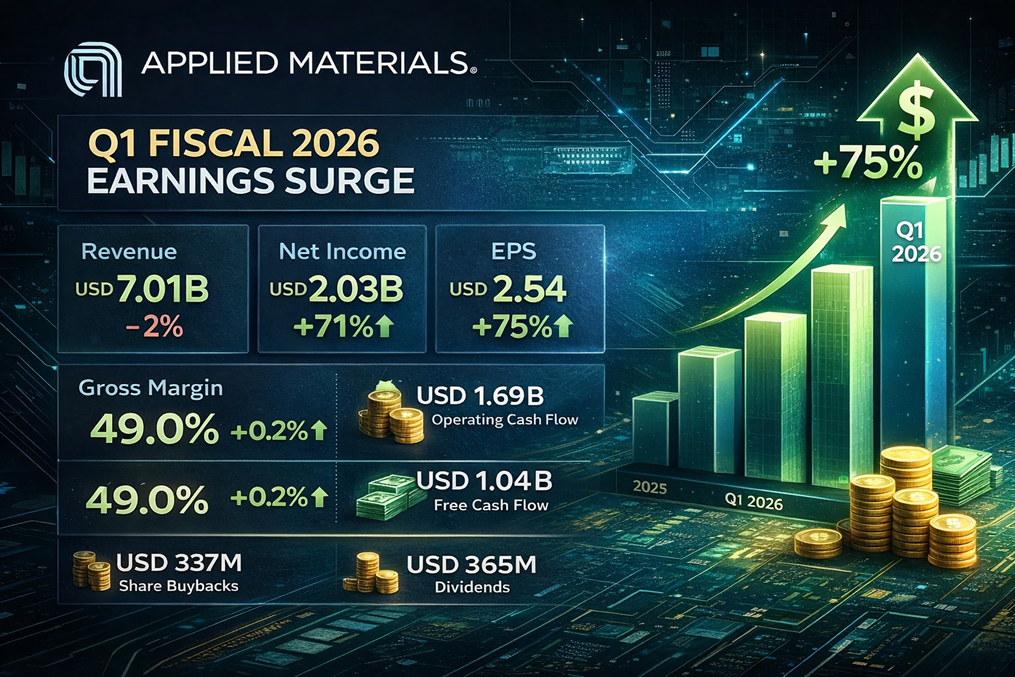
Image Source: Kalkine Group
Gross margin remained stable at 49.0%, compared with 48.8% in the prior year period, reflecting continued pricing discipline and operational efficiency. However, operating margin declined to 26.1% from 30.4% a year earlier, partly due to ongoing investments in research and development and capacity expansion. Non-GAAP operating margin was more stable at 30.0%, highlighting the company’s ability to sustain profitability despite incremental spending on future growth initiatives.
Cash generation remained robust. Applied Materials produced USD 1.69 billion in operating cash flow and USD 1.04 billion in non-GAAP free cash flow, representing a 91% increase compared with the prior-year quarter. Strong cash flow supported capital returns, including USD 337 million in share repurchases and USD 365 million in dividends, while maintaining investment in strategic initiatives.
AI Chip Demand and Semiconductor Equipment Growth Drive AMAT’s Strategic Position
A key driver of Applied Materials’ performance is accelerating demand for semiconductor equipment used in AI-related chip production. AI workloads require increasingly advanced logic chips, high-bandwidth memory, and advanced packaging solutions. These technologies require complex manufacturing processes, increasing reliance on specialized equipment.
Management highlighted record revenue from DRAM-related equipment, reflecting strong investment in memory technologies supporting AI applications. High-bandwidth memory, which is critical for AI accelerators, has emerged as a major growth area. Equipment demand tied to patterning, deposition, and advanced packaging processes is increasing as semiconductor manufacturers scale production to meet AI infrastructure requirements.
Semiconductor Industry Trends and Capital Spending Outlook Support Equipment Demand
The broader semiconductor equipment industry is benefiting from structural shifts in chip demand. Leading semiconductor manufacturers continue to invest in advanced manufacturing nodes, including gate-all-around transistor architectures and advanced memory technologies. These transitions increase process complexity, which typically requires more equipment per wafer, supporting long-term demand for semiconductor equipment suppliers.
Regional demand trends remain relatively balanced. Foundry and logic investment remains strong in key semiconductor manufacturing regions, including Taiwan, the United States, and South Korea. These markets are central to global semiconductor production and AI-related infrastructure expansion.
The company also reported that its book-to-bill ratio remains approximately at unity, indicating stable order intake relative to shipments. An elevated backlog further reflects sustained customer demand, even as supply chain conditions improve and lead times gradually normalize.
Applied Materials Technology Leadership in Advanced Packaging, EUV, and AI Chip Manufacturing
Applied Materials’ competitive positioning is closely linked to its leadership in materials engineering and semiconductor process technology. The company recently introduced deposition, etch, and materials modification systems designed to improve transistor performance at advanced manufacturing nodes, including 2-nanometer and beyond. These innovations support emerging chip architectures required for AI and high-performance computing.
Extreme ultraviolet (EUV) lithography adoption also creates opportunities for adjacent process steps such as deposition, etch, and metrology. As semiconductor manufacturers transition to smaller transistor geometries, process complexity increases, expanding demand for specialized equipment.
The company has also expanded manufacturing capacity and diversified its supply chain to improve production flexibility and reduce lead times. These measures support the company’s ability to meet customer demand in an environment characterized by increasing semiconductor capital expenditure.
Applied Materials Outlook: AI Infrastructure Investment and Semiconductor Equipment Demand Trends
Applied Materials’ latest earnings results highlight the company’s central role in supporting the semiconductor industry’s transition toward AI-driven computing. Earnings growth, stable margins, and strong cash flow reflect operational resilience and sustained demand for advanced semiconductor manufacturing equipment.
The structural expansion of AI infrastructure is reshaping semiconductor capital expenditure priorities, increasing demand for advanced manufacturing technologies. Applied Materials’ exposure to advanced packaging, memory, and logic manufacturing positions the company within key growth segments of the semiconductor ecosystem.
At the same time, semiconductor equipment demand remains influenced by cyclical and regulatory factors. The company’s performance will continue to depend on semiconductor capital expenditure trends, technology adoption cycles, and global regulatory developments.
Overall, the recent share price increase reflects market recognition of Applied Materials’ earnings strength and strategic positioning within the evolving semiconductor industry.
Technical Analysis (Daily Price Chart Analysis)
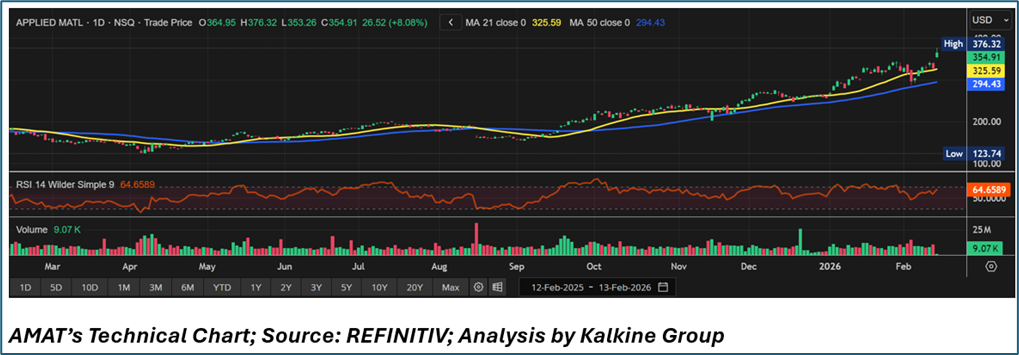
- Strong Uptrend Supported by Moving Average Structure: Applied Materials, Inc. (NASDAQ: AMAT) continues to exhibit a clear bullish trend, supported by consistent higher highs and higher lows. The stock closed at USD 354.91, remaining well above its 21-day moving average (USD 325.59) and 50-day moving average (USD 294.43). The upward slope and alignment of these averages indicate sustained buying interest and confirm strong short- and intermediate-term trend strength.
- Momentum Remains Positive Without Overbought Conditions: The RSI stands at approximately 64.7, reflecting healthy bullish momentum while remaining below overbought levels. The indicator’s position above the neutral 50 level suggests continued demand and positive sentiment. This momentum profile supports the broader uptrend without indicating excessive speculative positioning.
- Key Support and Resistance Levels Define Technical Outlook: Immediate resistance is positioned near the recent high of USD 376.32, which represents a key breakout level. On the downside, support is established near USD 325–330, aligned with the 21-day moving average, while stronger support lies near USD 290–295 at the 50-day moving average. Overall, the technical structure remains constructive, supported by trend strength and stable volume patterns.
Final Perspective
Applied Materials’ recent earnings performance and share price strength underscore its strategic positioning within the semiconductor equipment industry, particularly as AI-driven computing accelerates demand for advanced logic, memory, and packaging technologies. Despite a modest revenue decline, the company delivered strong earnings growth, stable gross margins near 49%, and robust operating and free cash flow, reflecting operational discipline and favourable product mix. Structural drivers including high-bandwidth memory expansion, advanced packaging adoption, and increased process complexity at leading-edge nodes continue to support equipment demand, while elevated backlog and stable order trends indicate sustained customer investment.
From a technical standpoint, the stock’s position above key moving averages and constructive momentum profile reinforces underlying strength. However, performance remains influenced by semiconductor capital expenditure cycles, regulatory factors, and industry cyclicality, making execution, technology leadership, and sustained AI-related investment critical determinants of Applied Materials’ longer-term operating trajectory.

_06_19_2026_04_14_48_775022.jpg)
 Jun 18, 2026
_06_19_2026_04_15_58_896873.jpg)
_06_19_2026_04_16_38_970455.jpg)
_06_19_2026_04_17_25_556135.jpg)
_06_19_2026_04_18_05_865257.jpg)
_06_19_2026_04_19_00_614719.jpg)
 Please wait processing your request...