
 AU
AU
 UK
UK
 CA
CA
 NZ
NZ
 IND
IND

 US
US

 Share
Share
 X (Formerly Twitter)
 Whatsapp
 Facebook
 LinkedIn
 Telegram
 Email This Article
 Copy Link
 Summarize with AI
 Chat GPT
 Perplexity
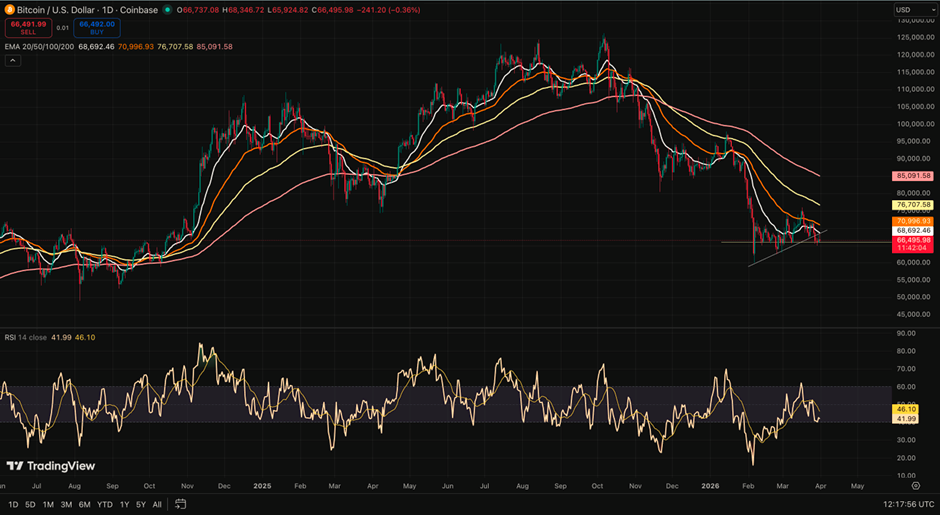
Source: tradingview.com, analysis by Kalkine Group
Bitcoin’s latest attempt to stabilise has once again faltered, with price action slipping back below a tightly clustered band of declining moving averages. At roughly $66,500, the asset remains structurally weak, unable to reclaim even its shortest-term trend indicators — a signal that selling pressure continues to dominate.
The technical backdrop is unambiguous. The 20, 50, 100 and 200-day exponential moving averages are aligned in a bearish sequence, forming a layered resistance structure that has repeatedly capped recovery efforts. The 20-day average near $68,700 has emerged as the immediate ceiling; each rally into this zone has been met with renewed supply rather than follow-through buying.
This configuration reflects more than short-term hesitation. It points to a broader transition from momentum-driven expansion to distribution. The failure of the early-2026 rebound — which briefly lifted Bitcoin towards the $68,000–$69,000 range — now appears increasingly characteristic of a bull trap rather than the start of a durable reversal.
Momentum indicators reinforce this reading. The relative strength index remains subdued in the low-40s, unable to sustain a move above the neutral 50 threshold. In trending markets, such persistent weakness typically signals that rallies are corrective in nature, not impulsive.
Attention is now shifting to the $60,000–$62,000 region, a support band that has so far contained the decline. Yet repeated tests risk eroding its integrity. A decisive break below this zone would likely expose a deeper retracement towards the $52,000–$54,000 range, extending the current drawdown and further entrenching bearish sentiment.
For bulls, the path to regaining control is clearly defined but remains distant. It would require a sustained move above the 20-day average, followed by confirmation through higher closes, improving momentum, and a progression towards the 50-day level near $71,000. At present, none of these conditions are in place.
From a broader perspective, Bitcoin’s near-50% retracement from its 2024 peak aligns with historical bear market dynamics. What remains absent, however, is the base-building phase typically required to transition back into a sustained uptrend.
Until such evidence emerges, the market appears locked in a familiar pattern: rallies that fail, resistance that holds, and a trend that continues to lean lower.


 Jun 05, 2026




 Please wait processing your request...