
 AU
AU
 UK
UK
 CA
CA
 NZ
NZ
 IND
IND

 US
US

 Share
Share
 X (Formerly Twitter)
 Whatsapp
 Facebook
 LinkedIn
 Telegram
 Email This Article
 Copy Link
 Summarize with AI
 Chat GPT
 Perplexity
Key Highlights
- The notable pullback comes amid industrial production weakness reduces demand for material handling equipment.
- Trading volume surged to 545.92K shares, with a relative volume of 1.21, indicating heightened institutional and retail interest in the stock.
- The company's market capitalization now stands at $481.96M, positioning it within the Manufacturing sector.
Shares of Columbus McKinnon (NASDAQ:CMCO) experienced a notable pullback on March 06, 2026, with the stock price dropping 9.1% to close at $16.77. The move caught the attention of both retail and institutional investors, as the company joined a broader wave of selling pressure that hit the industrials sector.
Why is CMCO stock falling today? The decline appears to be driven by a combination of company-specific developments and broader macroeconomic headwinds. Industrial production weakness reduces demand for material handling equipment. Concerns about customer capex pullback. For investors tracking this name, understanding the catalysts behind today's move is critical for making informed decisions about whether this represents a buying opportunity or a signal to reduce exposure.
In this comprehensive analysis, we break down the key factors driving CMCO stock's decline, examine the company's fundamental business model, review its recent financial performance, and provide context on what analysts and market participants are watching going forward. Whether you're a current shareholder or considering an entry point, this article covers everything you need to know about Columbus McKinnon's current situation.
What Moved the Stock Today
Company-Specific Catalysts
Industrial production weakness reduces demand for material handling equipment. Concerns about customer capex pullback. This development has rattled investor confidence in the near-term outlook for Columbus McKinnon, prompting a wave of selling that accelerated through the trading session. The heightened trading volume of 545.92K shares, significantly above normal levels, suggests that both retail traders and institutional investors were actively repositioning their portfolios.
Sector and Macroeconomic Factors
Industrial equipment market facing cyclical weakness. Manufacturing activity moderating. These broader market dynamics have created additional headwinds for CMCO, amplifying the impact of company-specific news. The Industrials sector as a whole has faced pressure in recent trading sessions, and Columbus McKinnon has not been immune to these prevailing winds.
Market Sentiment and Technical Factors
From a technical analysis perspective, CMCO's breach of key support levels appears to have triggered additional algorithmic and stop-loss selling. The stock's relative volume of 1.21 indicates participation well above average daily levels. Short sellers may also be contributing to downward pressure, as the notable pullback could attract momentum-driven traders looking to capitalize on negative sentiment. Market participants are now closely monitoring whether CMCO can establish a new support level or whether further downside remains ahead.
Key Reasons Behind the Move
- Earnings and Financial Performance: Columbus McKinnon's recent financial results have raised questions among investors. The company reported an EPS of $0.21 with year-over-year EPS growth of -35.01%. This negative growth trajectory has concerned analysts about the path to sustainable profitability.
- Valuation Concerns: At a current price of $16.77 and a market capitalization of $481.96M, the stock trades at a P/E ratio of 81.25, which appears elevated relative to sector peers, raising questions about whether the premium is justified.Investors are reassessing the risk-reward profile in light of today's developments.
- Broader Market Selloff: The decline in CMCO coincided with weakness across the broader industrials sector and general market volatility. Risk-off sentiment has led investors to reduce positions in higher-beta names, and Columbus McKinnon has been caught in this rotation out of growth and speculative holdings.
- Sector-Specific Headwinds: Industrial equipment market facing cyclical weakness. These industry-level challenges have weighed on investor sentiment for companies operating in the manufacturing space, creating a challenging environment for CMCO.
- Volume and Liquidity Dynamics: Today's trading volume of 545.92K represents a significant spike relative to average daily volume. This surge in activity suggests that larger institutional players may be rebalancing portfolios or exiting positions, adding to selling pressure and potentially exaggerating the magnitude of the price decline.
Company Overview
Business Model
Columbus McKinnon manufactures motion control products including hoists, cranes, and material handling equipment. The company serves industrial and construction markets globally. Columbus McKinnon generates revenue through manufacturing and selling hoists, chain hoists, and related equipment to distributors and end customers. Revenue also comes from aftermarket parts and services.
Revenue Sources
Columbus McKinnon generates revenue through several key channels:
- Hoist and crane equipment sales
- Motion control systems
- Aftermarket parts and service
- Equipment rental services
Growth Strategy
Expand into emerging markets and develop smart/connected hoisting solutions. Increase aftermarket service revenue and customer lifetime value.
Competitive Positioning
Established player in hoisting equipment with global distribution network. Facing competition from larger industrial equipment companies.
Stock Performance and Key Metrics
Understanding CMCO's recent stock performance provides important context for today's decline. Here is a snapshot of the company's key financial and trading metrics:
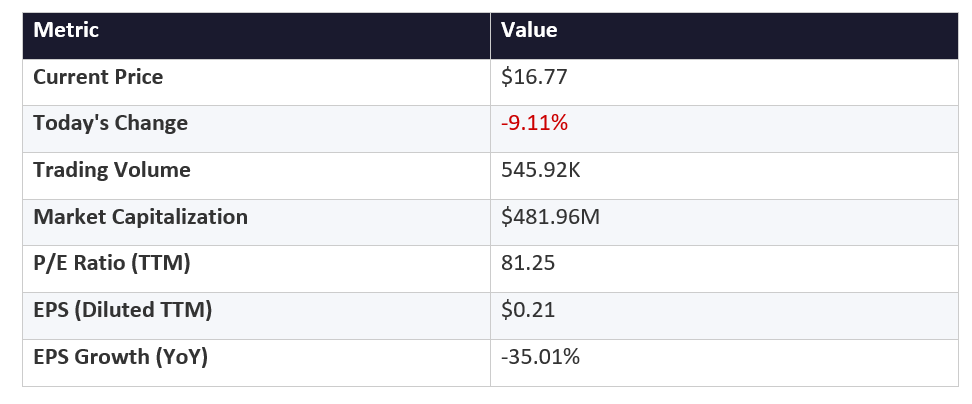
Within the Manufacturing industry, CMCO's 9.1% decline today puts it among the worst performers in the sector. The company's market cap of $481.96M places it in the small-to-mid cap category, where volatility tends to be more pronounced. The elevated P/E ratio of 81.25 suggests the market was pricing in significant growth expectations, which may now be at risk.
Industry and Market Context
To fully appreciate the significance of CMCO's decline, it is essential to understand the broader industry landscape in which Columbus McKinnon operates. The manufacturing sector has undergone significant transformation in recent years, driven by technological innovation, regulatory changes, and shifting consumer and enterprise demand patterns.
Industrial equipment market facing cyclical weakness. Manufacturing activity moderating. These dynamics have created both opportunities and challenges for companies like Columbus McKinnon. While the long-term secular trends in the space remain favorable, near-term headwinds including rising interest rates, geopolitical uncertainty, and supply chain disruptions have weighed on investor sentiment across the sector.
The competitive landscape within manufacturing continues to evolve rapidly. Larger, well-capitalized competitors are investing heavily in research and development, while smaller players like Columbus McKinnon must balance growth investments with the need to demonstrate a clear path to profitability. This dynamic has become increasingly important to investors in the current market environment, where patience for unprofitable growth stories has diminished considerably compared to the low-rate environment of prior years.
Regulatory developments also continue to shape the outlook for industrials companies. Government policies around trade, tariffs, and industry-specific regulations can have outsized impacts on company valuations and operating margins. For CMCO specifically, staying ahead of regulatory changes while executing on its growth strategy remains a critical balancing act that investors will continue to monitor closely.
What Analysts and Investors Are Watching
Looking ahead, several key factors will determine whether CMCO's current decline represents a temporary setback or the beginning of a more prolonged downturn. Market participants are closely monitoring the following developments:
- Industrial production trends
- Order backlog and pipeline
- Aftermarket revenue growth
- Gross margin trends
Wall Street analysts covering Columbus McKinnon are likely to revisit their price targets and earnings estimates in the coming days as they digest today's developments. Any downgrades or estimate revisions could create additional selling pressure, while reaffirmations of buy ratings could help stabilize the stock. Investors should pay close attention to analyst commentary for insights into the company's forward trajectory.
Institutional ownership patterns will also be worth monitoring. Quarterly 13F filings will reveal whether major fund managers are adding to or reducing their positions in CMCO. Significant changes in institutional ownership can signal shifting sentiment among the professional investment community and often precede sustained moves in either direction.
Risks Investors Should Know
Before making any investment decision regarding CMCO, investors should carefully consider the following risk factors that could impact the company's future performance and stock price:
- Cyclical industrial demand
- Competition from larger equipment manufacturers
- Supply chain disruptions
- Price competition
- Technology disruption
These risks are not exhaustive, and investors should conduct their own thorough due diligence before making investment decisions. The combination of company-specific and macro-level risks underscores the importance of proper position sizing and risk management when considering an investment in Columbus McKinnon.
Future Outlook and Growth Drivers
Despite today's sharp decline, Columbus McKinnon's long-term story is not solely defined by a single day's price action. Several potential growth catalysts could drive a recovery in the stock over the medium to long term, provided the company executes on its strategic vision:
- Smart equipment and connectivity solutions
- Emerging market expansion
- Aftermarket revenue growth
- Operational efficiency
The question investors must grapple with is whether CMCO's current valuation adequately reflects both the risks and opportunities ahead. At $16.77 per share with a market cap of $481.96M, the stock is priced at a level that could represent either a value trap or a compelling entry point, depending on how the company navigates the challenges ahead.
Management's ability to communicate a clear and credible path forward will be crucial in restoring investor confidence. Upcoming earnings calls, investor presentations, and strategic announcements will serve as important checkpoints for assessing whether Columbus McKinnon is on track to deliver on its stated objectives. Is CMCO a good investment? The answer depends largely on your investment time horizon, risk tolerance, and conviction in the company's ability to execute its growth strategy.
Investor Takeaways
Columbus McKinnon (CMCO) experienced a significant 9.1% decline on March 7, 2026, driven by a combination of company-specific catalysts and broader market headwinds. The selloff brought the stock to $16.77, with elevated trading volume suggesting meaningful institutional participation.
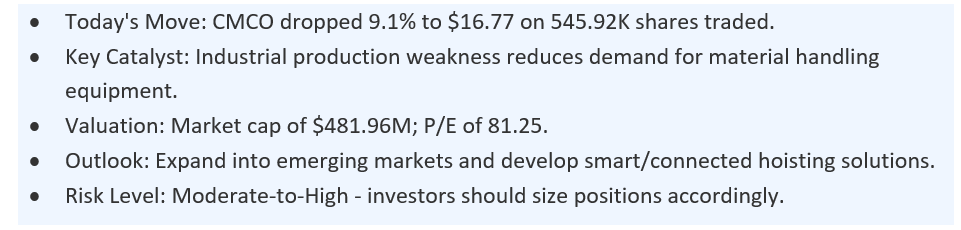
For current shareholders, today's decline warrants a careful reassessment of your investment thesis. If the fundamental reasons you initially invested in Columbus McKinnon remain intact, the pullback could represent an opportunity to add to your position at a lower cost basis. However, if the catalysts driving today's decline materially change your outlook, it may be prudent to reduce exposure.
For prospective investors considering a new position, patience may be warranted. Waiting for the stock to establish a clear support level and for management to provide updated guidance could help reduce the risk of catching a falling knife. What is the outlook for CMCO stock? While the near-term picture is clouded by uncertainty, the company's position in the manufacturing market and its strategic growth initiatives suggest there could be meaningful upside for investors with the right time horizon and risk appetite.
______________________________________________________________________
Disclaimer: This article is for informational purposes only and does not constitute financial advice. Investors should conduct their own research and consult with a qualified financial advisor before making any investment decisions. Past performance is not indicative of future results.


 Jun 13, 2026




 Please wait processing your request...