
 CA
 NZ
 UK
 AU
 IND

 US

 Share
 X (Formerly Twitter)
 Whatsapp
 Facebook
 LinkedIn
 Telegram
 Email This Article
 Copy Link
 Summarize with AI
 Chat GPT
 Perplexity
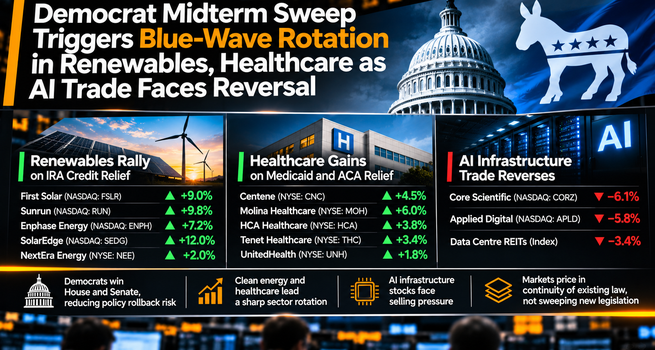
Key Highlights
1. Clean Energy Surges on IRA Credit Relief
First Solar (NASDAQ: FSLR) climbed as much as 9% in premarket trading as investors priced in reduced rollback risk for the Inflation Reduction Act's 45X domestic Manufacturing credits. Solar and storage names broadly gained 7-12%, marking one of the sharpest sector rotations of the year.
2. Healthcare Stocks Rally on Medicaid and ACA Reprieve
Centene (NYSE: CNC) and Molina Healthcare (NYSE: MOH) advanced 4.5% and 6% respectively, as markets bet that Democratic Leverage in 2027 appropriations negotiations would delay or soften scheduled Medicaid work requirements and ACA premium Subsidy expirations.
3. AI Infrastructure Trade Reverses as Capital Rotates
Data-centre pure plays including Core Scientific and Applied Digital fell in premarket as the rotation into policy-aligned sectors pulled capital from the AI exceptionalism trade that had dominated markets through the first three quarters of 2026.
Democrats' capture of both the House and Senate has set off a sharp repricing across U.S. Equity markets, with clean-energy and healthcare shares surging in premarket trading while artificial intelligence infrastructure stocks faced renewed selling pressure. The result — which analysts describe as a risk-premium adjustment rather than a forecast of sweeping new legislation — reflects the market's recalibration of the probability distribution around existing federal policy.
The immediate catalyst for the gains in renewable names is the reduced threat of further rollback of Inflation Reduction Act incentives. First Solar (NASDAQ: FSLR), the domestic thin-film module manufacturer, logged premarket gains of approximately 8-9%, a move that Mizuho analysts attributed in part to the company's direct exposure to the 45X manufacturing credit, which rewards U.S.-produced solar components. With domestic production capacity firmly in place, First Solar carries a structural advantage over pure importers in a world where those credits survive.
Residential solar installers including Sunrun (NASDAQ: RUN) advanced roughly 9-10%, while inverter and storage technology providers Enphase Energy (NASDAQ: ENPH) and SolarEdge Technologies (NASDAQ: SEDG) posted gains of 7-12%. For the latter two names, the policy bid matters especially because recent guidance had been soft; multiple expansion driven by reduced political risk premium offered a near-term Earnings narrative that fundamental results alone had not provided. Regulated Utility NextEra Energy (NYSE: NEE) moved modestly higher by approximately 2%, consistent with its lower pure-play Beta to the renewable development story.
On the healthcare side, the trade is a coverage-expansion thesis. Democrats have consistently flagged their intention to restore expired Affordable Care Act enhanced premium subsidies and push back on Medicaid work requirements that were written into prior legislation. Even without a legislative supermajority to pass sweeping reform, the new majority carries significant leverage in the 2027 appropriations cycle and in debt-ceiling negotiations. Centene (NYSE: CNC), the largest publicly listed ACA marketplace carrier with heavy Medicaid concentration, rose 4.5% in premarket trading. Molina Healthcare (NYSE: MOH), which derives approximately three-quarters of its premium Revenue from Medicaid, moved up 6%.
Hospital operators were also marked higher, with HCA Healthcare (NYSE: HCA) and Tenet Healthcare (NYSE: THC) gaining in the 3-4% range. The logic is straightforward: restored coverage translates directly into lower uncompensated care burdens, which flows to both Volume and margin. UnitedHealth Group (NYSE: UNH), which carries broader managed-care exposure with lower pure Medicaid concentration, was up modestly; it had already been a relative outperformer during the third quarter as capital rotated away from the technology sector.
The consumer staples and discount retail complex also received a bid on affordability grounds. Morgan Stanley had previously estimated that the SNAP and Medicaid cuts originally scheduled for implementation in 2027 would subtract approximately 20 basis points from real consumption growth in that year. A delay or Reversal of those cuts directly supports lower-income household spending capacity, reinforcing the Investment case for Walmart (NYSE: WMT) and Dollar General (NYSE: DG), which carry disproportionate exposure to value-seeking consumers.
The other side of the rotation tells a parallel story. AI infrastructure pure plays, data-centre real estate investment trusts, and high-valuation software names faced premarket pressure as money moved into policy-aligned sectors. Core Scientific and Applied Digital, which had benefited from the prior administration's permissive stance toward data-centre development, were among the names weaker in early trade. The rotation also reflected a softer dollar and lower Treasury yields, consistent with reduced odds of further pro-growth tax measures.
Market strategists at Barclays noted the result eases political risk on U.S. renewables and supporting infrastructure networks, a framing that broadly characterised the Sell-Side morning commentary. JPMorgan, Man Group, and State Street had each flagged consumer staples and healthcare as relative winners in a blue-sweep scenario; that call proved directionally correct within hours of the results becoming clear.
Investors and analysts cautioned that the veto constraint remains a binding one. The absence of a filibuster-proof Senate majority limits the scope for sweeping new legislation; what has actually changed is the risk premium applied to existing law, not the expectation of transformative new programs. The near-term market impact is primarily a sentiment and relative-positioning event. The concrete legislative catalysts to watch are the 2027 appropriations process, any formal text on ACA subsidy restoration, and Treasury guidance on IRA domestic content rules, all of which will materialise over the first half of next year.


 Nov 04, 2026





 Please wait processing your request...