
 AU
AU
 UK
UK
 CA
CA
 NZ
NZ
 IND
IND

 US
US

 Share
Share
 X (Formerly Twitter)
 Whatsapp
 Facebook
 LinkedIn
 Telegram
 Email This Article
 Copy Link
 Summarize with AI
 Chat GPT
 Perplexity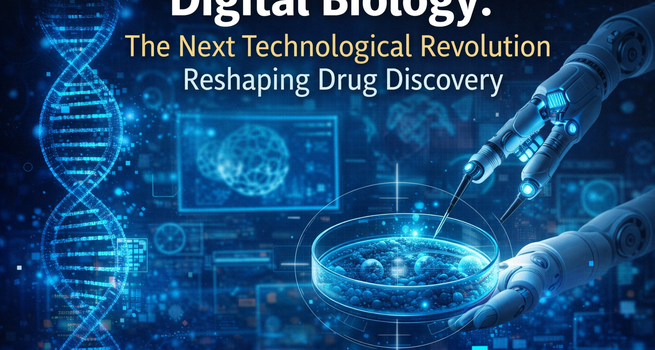
Key Highlights
- Digital biology aims to convert biological discovery into an engineering driven process.
- GPU powered computing and AI models are accelerating drug discovery timelines.
- Pharmaceutical R&D could shift from trial and error experimentation to predictive simulation.
- Technology companies are becoming critical infrastructure providers for life sciences.
- Investors are increasingly watching the intersection of AI, biotech, and high performance computing.
Introduction: Why Digital Biology Matters for Global Markets
The global pharmaceutical industry has historically relied on a slow and uncertain discovery process. Drug development often takes more than a decade and costs billions of dollars. Most experimental molecules fail before reaching the market.
However, a new technological framework is emerging that could fundamentally alter how medicines are discovered and developed. This approach is often described as digital biology.
Recent comments by Jensen Huang, the chief executive of NVIDIA, have intensified attention on this field. Huang argues that biology is transitioning from a scientific discipline based on experimentation to an engineering discipline powered by computation.
If this shift proves accurate, the implications for the pharmaceutical industry could be profound. Drug discovery timelines could shorten dramatically, development costs may fall, and new categories of therapies could emerge much faster than previously possible.
For investors, digital biology sits at the intersection of biotechnology, artificial intelligence, and advanced computing infrastructure. The sector may become one of the most significant long term drivers of innovation in global healthcare.
What Is Digital Biology?
Digital biology refers to the use of artificial intelligence, advanced simulation, and high performance computing to model biological systems.
Traditionally, biological research has been experimental. Scientists test hypotheses in physical laboratories, often through a long sequence of trial and error experiments. Each experiment generates data, but the process is slow and expensive.
Digital biology attempts to move much of this discovery process into a computational environment.
In practical terms, digital biology involves several key components.
- Biological Data Digitization
Large datasets from genomics, proteomics, molecular chemistry, and clinical trials are converted into machine readable data. This data becomes the foundation for training AI models.
- Predictive AI Models
Machine learning models analyze biological data to predict how proteins fold, how molecules interact with cells, and how potential drugs may behave in the body.
A major milestone in this area was the development of protein structure prediction systems such as AlphaFold by DeepMind.
- Simulation Based Drug Discovery
Instead of synthesizing thousands of molecules in physical laboratories, researchers can simulate molecular interactions digitally. Millions of potential drug candidates can be evaluated computationally before any real world testing occurs.
- High Performance Computing Infrastructure
Large scale GPU clusters powered by companies such as NVIDIA provide the computational capability required to run complex biological simulations.
Together, these tools transform biology into a data driven engineering problem.
Global Healthcare Industry Context: Rising Costs and R&D Bottlenecks
The pharmaceutical sector faces structural challenges that make digital biology particularly attractive.
Drug development costs have steadily increased over the past several decades. Estimates from industry studies suggest that bringing a new drug to market can cost more than $2 billion when accounting for failed trials.
Several structural factors contribute to these rising costs.
High Failure Rates
More than 90 percent of drug candidates fail during clinical trials. Many compounds fail because their biological interactions were poorly understood during early research stages.
Complex Biological Systems
The human body contains billions of interacting biochemical processes. Predicting how a new molecule will behave within this system remains extremely difficult using traditional methods.
Long Development Cycles
Drug development often takes 10 to 15 years from discovery to regulatory approval. This timeline creates substantial capital requirements and delays the arrival of new therapies.
Digital biology aims to address these bottlenecks by introducing computational modeling earlier in the discovery pipeline.
If researchers can accurately predict biological behavior before laboratory testing, the number of failed candidates could decline significantly.
Core Analysis: How Digital Biology Could Transform Drug Discovery
AI Driven Molecular Design
In traditional pharmaceutical research, scientists screen large libraries of molecules to identify potential drug candidates.
Digital biology allows AI models to generate entirely new molecular structures designed to interact with specific biological targets.
Instead of searching through existing compounds, researchers can computationally design new molecules with optimized properties.
This approach dramatically expands the possible universe of drug candidates.
Protein Folding and Structural Biology
Understanding protein structures is critical for drug discovery. Proteins control most biological functions and are often the targets of pharmaceutical therapies.
The problem is that predicting protein structures is extremely complex.
Systems such as AlphaFold have demonstrated that artificial intelligence can accurately predict protein structures from genetic sequences.
This capability accelerates the identification of drug targets and improves the precision of molecular design.
Simulation of Biological Systems
One of the most powerful aspects of digital biology is the ability to simulate biological processes before conducting physical experiments.
Researchers can model how potential drugs interact with proteins, cells, and metabolic pathways.
This simulation capability dramatically reduces the cost of early stage experimentation.
Instead of synthesizing thousands of molecules in laboratories, researchers can simulate millions of variations digitally.
Continuous Learning Systems
Another important feature of digital biology is the compounding nature of data.
Each experiment generates additional training data for AI models. Failed experiments become valuable inputs that improve future predictions.
Over time, these models become increasingly accurate.
This creates a feedback loop where discovery accelerates as the dataset expands.
Financial and Market Implications for Investors
Digital biology has important implications across several sectors.
Pharmaceutical Companies
Large pharmaceutical firms could benefit from faster and more efficient research pipelines.
Companies that successfully integrate AI driven discovery platforms may reduce development costs and bring therapies to market more quickly.
However, traditional R&D models may face disruption if technology driven competitors achieve significantly higher discovery productivity.
Technology Companies
Technology companies are emerging as essential infrastructure providers for digital biology.
Advanced computing platforms and GPU clusters supplied by firms such as NVIDIA are required to train and run large biological models.
This creates a new demand channel for high performance computing.
Biotechnology Startups
A new generation of biotech firms is being built around AI first discovery platforms.
These companies combine machine learning expertise with biological research capabilities.
Several venture backed startups are already applying AI driven drug design to areas such as oncology, rare diseases, and protein engineering.
Capital Allocation Trends
Investors are increasingly allocating capital toward companies that operate at the intersection of biotechnology and artificial intelligence.
Venture funding in computational biology platforms has grown rapidly over the past several years, reflecting expectations that the sector could redefine pharmaceutical innovation.
Strategic Outlook: The Long Term Evolution of Digital Biology
Digital biology remains in an early stage of development, but several trends suggest the sector will expand significantly.
Integration of AI and Biology
AI models are improving rapidly as datasets grow and computing power increases. This trend could dramatically enhance predictive accuracy in biological modeling.
Expansion of Biological Data
Advances in genome sequencing, medical imaging, and molecular profiling are generating massive new datasets. These datasets provide the raw material required to train increasingly powerful biological models.
Cloud Based Research Infrastructure
Many pharmaceutical companies are adopting cloud based computing environments that allow researchers to run large scale simulations without building internal infrastructure.
Collaborations Between Tech and Pharma
Technology firms, biotech startups, and pharmaceutical companies are forming partnerships to accelerate the adoption of AI driven research tools.
Over the long term, these collaborations could reshape how medicines are discovered and developed.
Conclusion
Digital biology represents a major shift in how humanity studies and manipulates biological systems.
For centuries, biological discovery has relied on experimentation and incremental insight. The emerging combination of artificial intelligence, high performance computing, and massive biological datasets introduces a new paradigm.
In this model, biological processes become computational problems that can be simulated, optimized, and engineered.
If this transformation continues, the pharmaceutical industry may move from a slow trial and error system to a faster and more predictable discovery engine.
For investors and industry participants, the convergence of AI, biotechnology, and advanced computing may become one of the most important innovation cycles of the coming decades.
FAQ
What is digital biology in simple terms?
Digital biology uses artificial intelligence and computer simulations to study biological systems. Instead of relying only on laboratory experiments, scientists analyze biological data using computational models to predict how molecules, proteins, and cells behave.
How does digital biology accelerate drug discovery?
AI models can simulate molecular interactions before laboratory testing begins. This allows researchers to screen millions of potential drug candidates digitally, reducing the number of expensive physical experiments and accelerating the discovery process.
Which technologies power digital biology?
Digital biology relies on machine learning, large biological datasets, high performance computing, and advanced simulation tools. GPU based computing platforms from companies such as NVIDIA play a critical role in training and running these complex models.
Why are investors interested in digital biology?
The technology could dramatically reduce drug development costs and timelines. This creates opportunities for pharmaceutical companies, biotechnology startups, and computing infrastructure providers that enable AI driven biological research.
Could digital biology replace traditional pharmaceutical research?
Digital biology is unlikely to completely replace laboratory research. However, it can significantly improve early stage discovery by predicting biological interactions before experiments are conducted, making the overall development process more efficient.


 Jun 16, 2026




 Please wait processing your request...