
 AU
AU
 UK
UK
 CA
CA
 NZ
NZ
 IND
IND

 US
US

 Share
Share
 X (Formerly Twitter)
 Whatsapp
 Facebook
 LinkedIn
 Telegram
 Email This Article
 Copy Link
 Summarize with AI
 Chat GPT
 Perplexity
This analysis is for informational purposes only and does not constitute financial advice.
Overview
As global equity markets attempt to stabilise following recent volatility, investors may be tempted to interpret the latest rebound in the S&P 500 as a compelling dip-buying opportunity. However, a measured and disciplined approach remains essential. While oversold technical conditions can trigger short-term rallies, the broader technical structure and weakening market breadth suggest that the current bounce lacks the conviction typically associated with durable reversals.
Rather than aggressively accumulating at these levels, investors may be better served by maintaining strategic patience and focusing on portfolio quality and risk management.
Key Takeaway
The S&P 500 and Nasdaq Composite continue to trade below their respective 50-day moving averages — a widely monitored indicator of intermediate trend direction. Until these key levels are reclaimed on a sustained basis with strong follow-through, the broader market outlook remains uncertain. A convincing technical shift has yet to materialise.

NASDAAQ Composite Price Chart. Image Source: tradingview.com, Analysis by Kalkine Group
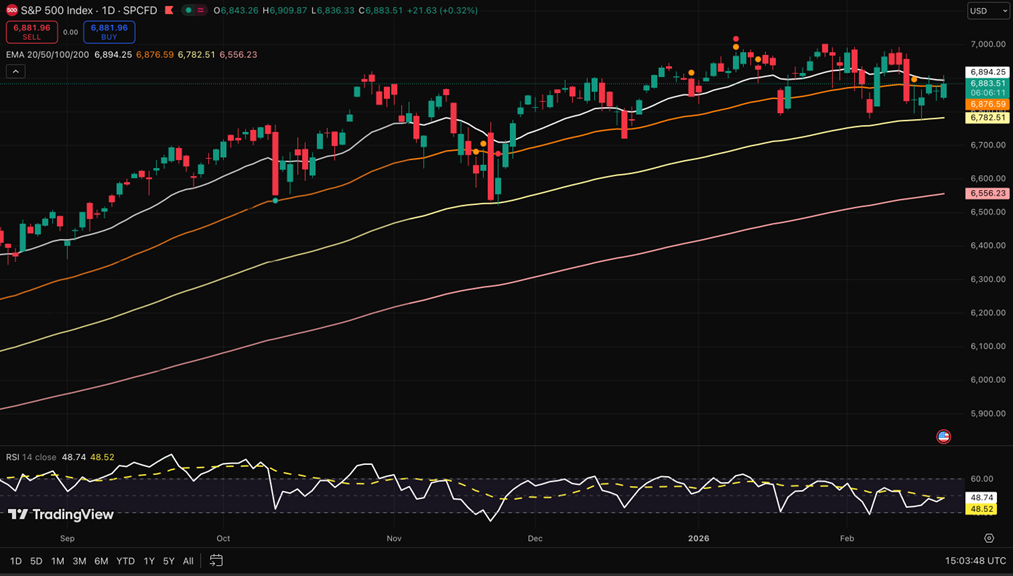
S&P 500 Daily Price Chart. Image Source: tradingview.com, Analysis by Kalkine Group
The Technical Picture: Bounce Without Conviction
At first glance, the recent recovery in U.S. equities appears constructive. Yet a deeper look at market internals paints a more cautious picture. Both major indices remain beneath their 50-day moving averages — a threshold often viewed as a dividing line between improving momentum and continued vulnerability.
More concerning is the lack of follow-through. Gains achieved during the rebound have frequently been retraced in subsequent sessions, a pattern more consistent with relief rallies or bear market bounces than the start of a sustained uptrend. A durable recovery typically features a series of higher highs and higher lows, supported by expanding volume and broad participation. Those conditions have not yet been firmly established.
Without sustained technical confirmation, the risk of another leg lower cannot be dismissed.
Sector Strategy: Trim Weakness, Respect Strength
From a sector rotation standpoint, this environment calls for selective repositioning rather than broad risk-on exposure.
Technology and Consumer Discretionary, both major beneficiaries of the previous bull cycle remain areas of vulnerability. Shifting rate expectations continue to weigh on valuation-sensitive growth stocks, while Consumer Discretionary faces potential headwinds from moderating spending trends. Investors may consider using the recent rebound to reduce exposure to weaker or underperforming names within these segments, thereby lowering portfolio risk without exiting entirely.
In contrast, Energy has emerged as a relative bright spot. Supported by firmer oil prices and improving relative strength metrics, the sector has demonstrated resilience amid broader market indecision. For those seeking exposure to commodity-linked or more defensive areas, Energy may currently present a comparatively stronger risk-reward profile.
Breadth and Momentum: Warning Signs Persist
Market breadth remains a critical concern. Sustainable advances are typically supported by widespread participation across sectors and market capitalisations. Yet the present rebound appears uneven, with leadership concentrated in selective pockets rather than broadly distributed across the equity landscape. This narrow participation profile raises valid questions about the durability of the move.
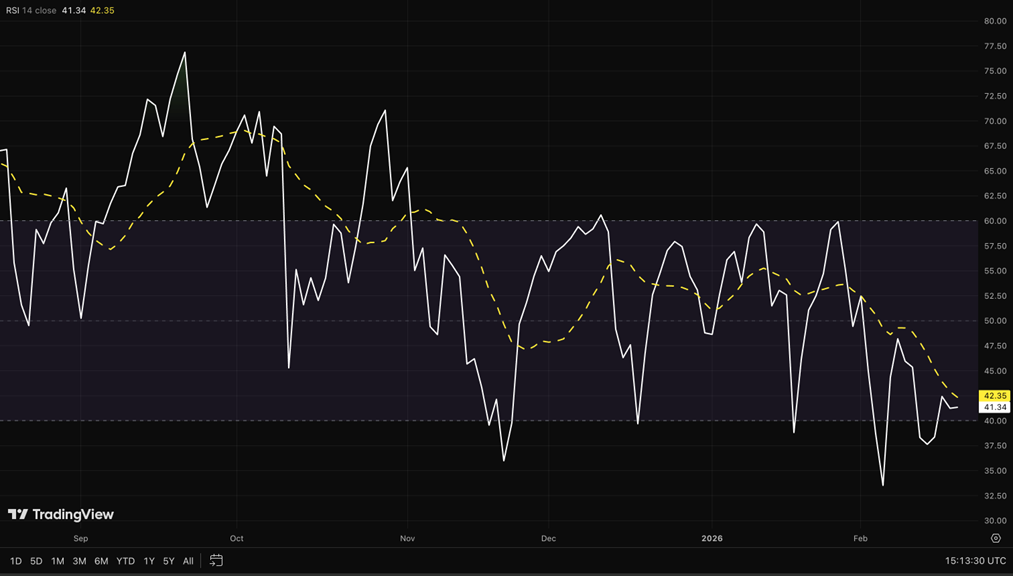
Relative Strength Index (14-D RSI), NASDAQ Composite. Image Source: tradingview.com, Analysis by Kalkine Group
The momentum picture reinforces that caution. The 14-day Relative Strength Index (RSI) on the Nasdaq Composite, as shown in the attached chart, has remained largely confined to the lower half of its range in recent months. Notably, rallies in RSI have repeatedly stalled near the 55–60 zone, well below the bullish 70 threshold, before rolling over again. This pattern reflects fading upside momentum rather than the emergence of sustained strength.
Although RSI has bounced from oversold territory near the 30 level on multiple occasions, those recoveries have lacked follow-through and have not transitioned into sustained bullish momentum regimes. Instead, the indicator continues to carve out lower highs, suggesting that buying pressure remains tentative.
In this context, oversold readings may continue to generate tactical rebounds, but without a decisive push above the 60 level, accompanied by improving breadth, momentum remains fragile. Until that shift occurs, the broader market recovery cannot be considered technically robust.
Risk Considerations
Participating aggressively in low-quality rallies, particularly those driven by short covering and technical oversold conditions rather than improving fundamentals can expose portfolios to renewed downside risk. In uncertain environments, capital preservation becomes a priority.
Investors who chase short-term rebounds without confirmation may find themselves navigating heightened volatility if the broader downtrend resumes.
Patience as a Strategy
In Kaline’s assessment, the present market setup calls for disciplined restraint. Selective opportunities may exist in fundamentally strong companies with durable earnings profiles and defensible competitive positions. However, the broader index-level risk-reward balance does not yet justify aggressive accumulation.
A more constructive signal would involve a decisive and sustained reclaim of the 50-day moving averages by both the S&P 500 and Nasdaq, accompanied by strengthening breadth and consistent follow-through across multiple sessions.
Until then, maintaining appropriate cash levels, trimming weaker exposures, and prioritising portfolio resilience may prove more prudent than chasing the current bounce.
Patience, in this context, is not inaction, it is a deliberate and strategic choice. Markets ultimately reward discipline. Waiting for clarity rather than acting on hope may offer investors more attractive entry points ahead.
Disclaimer: This article has been prepared by Kalkine Media for informational purposes only and does not constitute financial, investment, or legal advice. The information herein is based on publicly available sources believed to be reliable. Readers should conduct independent research and seek professional advice before making investment decisions. Past performance is not indicative of future results.
© 2026 Kalkine Equities LLC . All rights reserved.


 Jun 13, 2026




 Please wait processing your request...