
 AU
AU
 UK
UK
 CA
CA
 NZ
NZ
 IND
IND

 US
US

 Share
Share
 X (Formerly Twitter)
 Whatsapp
 Facebook
 LinkedIn
 Telegram
 Email This Article
 Copy Link
 Summarize with AI
 Chat GPT
 Perplexity
Gold and Silver prices weakened sharply on Tuesday, extending their recent pullback as investors turned cautious ahead of key U.S. economic data and closely watched diplomatic developments involving the United States and Iran. The broader precious metals complex also came under pressure, reflecting a fragile risk environment and subdued trading activity across global markets.
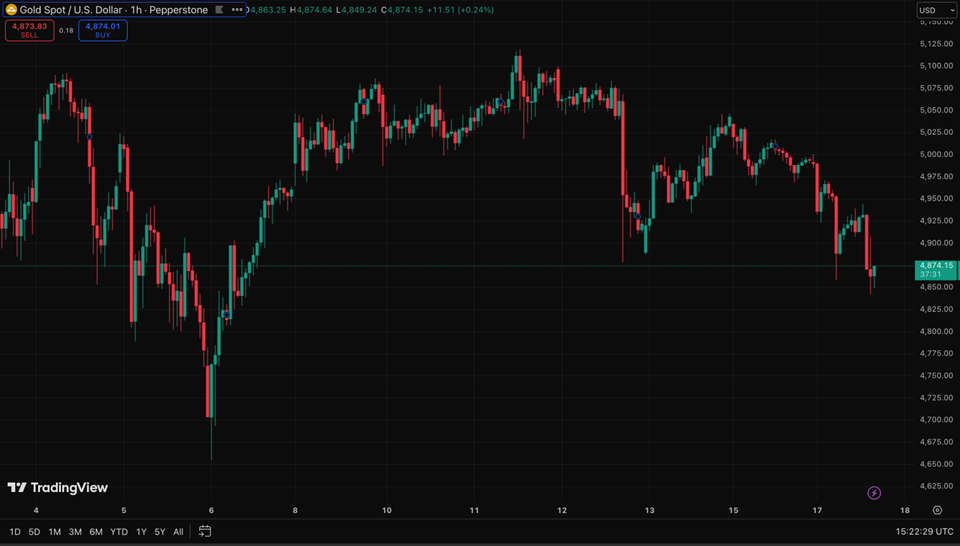
XAU/USD Hourly Chart. Image Source: tradingview.com
Spot gold declined more than 2% to trade near $4,871 per ounce, while April gold futures dropped over 2%, slipping below the $4,950 mark. Silver posted steeper losses, sliding over 5%, while platinum prices also retreated, underscoring broad-based weakness across the metals space.
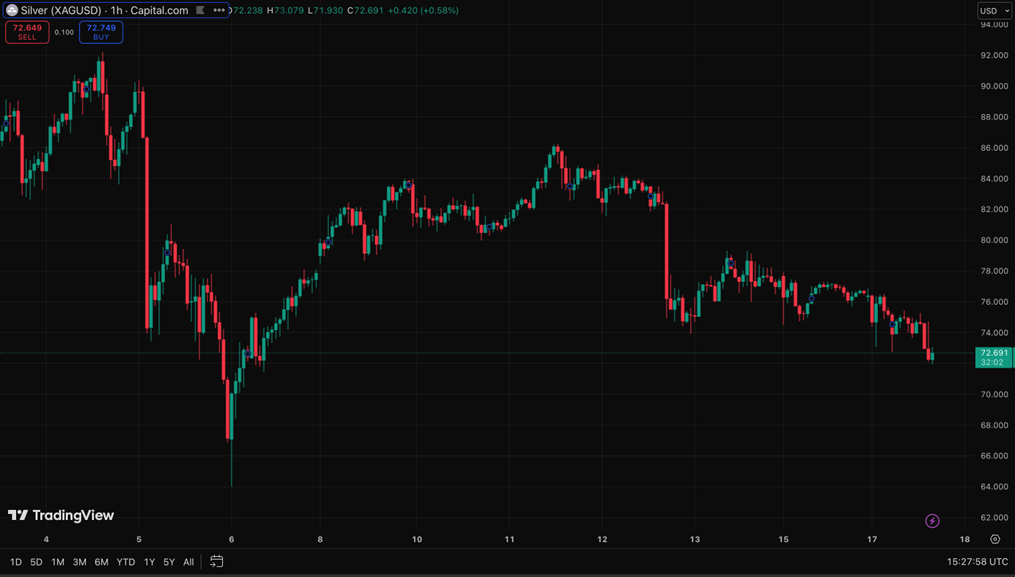
XAG/USD Hourly Price Chart. Image Source: tradingview.com
Thin liquidity conditions added to the volatility. Market holidays in both the U.S. and China dampened participation, amplifying price swings. At the same time, a modest uptick in the U.S. dollar index weighed on dollar-denominated commodities, further pressuring gold and silver prices.
U.S.-Iran Nuclear Talks Fail to Lift Safe-Haven Demand
Investor attention remains firmly fixed on diplomatic talks between U.S. and Iranian officials in Geneva, aimed at reviving discussions around Tehran’s nuclear program. The negotiations are unfolding against a backdrop of elevated geopolitical tension in the Middle East, marked by increased military activity and strategic posturing on both sides.

Image Source: Kalkine Group
Despite these developments, gold failed to attract its usual safe-haven flows. Market participants appear hesitant to rebuild long positions after the sharp correction seen since late January, when precious metals retreated from record highs amid aggressive profit-taking.
The muted response suggests that geopolitical risk alone may no longer be sufficient to drive sustained upside in gold prices, particularly when broader macroeconomic uncertainties dominate investor thinking.
U.S. Economic Data and Fed Outlook Take Center Stage
The near-term direction of gold prices is increasingly tied to upcoming U.S. macroeconomic indicators and expectations around interest rate policy. This week’s calendar includes industrial production data and, more importantly, the Personal Consumption Expenditures (PCE) price index, the Federal Reserve’s preferred inflation gauge.
Markets are also awaiting the release of the Federal Reserve’s January meeting minutes, which could provide further clarity on policymakers’ thinking around inflation persistence and the timing of potential rate cuts.
Uncertainty surrounding U.S. monetary policy has emerged as a major headwind for precious metals in recent weeks. Concerns that interest rates could remain higher for longer have reduced gold’s appeal, particularly after the metal’s strong speculative rally earlier this year.
Adding to the pressure, recent developments around the future leadership of the Federal Reserve have unsettled markets. Expectations of a less accommodative policy stance have prompted investors to reassess exposure to non-yielding assets such as gold.
Precious Metals Face a Test of Confidence
While long-term structural drivers for gold, including inflation hedging and geopolitical risk remain intact, near-term sentiment has clearly shifted. Traders are increasingly focused on economic fundamentals, real yields, and central bank policy signals, rather than headline-driven risk events.
Until clearer signals emerge from U.S. inflation data and the Federal Reserve, gold prices may continue to face resistance, with volatility likely to remain elevated across the precious metals market.

_06_19_2026_04_14_48_775022.jpg)
 Jun 18, 2026
_06_19_2026_04_15_58_896873.jpg)
_06_19_2026_04_16_38_970455.jpg)
_06_19_2026_04_17_25_556135.jpg)
_06_19_2026_04_18_05_865257.jpg)
_06_19_2026_04_19_00_614719.jpg)
 Please wait processing your request...