
 AU
AU
 UK
UK
 CA
CA
 NZ
NZ
 IND
IND

 US
US

 Share
Share
 X (Formerly Twitter)
 Whatsapp
 Facebook
 LinkedIn
 Telegram
 Email This Article
 Copy Link
 Summarize with AI
 Chat GPT
 Perplexity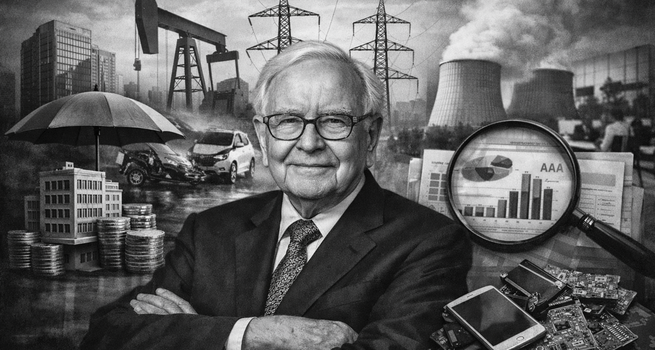
Key Highlights
- Berkshire Hathaway raised its 13F equity portfolio value to about 274 billion dollars in Q4 2025, with the top five holdings comprising nearly 70 percent.
- New exposure was added through a small stake in NYT, while positions in CVX, CB, and DPZ were further increased.
- AMZN saw a sharp reduction, alongside continued trimming in AAPL and BAC to lock in gains.
- Core long term holdings such as AXP, KO, and MCO were left unchanged, reinforcing a concentrated conviction driven strategy.
- Energy and insurance allocations expanded, signalling a steady rotation toward cash flow resilience and durable earnings streams.
Berkshire Hathaway’s latest regulatory filing offers a careful glimpse into how capital is being repositioned at Berkshire Hathaway Inc. As disclosed in the firm’s Form 13F filed on February 17, 2026, the value of its listed US equity portfolio rose to about 274 billion dollars at the end of the fourth quarter of 2025, up from roughly 267 billion dollars three months earlier. The rise was steady rather than dramatic. The changes within it were measured.
The portfolio remains highly concentrated. Five holdings account for close to 70 percent of reported assets. Those positions are Apple Inc. (NASDAQ: AAPL), American Express Company (NYSE: AXP), Bank of America Corporation (NYSE: BAC), The Coca Cola Company (NYSE: KO), and Chevron Corporation (NYSE: CVX). Concentration has long been a defining trait of Berkshire’s equity strategy. Conviction matters more than diversification for its chairman.
In total, the filing lists 40 positions. Many are small relative to the scale of the conglomerate. A few adjustments, however, reveal the direction of travel.
A modest media addition – (NYSE: NYT)
The only new position in the quarter was The New York Times Company (NYSE: NYT). The stake represents around 0.13 percent of the portfolio and was acquired at prices between approximately 54 and 71 dollars per share. The stock now trades above that range near 74 dollars. By Berkshire standards the position is small. Yet it reflects an interest in subscription driven models with recurring revenue and pricing power. Buffett has long expressed admiration for businesses that can charge modestly more each year without losing customers.
Energy and insurance receive fresh capital
Chevron Corporation (NYSE: CVX) saw another increase. The holding now accounts for more than 7 percent of the portfolio. Berkshire added roughly 7 percent to its stake during the quarter. It owns about 6.2 percent of the company. The position was first built during the market weakness of 2020 and has since been actively adjusted. With shares trading near 181 dollars, the investment remains central to Berkshire’s energy exposure.
Insurance also drew attention. Chubb Limited (NYSE: CB) was increased by around 9 percent in the quarter and now represents close to 4 percent of the portfolio. Berkshire owns roughly 8.5 percent of the insurer. Since first revealing the position in 2023, after confidential treatment expired, the company has steadily accumulated shares. The appeal is plain. Insurance generates float, and float provides investable capital.
In consumer businesses, Domino’s Pizza Inc. (NYSE: DPZ) was lifted by about 12 percent. The stock trades near 374 dollars, below much of Berkshire’s earlier purchase range. The firm now owns close to 9.9 percent of the pizza chain. The increase suggests a willingness to add when valuations moderate.
Smaller additions were made to Lamar Advertising Company (NASDAQ: LAMR) and other existing holdings.
Profits taken in large technology and banking names: AMZN, AAPL and BAC
On the selling side, Apple Inc. (NASDAQ: AAPL) was trimmed again. The position still accounts for about 23 percent of the portfolio. The stake, originally built at an adjusted cost near 35 dollars per share, was reduced by roughly 4 percent in the quarter. With shares around 264 dollars, Berkshire continues to realize gains while retaining a dominant exposure.
Bank of America Corporation (NYSE: BAC) was also cut by about 9 percent. The bank trades near 52.74 dollars. Berkshire’s overall cost basis is around 14 dollars per share, reflecting gains accumulated over many years. The ownership stake now stands near 6.8 percent.
Amazon.com Inc. (NASDAQ: AMZN) experienced a sharper reduction. The position was lowered by approximately 77 percent during the quarter. Shares trade near 201 dollars. The sale continues a broader pattern of harvesting gains in technology and financial holdings that have appreciated substantially.
Enduring holdings remain untouched
American Express Company (NYSE: AXP) and The Coca Cola Company (NYSE: KO) remain long held core positions. Their cost bases, about 8.49 dollars and 3.25 dollars respectively, illustrate the compounding effect of time and retained earnings.
Moody’s Corporation (NYSE: MCO) also remains steady at about 4.6 percent of the portfolio. With shares near 423 dollars and a cost basis just above 10 dollars, it stands as one of Berkshire’s most successful long term investments. The conglomerate owns roughly 13 percent of the rating agency.
Energy exposure extends further through Occidental Petroleum Corporation (NYSE: OXY). Including common shares and warrants, Berkshire controls close to one third of the company. The structure of the preferred shares and warrants gives the position strategic as well as financial weight.
Beyond the filing
Investments in Japanese trading houses such as ITOCHU Corporation, Mitsubishi Corporation and Mitsui and Co. have appreciated since their purchase in 2020. These positions are not detailed in the US 13F filing but remain significant to Berkshire’s global strategy. Meanwhile, the group completed its exit from BYD Company Limited in 2025 after several years of gradual reduction.
A study in disciplined adjustment
The fourth quarter activity does not signal a change in philosophy. Instead, it reflects disciplined capital allocation. Gains in large technology and banking holdings are being realised gradually. Capital is being directed toward energy, insurance and selected consumer franchises where earnings durability appears strong.
With about 70 percent of assets concentrated in five companies, Berkshire’s approach continues to favour conviction over diffusion. The filing shows movement, but not restlessness. It suggests a recalibration shaped by valuation, cash flow resilience and long term return expectations.
This article is based on publicly available regulatory filings and is intended for informational purposes only. It does not constitute investment advice or a recommendation to buy or sell any security. Investors should conduct their own due diligence and consider their financial circumstances before making investment decisions.


 Jun 13, 2026




 Please wait processing your request...