
 AU
AU
 UK
UK
 CA
CA
 NZ
NZ
 IND
IND

 US
US

 Share
Share
 X (Formerly Twitter)
 Whatsapp
 Facebook
 LinkedIn
 Telegram
 Email This Article
 Copy Link
 Summarize with AI
 Chat GPT
 Perplexity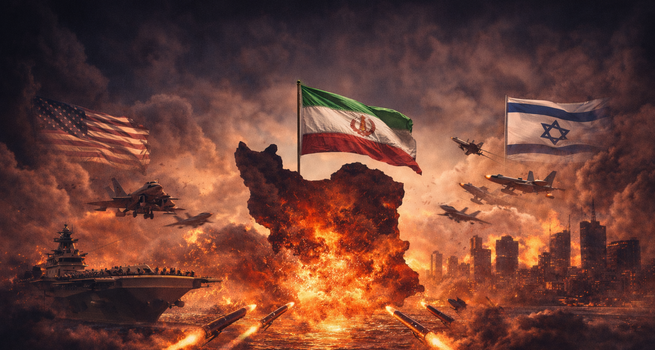
Key Highlights
- Operation Epic Fury has intensified geopolitical risk across global capital markets.
- Oil prices and defence stocks reflect a rising World War III risk premium.
- The Russia–China–Iran alignment raises structural macroeconomic and regulatory uncertainty.
- Precision warfare now competes with mass drone production, altering cost economics.
- Institutional investors reassess growth outlook amid expanding second-theatre conflict risk.
Escalation and Market Structure
On February 28, 2026, the United States and Israel launched Operation Epic Fury against Iran, targeting leadership compounds and missile infrastructure. By March 1, Tehran confirmed the death of Ayatollah Ali Khamenei. Retaliatory strikes followed against U.S. bases in Bahrain and Qatar, widening the theatre.
The immediate military exchange was visible. The broader market reaction was structural.
Brent crude rose sharply as the Strait of Hormuz risk premium re-emerged. Defence contractors outperformed broader indices. Treasury yields oscillated between safe-haven demand and inflation anxiety. Volatility indices reflected a repricing of geopolitical tail risk rather than a temporary shock.
The deeper concern is not whether this becomes a conventional global war in the mould of 1939. It is whether markets are entering a prolonged gray-war regime — a conflict model where kinetic strikes coexist with cyber disruption, satellite interference, supply-chain sabotage and algorithmic manipulation.
If a third world war emerges, it may not resemble the industrial wars of the 20th century. It would be financially interconnected, technologically mediated and economically persistent.
The Gray War Framework
Modern conflict rarely begins with formal declarations. It accumulates through incremental escalations: sanctions, proxy engagements, cyber intrusions and financial isolation.
The Iran theatre did not begin in February 2026. It reflects years of nuclear diplomacy breakdown, regional proxy friction and expanding military cooperation between Russia, China and Iran.
In this environment, digital infrastructure becomes strategic terrain. Information operations influence domestic opinion. Financial markets transmit pressure. Currency volatility, energy pricing and trade routes are weaponised.
The objective in gray-war dynamics is often systemic destabilisation rather than territorial conquest. It is about weakening cohesion and stretching fiscal capacity over time.
This is not simply military strategy. It is macroeconomic confrontation.
The Triple-Threat Architecture
A defining element of the current escalation is the coordination between Russia, China and Iran. Though not a formal alliance, the cooperation is increasingly operational.
Russia has supplied advanced air defence systems and platforms such as the Su-35 fighter jet, designed to challenge stealth aircraft. That complicates assumptions of uncontested air superiority.
China provides resilience in communications and navigation. Its BeiDou satellite network functions as a GPS alternative, offering redundancy in contested environments. Satellite expansion also enhances signals intelligence capabilities, particularly across strategic maritime corridors.
Iran contributes scale. Its ballistic missile inventory and drone production prioritise affordability and volume. High-altitude long-endurance platforms and swarm tactics alter the economics of air defence.
The combined architecture narrows technological asymmetry and shifts the cost equation of conflict.
Precision Versus Mass: The Cost Economics of War
The United States relies heavily on precision-guided munitions such as Tomahawk cruise missiles. These deliver high strategic accuracy but at significant cost per unit.
By contrast, Russia, Iran and China have expanded production of lower-cost drones and missile systems. Industrial scale and state-directed manufacturing enable sustained output.
This divergence introduces a structural financial consideration. A multi-million-dollar interceptor may neutralise a drone costing a fraction of that amount. Over time, sustained engagements test fiscal durability rather than tactical capability alone.
Defence procurement budgets may rise materially. Higher spending widens fiscal deficits. Expanded Treasury issuance influences bond yields. Elevated yields compress equity valuations, particularly for long-duration growth stocks.
War economics feeds directly into capital allocation and valuation frameworks.
Energy Infrastructure and Inflation Transmission
Iran’s geographic position remains central. The Strait of Hormuz channels a substantial share of global oil exports. Even limited disruptions reprice crude markets rapidly.
Energy inflation cascades across supply chains. Transport costs increase. Industrial margins narrow. Central banks face renewed trade-offs between inflation containment and growth support.
Institutional investors must consider a dual-shock scenario:
- Supply-side energy inflation.
- Fiscal expansion through defence expenditure.
Both challenge earnings projections and equity multiple assumptions.
The stock market is responding not only to military developments but to the prospect of a structurally altered macroeconomic regime.
The Strategic Trap Thesis
Some analysts argue that the United States risks entering a prolonged second theatre of war while Russia remains engaged in Ukraine. Sustained engagement stretches logistics, inventories and fiscal capacity.
From a strategic standpoint, extended conflict absorbs resources and political focus. Over time, public debt rises and domestic divisions widen.
Gray-war dynamics amplify internal fragmentation. Information operations, social media influence and political polarisation compound fiscal strain.
Markets recognise that geopolitical stress interacts with domestic politics. That interaction raises volatility and risk premiums across asset classes.
Air Dominance and Its Constraints
The United States retains advantages in stealth aviation and carrier strike group mobility. Israel’s missile defence architecture remains operationally effective against many projectile classes.
However, hypersonic systems and saturation drone attacks stress defensive layers. No system is impermeable. The contest becomes one of endurance, cost ratios and industrial replenishment.
Markets respond accordingly. Insurance premiums, shipping rates and defence equities embed probabilistic risk adjustments rather than binary assumptions of security.
Regulatory and Financial Fragmentation
Escalation often accelerates sanctions regimes. Financial institutions face compliance complexity. Payment networks risk fragmentation as geopolitical blocs seek autonomy.
A bifurcated financial system increases transaction costs and reduces cross-border capital efficiency. Emerging markets dependent on energy imports face currency volatility and balance-of-payments stress.
Technology regulation may tighten under national security justifications. Export controls on semiconductors and satellite components could expand.
Thus, World War III risk, if it materialises, would manifest not only in military theatres but in regulatory and financial architecture.
Is This the Beginning of World War III?
The phrase “World War III” implies global mobilisation and formal alliances. Contemporary conflict may unfold differently: decentralised, technologically integrated and economically entangled.
If such a war emerges, it may not begin with a single declaration. It may evolve through overlapping theatres, financial sanctions, digital disruption and energy leverage.
Markets care less about terminology than about duration and scale. A short, contained escalation could stabilise risk premiums. A prolonged multi-theatre confrontation would reshape globalisation, supply chains and capital flows.
Probability distributions remain fluid. Policy decisions in Washington, Jerusalem, Tehran, Moscow and Beijing will determine whether escalation consolidates or stabilises.
Capital Markets in a Higher-Risk Regime
From a valuation perspective, several pathways exist:
- Contained escalation: temporary oil spike, defence sector outperformance, moderate volatility.
- Prolonged conflict: structurally higher energy prices, sustained fiscal deficits, equity multiple compression.
- Geopolitical bloc formation: accelerated de-globalisation, reduced productivity growth, higher cost of capital.
Institutional investors must recalibrate growth outlook assumptions and liquidity expectations accordingly.
The central question is not whether markets can absorb a shock. It is whether they must adapt to a sustained reordering of geopolitical and industrial power.
Conclusion: Dominance Under Review
Operation Epic Fury represents an inflection point, but the structural contest predates it. The Russia–China–Iran coordination, industrial-scale drone capacity and satellite redundancy reflect a new strategic architecture.
This environment challenges long-standing assumptions of uncontested dominance. Precision confronts mass. Fiscal capacity confronts industrial throughput. Financial markets become both signal and instrument.
Whether this ultimately constitutes World War III remains uncertain. What is clearer is that the global risk framework has shifted.
For capital markets, that structural repricing of geopolitical endurance may prove more consequential than any single strike.


 Jun 13, 2026




 Please wait processing your request...