
 AU
AU
 UK
UK
 CA
CA
 NZ
NZ
 IND
IND

 US
US

 Share
Share
 X (Formerly Twitter)
 Whatsapp
 Facebook
 LinkedIn
 Telegram
 Email This Article
 Copy Link
 Summarize with AI
 Chat GPT
 Perplexity
Meta Platforms 2025 Financial Performance: Revenue Growth and Advertising Momentum
Meta Platforms entered 2026 following a year of robust financial expansion. In the fourth quarter of 2025, total revenue reached $58.9 billion, representing a 25% year-over-year increase. Advertising remained the dominant contributor, with Family of Apps ad revenue of $58.1 billion, up 24% (23% on a constant currency basis).
Two primary metrics underpinned this performance:
- Ad impressions increased 18%, reflecting sustained user engagement and optimization of ad load.
- Average price per ad rose 6%, indicating improved advertiser demand and performance gains.
Management attributed the uplift partly to advancements in recommendation systems and AI-driven ad ranking models. Conversion rates improved following infrastructure upgrades and model scaling efforts. The combination of higher volume and pricing power suggests that Meta’s monetization engine remains structurally resilient, even amid macroeconomic uncertainty.
Beyond advertising, Family of Apps’ other revenue grew 54% to $801 million, driven largely by WhatsApp paid messaging and MetaVerified subscriptions. While small relative to advertising, these streams indicate incremental diversification within the broader ecosystem.
User Engagement and Platform Growth: Daily Active People Surpass 3.5 Billion
Meta’s scale remains a defining competitive asset. In December, more than 3.5 billion people used at least one of its applications daily. Engagement metrics showed measurable improvements across key surfaces:
- Facebook feed and video views increased 7% following ranking optimizations.
- Same-day Reels surfaced on Facebook rose more than 25% sequentially.
- On Instagram, original content now accounts for 75% of US recommendations.
- Time spent on Threads increased 20% after recommendation enhancements.
AI-driven personalization is central to these gains. Meta has begun integrating large language models (LLMs) into recommendation pipelines, improving contextual understanding of content and user intent. The company’s foundational ads model, GEM, and unified architecture, Lattice, contributed to higher ad quality and measurable conversion improvements.
In parallel, Meta AI adoption accelerated. Daily actives generating media tripled year over year, and AI-powered media creation within Reels nearly tripled sequentially. These developments illustrate how AI is influencing both content creation and monetization efficiency.
AI Infrastructure and Capital Expenditure: Meta’s $115–$135 Billion Investment Plan
A central theme of Meta Platforms’ 2025-2026 strategy is aggressive infrastructure investment. Fourth-quarter capital expenditures totaled $22.1 billion, primarily directed toward data centers, servers, and network capacity.
For full-year 2026, capital expenditures are projected between $115 billion and $135 billion. The majority will support Meta Superintelligence Labs and core infrastructure expansion under the MetaCompute initiative. This represents a substantial step-up in spending and underscores management’s conviction in AI as a long-term growth driver.
Total expenses for 2026 are expected between $162 billion and $169 billion, with infrastructure and technical talent hiring as primary contributors. Employee headcount exceeded 78,800 at year-end, up 6% year over year, reflecting AI and engineering recruitment.
Despite elevated investment levels, management expects 2026 operating income in absolute dollars to exceed 2025 levels. Free cash flow in Q4 2025 was $14.1 billion, and Meta ended the quarter with $81.6 billion in cash and marketable securities against $58.7 billion in debt. The balance sheet remains positioned to fund multi-year infrastructure expansion, though external financing remains a possible supplementary tool.
Reality Labs and Immersive Media: Measured Progress Amid Losses
Reality Labs generated $955 million in Q4 revenue, down 12% year over year due to comparisons with the prior launch cycle and retail channel dynamics. Operating losses are expected to remain similar in 2026 before gradual improvement in subsequent years.
Strategic focus has shifted toward AI-enabled glasses and wearables, alongside mobile expansion of Horizon. Management has framed immersive media as a longer-term evolution of digital interaction rather than a near-term profit center.
While the segment continues to weigh on consolidated margins, capital allocation reflects prioritization of AI infrastructure and core advertising capabilities over aggressive hardware scaling.
2026 Revenue Outlook and Operating Income Expectations
For the first quarter of 2026, revenue is projected in the range of $53.5 billion to $56.5 billion, supported by strong advertiser demand and an estimated 4% foreign currency tailwind. Management also indicated expectations for full-year operating income to exceed 2025 levels in absolute terms.
However, growth rates may moderate later in the year due to:
- Diminishing currency benefits.
- More challenging year-over-year comparisons.
- Adjustments to less-personalized advertising offerings in the European Union.
The full-year 2026 tax rate is expected between 13% and 16%, assuming no material changes in the tax environment.
Regulatory and Legal Risks: EU and US Headwinds
Meta disclosed ongoing regulatory scrutiny in both the European Union and the United States. Trials scheduled in 2026, particularly around youth-related issues, may result in material outcomes. Additionally, updated EU ad offerings aligned with regulatory requirements could affect monetization efficiency in certain regions.
These factors introduce uncertainty into forward growth trajectories and underscore the importance of geographic diversification.
Strategic Positioning in AI and Digital Advertising
Meta’s 2025-2026 performance reflects two intertwined dynamics: strong core advertising momentum and an unprecedented scale-up in AI infrastructure investment. The advertising business continues to generate substantial cash flow, benefiting from enhanced recommendation systems and improved ad ranking models. At the same time, the company is committing significant capital toward long-term AI capabilities, including model unification, infrastructure ownership flexibility, and compute optimization.
The strategic tension lies in balancing short-term profitability with long-term capacity building. Management’s guidance suggests confidence in maintaining operating income growth despite expanded capital commitments.
In aggregate, Meta Platforms enters 2026 as a company leveraging scale, data, and AI integration to reinforce its advertising franchise while positioning for broader shifts in digital interaction. Financial strength provides latitude for investment, yet regulatory developments and execution risks remain material variables in assessing the company’s medium-term trajectory.
Technical Analysis (Daily Price Chart Analysis)
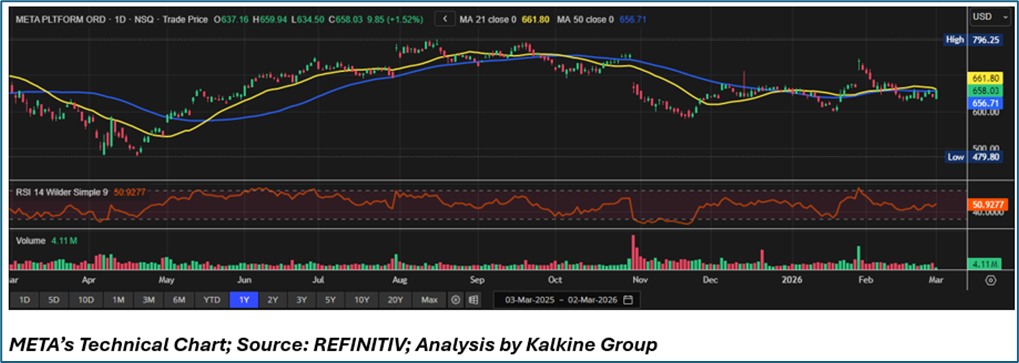
Moving Averages and Trend Structure Analysis – Meta Platforms (META)
Meta Platforms is presently exhibiting a consolidation phase within a broader medium-term uptrend. The 21-day moving average (approximately 661.80) has converged toward the 50-day moving average (approximately 656.71), with price recently trading near 658.03. This compression between short- and intermediate-term moving averages indicates a loss of directional momentum and reflects equilibrium between buyers and sellers. Notably, price is oscillating marginally below the 21-day average while remaining proximate to the 50-day average, suggesting that near-term bullish momentum has moderated without conclusively reversing the prevailing trend structure. The flattening slope of both averages further reinforces the interpretation of range-bound behavior rather than a decisive breakout or breakdown phase.
Relative Strength Index (RSI) and Momentum Diagnostics
The 14-period RSI is positioned near 50.9, effectively at the midpoint of the momentum spectrum. This neutral reading indicates the absence of overbought or oversold conditions and aligns with the observed price consolidation. The RSI’s recent stabilization around the 50 threshold implies balanced momentum, with neither accumulation nor distribution exerting dominant pressure. Importantly, there is no visible bearish divergence against recent price structure, nor evidence of accelerating bullish momentum. The oscillator’s behavior suggests that directional conviction remains limited, and a decisive move beyond the 60–65 band or below the 40 level would be required to confirm renewed trend strength in either direction.
Volume Dynamics and Support–Resistance Configuration
Recent trading volumes appear moderate relative to prior spikes observed during periods of higher volatility, particularly in late 2025. The absence of elevated participation during recent price movements indicates that current consolidation lacks strong institutional conviction. Technically, the chart identifies a 52-week high near 796.25 and a low near 479.80, framing the broader trading envelope. In the intermediate term, the 650–660 zone now functions as a pivotal equilibrium region given its alignment with both key moving averages. Sustained closes above the 21- and 50-day averages would reassert short-term bullish structure, while a decisive breach below the 50-day average could expose lower support levels established during the prior consolidation in the low-630s region. Overall, META’s technical configuration reflects a compression phase within a longer-term upward trajectory, with directional resolution likely contingent upon volume expansion and renewed momentum confirmation.
Final Perspective
Meta Platforms enters 2026 with strong advertising momentum, expanding AI integration, and sustained user engagement across its global ecosystem. The company is simultaneously accelerating infrastructure investment while maintaining expectations for higher absolute operating income, reflecting financial resilience despite elevated capital intensity. Technically, the stock is consolidating within a broader uptrend, with neutral momentum signaling a pause rather than structural weakness. The medium-term trajectory will likely be shaped by execution in AI monetization, regulatory developments, and the balance between reinvestment and profitability.


 Jun 04, 2026




 Please wait processing your request...