
 AU
AU
 UK
UK
 CA
CA
 NZ
NZ
 IND
IND

 US
US

 Share
Share
 X (Formerly Twitter)
 Whatsapp
 Facebook
 LinkedIn
 Telegram
 Email This Article
 Copy Link
 Summarize with AI
 Chat GPT
 Perplexity
Micron Technology, Inc. has entered fiscal 2026 with record financial performance, reflecting a sharp upturn in the memory cycle driven by artificial intelligence (AI) infrastructure demand. Quarterly revenue reached $13.6 billion, increasing 21% sequentially and 57% year over year, marking the third consecutive quarter of record sales.
Gross margin expanded to 56.8%, up 11 percentage points from the prior quarter, supported by higher pricing, disciplined cost execution, and favorable product mix. Operating income totaled $6.4 billion, representing a 47% operating margin. Non-GAAP diluted earnings per share were $4.78, up 58% sequentially and 167% from the prior year period.
Free cash flow reached a record $3.9 billion. The balance sheet strengthened during the quarter, with $2.7 billion of debt retired and liquidity of $15.5 billion. These metrics suggest a company operating at peak cyclical conditions, supported by tight industry supply and structurally stronger demand dynamics.
DRAM and NAND Market Trends: Pricing Power and Bit Shipment Growth
Micron’s growth remains anchored in its DRAM and NAND franchises. DRAM revenue reached a record $10.8 billion, rising 69% year over year. Sequentially, DRAM bit shipments were modestly higher, while pricing increased 20%, underscoring supply constraints across the industry.
NAND revenue rose to $2.7 billion, up 22% both sequentially and year over year. Bit shipments increased in the mid-to-high single-digit percentage range, with prices up in the mid-teens. Management expects calendar 2026 industry bit shipment growth of approximately 20% for both DRAM and NAND, constrained primarily by limited supply rather than demand weakness.
Inventory levels declined slightly to $8.2 billion, with total inventory days at 126 and DRAM inventory below 120 days. These levels indicate continued tightness, particularly in high-value segments such as data center and AI memory.
High Bandwidth Memory (HBM) Growth and AI-Driven Demand Outlook
High Bandwidth Memory (HBM) has become central to Micron’s investment narrative. All calendar 2026 HBM price and volume agreements have been finalized, and management projects the HBM total addressable market (TAM) to reach $100 billion by 2028, up from $35 billion in 2025. This implies an estimated 40% compound annual growth rate, with the $100 billion milestone now expected two years earlier than prior forecasts.
HBM4 is scheduled to ramp in the second half of calendar 2026. Management has emphasized strong profitability for HBM products and noted that HBM supply will remain tight alongside broader DRAM constraints. The company acknowledged that it can currently meet only 50% to two-thirds of demand from certain key customers in the medium term.
Server unit demand is forecast to grow in the high-teens percentage range in 2025, above prior expectations. AI data center build-outs continue to increase memory content per server, reinforcing structural demand drivers beyond traditional cyclical recovery.
Business Unit Performance: Data Center, Mobile, Automotive and Embedded
Micron’s revenue diversification highlights the breadth of current demand.
The Cloud Memory Business Unit generated $5.3 billion, representing 39% of total revenue, with a 66% gross margin. The Core Data Center Business Unit delivered $2.4 billion, up 51% sequentially, with a 51% gross margin.
Mobile and Client revenue reached $4.3 billion, accounting for 31% of total sales. Smartphone unit growth is expected to be low single digits in 2025; however, flagship handset DRAM content continues to rise, with 12GB configurations representing 59% of mix in the most recent quarter. Automotive and Embedded revenue rose to $1.7 billion, supported by advanced driver-assistance systems and embedded applications.
These segments collectively illustrate that while AI is the dominant driver, broader end-market conditions are also stabilizing.
Capital Expenditures, Technology Ramps, and Supply Constraints
Micron raised fiscal 2026 capital expenditure guidance to $20 billion from $18 billion, primarily to expand HBM and 1-gamma DRAM supply. The 1-gamma node is expected to become the majority of DRAM bit output by the second half of calendar 2026, while G9 NAND will drive NAND bit growth.
Importantly, greenfield fab output will not meaningfully contribute until 2027 and beyond. The first Idaho facility is now expected to produce wafers by mid-2027, with a second Idaho fab targeted for 2028. A New York fab groundbreaking is planned for early 2026, with production expected in 2030 or later.
Management has repeatedly emphasized structural supply constraints. Clean room expansion timelines are lengthening globally, and the shift toward HBM carries a three-to-one trade ratio with DDR5 capacity, further tightening supply. The company expects aggregate industry supply to remain substantially short of demand through at least 2026.
Profitability Outlook and Fiscal Q2 2026 Guidance
For fiscal Q2 2026, Micron guided revenue of approximately $18.7 billion (± $400 million), gross margin near 68% (± 1%), and EPS of approximately $8.42 (± $0.20). Operating expenses are expected to rise modestly to $1.38 billion, reflecting higher R&D investment in advanced DRAM and NAND nodes.
Management indicated that while gross margin expansion is expected to continue, incremental percentage gains may moderate relative to recent sequential jumps. Startup costs associated with new facilities will gradually enter the cost structure, though current pricing dynamics offset much of this pressure.
Risks: Supply Constraints and Consumer Market Sensitivity
Despite record performance, risks remain inherent to the memory industry. Management acknowledged that certain consumer markets may face unit demand sensitivity to pricing conditions in 2026. Additionally, the inability to meet full customer demand could limit near-term revenue upside, even in a strong pricing environment.
The capital intensity required to support HBM and advanced node transitions also introduces execution risk. Memory markets have historically exhibited volatility, though the current cycle is characterized by longer-term AI infrastructure commitments and multiyear customer contracts with stronger structural terms than prior agreements.
Strategic Positioning in the AI Memory Cycle
Micron’s 2025–2026 trajectory reflects a company benefiting from both cyclical recovery and structural transformation. AI workloads are increasing memory content per server, elevating HBM to a strategic product category rather than a niche segment. Multiyear DRAM and NAND agreements with firmer commitments signal a shift in industry contract structure.
With supply constrained and advanced node transitions driving incremental output, Micron appears positioned to capture elevated pricing and margin conditions into fiscal 2026. The longer-term question centers on how quickly incremental capacity comes online and whether demand growth, particularly in AI data centers, continues at its current pace.
In aggregate, Micron enters fiscal 2026 with record financial metrics, a strengthened balance sheet, and heightened exposure to AI-driven demand. The interplay between sustained supply discipline and structural memory content growth will likely define its performance through the next phase of the semiconductor cycle.
Technical Analysis (Daily Price Chart Analysis)
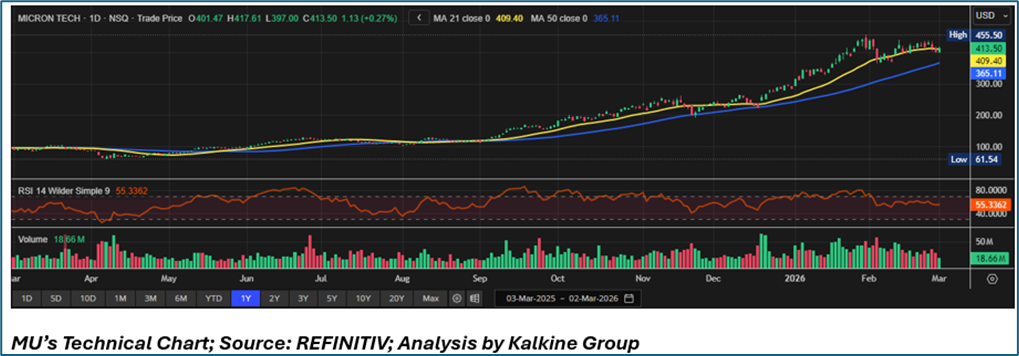
Primary Trend Structure and Moving Average Alignment – Micron Technology, Inc. (MU)
Micron Technology, Inc. continues to exhibit a well-defined primary uptrend on the daily timeframe. Price is currently trading near $413.50, maintaining a constructive position above both the 21-day moving average (~$409.40) and the 50-day moving average (~$365.11). The positive slope of both averages, coupled with sustained price separation from the 50-day average, confirms strong intermediate-term momentum. Notably, the 21-day average has consistently acted as dynamic support during prior pullbacks, reinforcing the presence of systematic dip-buying behavior. The broader trend structure remains intact unless price decisively breaches the 50-day moving average on expanding downside volume.
Momentum Configuration and RSI Dynamics
The 14-period RSI is positioned near 55.3, reflecting neutral-to-moderately constructive momentum conditions. Unlike prior peaks where RSI approached overbought territory, the current reading suggests consolidation within an ongoing bullish structure rather than exhaustion. This mid-range RSI positioning provides technical latitude for further upside without immediate overextension risk. Importantly, the absence of bearish divergence against recent price highs indicates that momentum remains broadly aligned with trend direction. A sustained move above the 60–65 RSI band would signal renewed acceleration, while a breakdown below 50 would suggest short-term momentum deterioration and potential corrective rotation.
Volume Profile and Support–Resistance Framework
Recent volume patterns appear orderly, with no evidence of climactic distribution near current highs. Participation has moderated relative to prior breakout phases, consistent with consolidation at elevated levels rather than aggressive profit-taking. Structurally, the $450–$455 zone defines immediate resistance, corresponding to recent swing highs. On the downside, the $405–$410 region near the 21-day average serves as first-layer support, while the $360–$370 band around the 50-day moving average represents a more significant technical floor. Overall, MU’s technical configuration reflects a mature but intact bullish trend, with price consolidating constructively beneath resistance while maintaining key moving average support and balanced momentum conditions.
Final Perspective
Micron Technology, Inc. enters fiscal 2026 at a cyclical and structural inflection point, supported by record revenue, expanding margins, and tightening industry supply conditions driven by AI-related memory demand. With HBM fully allocated for 2026 and advanced node transitions underpinning bit growth, profitability remains closely tied to sustained pricing discipline and capacity execution. The central variable for the coming period will be the durability of AI-driven demand relative to the pace of incremental supply additions across the global memory ecosystem.


 Jun 13, 2026




 Please wait processing your request...