
 AU
AU
 UK
UK
 CA
CA
 NZ
NZ
 IND
IND

 US
US

 Share
Share
 X (Formerly Twitter)
 Whatsapp
 Facebook
 LinkedIn
 Telegram
 Email This Article
 Copy Link
 Summarize with AI
 Chat GPT
 Perplexity
Key Highlights
- Moderna shares jumped over 16 percent after settling a major patent dispute.
- The company agreed to pay up to $2.25 billion to Arbutus Biopharma and Genevant Sciences.
- The settlement removes a long standing legal risk tied to its COVID 19 vaccine technology.
- The European Medicines Agency issued a positive opinion on Moderna’s influenza and COVID combination vaccine.
- Investors are reassessing Moderna’s long term infectious disease pipeline and earnings potential.
Biotechnology Sector Analysis: Moderna Clears a Major Legal Overhang
Shares of Moderna experienced a sharp rally after the biotechnology company reached a settlement in a long running patent dispute related to the lipid nanoparticle technology used in its COVID 19 vaccine. The agreement resolves years of litigation that had created uncertainty around potential royalty obligations and intellectual property rights.
Under the terms of the settlement, Moderna will pay Arbutus Biopharma and Genevant Sciences up to $2.25 billion. In exchange, the agreement eliminates future royalty claims tied to Moderna’s infectious disease portfolio that uses the contested delivery technology.
The market reacted quickly to the announcement. Shares of Moderna rose sharply during the trading session and closed at $57.86, marking a gain of more than 16 percent from the previous close.
For investors, the settlement represents more than a legal development. It removes a key overhang that had complicated long term valuation assumptions for the company’s mRNA platform and its expanding vaccine pipeline.
Global Vaccine Market Trends and the Evolution of mRNA Technology
The biotechnology sector has undergone a significant transformation since the global pandemic accelerated the development of mRNA based therapeutics. Companies that successfully commercialized mRNA vaccines during the pandemic are now transitioning from a single product model toward broader platform driven portfolios.
Moderna sits at the center of this shift. Its COVID 19 vaccine generated tens of billions of dollars in revenue during the pandemic years. However, as demand normalized, the company faced investor skepticism regarding the durability of its future revenue streams.
The next phase of growth for Moderna depends on the expansion of its infectious disease pipeline. The company is developing multiple vaccines targeting respiratory illnesses, oncology applications, and rare diseases using the same mRNA technology platform.
Within the vaccine market, respiratory disease prevention remains a large and competitive opportunity. Influenza vaccines alone represent a global market worth several billion dollars annually. The integration of COVID protection into combination vaccines could further reshape this market by offering improved convenience and broader immunity coverage.
This is why the recent positive opinion from the European Medicines Agency for Moderna’s combination influenza and COVID vaccine is strategically important. The vaccine targets individuals aged 50 and older, a demographic that represents a large share of respiratory disease risk.
If approved, combination vaccines could strengthen Moderna’s position in seasonal vaccination markets while reinforcing the commercial relevance of its mRNA technology.
Stock Market Outlook: Strategic Implications of the Patent Settlement
The resolution of the patent dispute has several implications for Moderna’s strategic positioning and investor confidence.
First, the settlement provides legal clarity around the lipid nanoparticle delivery system that underpins many of Moderna’s vaccines. Intellectual property disputes in biotechnology often introduce long term royalty obligations that can materially impact margins and cash flow projections.
By eliminating the possibility of ongoing royalties tied to the disputed technology, Moderna effectively removes a recurring cost that analysts had previously incorporated into valuation models.
Second, the agreement simplifies the company’s future product development strategy. Without the risk of extended litigation or licensing uncertainty, Moderna can pursue additional vaccine candidates using the same delivery technology across its broader infectious disease portfolio.
Third, the settlement signals financial strength. Although the company agreed to a payment of up to $2.25 billion, Moderna retains significant cash reserves built during the pandemic years. Investors often interpret such settlements as a strategic move to remove uncertainty rather than a sign of operational weakness.
Taken together, these factors help explain the strong market reaction following the announcement.
Earnings Outlook and Capital Allocation Strategy
While Moderna’s pandemic era revenue levels are unlikely to return in the near term, the company remains focused on expanding its pipeline across several therapeutic areas.
The firm has invested heavily in research and development to accelerate the launch of next generation vaccines and treatments. Key areas of focus include respiratory vaccines, cancer vaccines based on personalized mRNA approaches, and treatments for rare genetic conditions.
From a financial perspective, Moderna still benefits from a strong balance sheet built during the peak vaccine years. This capital base allows the company to continue investing aggressively in clinical development while navigating the revenue normalization phase following the pandemic.
For investors, the central question is whether Moderna can successfully convert its research pipeline into commercially viable products over the next decade.
The removal of legal uncertainty strengthens that narrative. It allows analysts to focus more directly on pipeline progress, regulatory approvals, and long term revenue diversification.
Technical Analysis: Price Action Analysis and Momentum Indicators
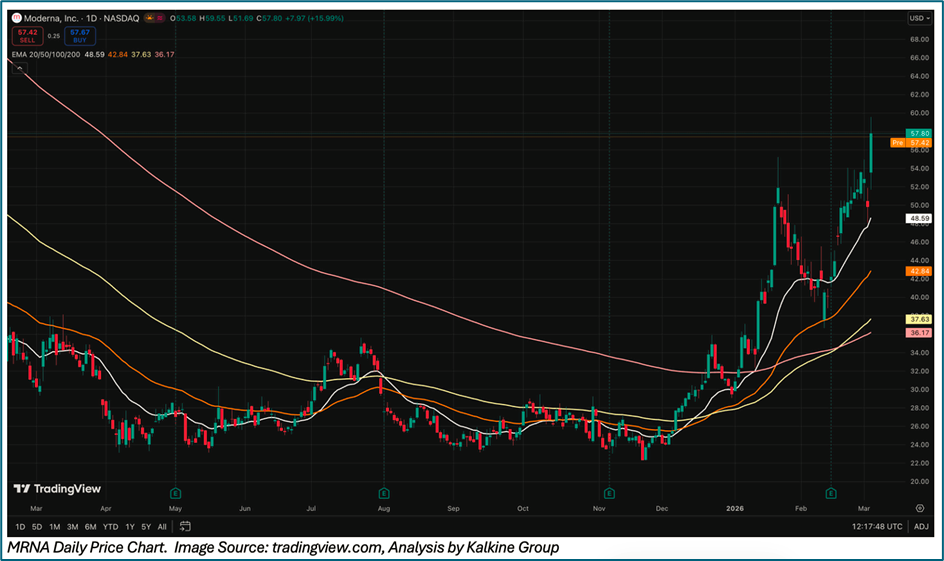
Daily Price Chart Analysis
The daily price chart for Moderna Inc. (MRNA) shows a notable shift in market structure over recent months.
After an extended period of decline through much of the previous year, the stock began forming a base in the $22 to $28 range during the second half of the year. This prolonged consolidation phase established a structural support zone where selling pressure gradually weakened.
The price action began to improve toward the end of the year as the stock formed a sequence of higher lows. This shift suggested that buyers were gradually regaining control.
The most recent rally represents a decisive continuation of that trend. The sharp upward move following the patent settlement announcement pushed the stock toward the upper boundary of its recent price range.
The latest daily candle also reflects strong bullish momentum, with the stock closing near session highs.
If the price sustains above the $55 region, the next resistance zone may emerge around $65 where previous rallies encountered selling pressure.
On the downside, the $45 to $48 region now appears to be an important support area.
Moving Average Structure
The chart shows a constructive alignment among key moving averages.
The stock has moved decisively above its 21 day exponential moving average, which currently sits near the $48 region. This short term indicator is often used by traders to gauge near term momentum.
The price is also trading above the 50 day exponential moving average near $42.8, suggesting that the medium term trend is strengthening.
Below these levels sits the 100 day moving average near $37.6, which previously acted as resistance but now serves as deeper structural support.
The 200 day moving average remains higher near $36, reflecting the longer term downtrend that dominated earlier periods. However, the recent rally has significantly narrowed the gap between current price levels and this long term indicator.
A sustained period of trading above these moving averages would signal improving technical strength.
Momentum Indicators
Momentum indicators are beginning to confirm the positive shift in price action.
The Relative Strength Index has moved higher following the latest rally, indicating increased buying pressure. Momentum readings approaching the upper range typically reflect strong bullish participation in the market.
At the same time, the Moving Average Convergence Divergence indicator appears to be turning upward after a period of neutral momentum.
If the MACD line crosses above its signal line while maintaining positive histogram expansion, it would support the case for continued upside momentum.
Volume Analysis
Trading volume expanded significantly during the latest rally.
Higher volume during price advances often suggests that institutional investors are participating in the move rather than it being driven solely by short term traders.
Sustained trading activity above the recent average would reinforce the credibility of the breakout attempt currently underway.
Investment Strategy and Long Term Growth Catalysts
Looking ahead, Moderna’s long term investment thesis now rests on three primary drivers.
The first is the expansion of its respiratory vaccine portfolio. Combination vaccines that protect against multiple respiratory illnesses could transform seasonal vaccination programs and generate stable recurring revenue.
The second is oncology innovation. Moderna is exploring personalized cancer vaccines that use mRNA technology to stimulate the immune system to target specific tumor mutations. If successful, this area could represent a major growth opportunity.
The third is global regulatory progress. Positive feedback from regulators such as the European Medicines Agency increases the likelihood that additional vaccine candidates could reach commercialization.
However, risks remain. Clinical trial outcomes, regulatory decisions, and competitive developments within the biotechnology sector will continue to influence the company’s long term valuation.
Conclusion
Moderna’s strong stock rally reflects a significant shift in investor perception. By resolving a complex patent dispute tied to its COVID 19 vaccine technology, the company has removed a major legal overhang that had clouded its long term outlook.
At the same time, regulatory momentum for its combination influenza and COVID vaccine reinforces the strategic value of its mRNA platform. Together, these developments suggest that the market is beginning to reassess Moderna’s future beyond pandemic era revenues.
For investors, the key question now is whether the company can translate its technology platform into a diversified pipeline of commercially successful vaccines and therapeutics. The answer will shape the next chapter of the biotechnology sector’s mRNA revolution.
FAQ
Why did Moderna stock rise sharply?
Moderna shares surged after the company settled a long running patent dispute related to its COVID 19 vaccine technology. The settlement removed uncertainty regarding potential royalties and legal liabilities, improving the company’s long term financial outlook.
What was the patent dispute about?
The dispute involved lipid nanoparticle technology used to deliver mRNA vaccines into human cells. Arbutus Biopharma and Genevant Sciences claimed intellectual property rights connected to the technology used in Moderna’s COVID vaccine.
What does the settlement mean for Moderna’s future vaccines?
The agreement confirms that Moderna will not owe future royalties tied to its infectious disease portfolio. This provides clarity for the development of additional vaccines using the same delivery technology.
What is the significance of the EMA opinion on Moderna’s new vaccine?
The European Medicines Agency issued a positive opinion on Moderna’s combination influenza and COVID vaccine for individuals aged 50 and older. This supports the company’s strategy to develop multi disease respiratory vaccines.
What should investors watch next?
Investors will closely monitor regulatory approvals, clinical trial results, and progress across Moderna’s vaccine pipeline. Future developments in oncology vaccines and respiratory disease prevention could play a major role in shaping the company’s long term growth trajectory.


 Jun 13, 2026




 Please wait processing your request...